
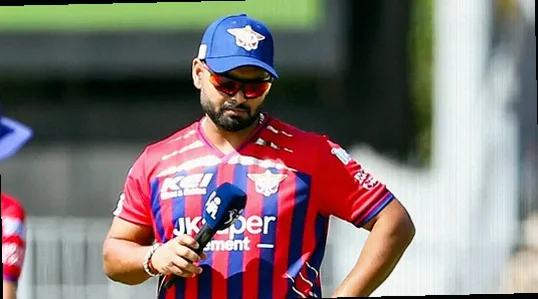
Rishabh Pant’s arrival at Lucknow Super Giants was pitched as more than a headline acquisition. The reported ₹27 crore investment carried layers of planning: captaincy expectations, the scarcity of quality Indian wicketkeeper-batters, added security with the gloves, the marketing pull of a high-profile name, and the belief that the franchise could shape its next competitive cycle around him. With the second year of that cycle now over, the arithmetic is not kind to LSG. Pant’s 2026 output did not come close to paying back the annual commitment, forcing the franchise to weigh a straightforward question heading into 2027: can LSG still justify a ₹27 crore yearly burden after a season in which Pant recovered only about half of that cost?
Key takeaways
- Rishabh Pant’s total 2026 season value is estimated at ₹14.28 crore against an annual cost of ₹27 crore.
- His estimated net loss for the season is ₹12.72 crore, with a cost recovery rate of 52.90%.
- Over the full campaign, Pant made meaningful financial impact in only two matches—worth ₹8.81 crore combined out of his ₹14.28 crore total.
- His player-performance segment accounted for ₹20.73 crore of cost but returned only ₹9.33 crore, leaving the larger loss.
- Captaincy value reduced the damage, with a smaller loss of ₹1.31 crore from that segment.
- At the end of 2026, the contract’s defensibility depends on whether LSG believe the next season can justify paying ₹27 crore again.
The financial debate turns on two standout nights
Pant’s season story is less about steady day-to-day value and more about sharp peaks. His biggest profitable return arrived in Match 10 versus Sunrisers Hyderabad, where his estimated value was ₹5.49 crore against a match cost of ₹1.93 crore—creating a profit of ₹3.56 crore for LSG in that game alone.
The other major spike came in Match 50 against Royal Challengers Bengaluru. In that contest, Pant’s estimated output was ₹3.32 crore, ending with a profit of ₹1.39 crore.
Those two matches were not small bright spots; they formed the backbone of his financial ledger. Together, they contributed ₹8.81 crore out of Pant’s total estimated season worth of ₹14.28 crore—meaning nearly 62% of his value came from just those two evenings.
That concentration left the remainder of the campaign exposed. Across the other 12 matches, Pant generated only ₹5.47 crore worth against a combined cost load of roughly ₹23.14 crore. This is the point where the ₹27 crore commitment begins to look especially heavy: for a mid-priced player, two profit-generating games can keep a season respectable, but for a player at Pant’s salary, the expectation is that more of his performances must repeatedly land in the same value band.
Importantly, the issue was not that Pant never influenced games. The problem, as the ledger reflects it, is that LSG paid for repeated high-value influence but received it in fragmented bursts—while the quieter appearances limited damage, they also did not compensate for the under-return elsewhere. In short, the season shows two strong recoveries and a long stretch of matches where the return did not match the cost.
Breaking down the ₹27 crore: batting, keeping, and captaincy
LSG’s bill was not only for batting. Part of the purchase was also for leadership. When the season is separated that way, a clearer picture emerges—though it does not rescue the overall deal.
In the player-performance portion, ₹20.73 crore of cost is attributed to Pant’s batting/fielding contribution, with an estimated return of ₹9.33 crore. That leaves a player-performance loss of ₹11.41 crore.
On the captaincy side, ₹6.27 crore of cost is assigned to leadership impact, with an estimated output of ₹4.96 crore. That segment finishes with a smaller loss of ₹1.31 crore.
This split matters because the strongest argument for retaining a ₹27 crore structure naturally leans on captaincy. LSG can reasonably claim that Pant brought more than batting, that his leadership has dressing-room value not fully captured by simple models, and that a team built around him needs more than one season before final judgments. Those points can hold—up to a point.
But at ₹27 crore, captaincy cannot function as a blanket excuse for under-return from the core role. The player still has to justify the contract, because leadership can add value, not replace missing production from the batter-wicketkeeper contribution.
On batting usage, Pant faced 227 balls in the season. For a player in this price bracket, that volume is not enough unless scoring impact becomes frequent and decisive. While his batting influence still formed the largest part of his overall cricketing worth, the repeatability and the number of high-impact opportunities did not align with the salary band.
His wicketkeeping and fielding also did not create a separate defensive advantage strong enough to change the financial outcome. Pant recorded 10 catches and four drops, resulting in a catching efficiency of 71.43%. The gloves added to the total package, but not at a level that could overturn the ledger verdict.
Also Read: Shreyas Iyer turns Punjab Kings' playoff panic into hope with maiden IPL hundred and winning six vs LSG
The ₹27 crore question for 2027: burden, proof, and market reality
The difficulty for LSG is that IPL contracts are not one-season auction receipts that are judged only by a single year’s headlines. Franchises commit for a cycle. Pant’s ₹27 crore was paid with 2025, 2026, and 2027 in mind. One disappointing or underwhelming season does not automatically end the logic of a multi-year deal. However, it does shift the burden of proof.
After 2026, LSG can no longer argue they are paying ₹27 crore purely for expected dominance. They are now paying ₹27 crore while carrying evidence that the return landed about ₹12.72 crore short of the cost. That makes 2027 a pressure season for the investment, not only for Pant as a player.
Under a reset lens, Pant’s fair value after this season would look much lower. His strict ledger value stands at ₹14.28 crore. If premiums are added for him being an Indian wicketkeeper-batter, along with captaincy premium and the scarcity factor seen in auction markets, a rational price would drift into the ₹15–16 crore band. A desperate franchise might stretch that to ₹17–18 crore because players with Pant’s overall profile are rare, but ₹27 crore is a different category altogether. At that level, the premium is no longer controlled—it becomes a bet on a rebound.
LSG may still decide to keep faith because releasing or weakening belief after 2026 could create its own cricketing and squad-building complications. There is also a cricketing case for patience: Pant’s ceiling remains high, his role is still valuable, and his best games show he can produce expensive match-turning value. A franchise cannot build only by reacting to one ledger year.
Still, patience is not the same as justification. LSG can remain patient with Pant while also recognizing that ₹27 crore was not supported by his 2026 output.
What would make the price defensible next season
Pant does not need a miracle season in 2027 to change the narrative—he needs a more complete year. The first requirement is batting volume. A ₹27 crore batter-keeper cannot have too many matches where his innings never becomes a major financial event. LSG need him to face more balls in high-value situations and convert more appearances into match-shaping outcomes.
Second, the “loss nights” must shrink. Premium players will not profit in every match, but the damage in low-return games has to be smaller. Pant’s 2026 ledger became difficult to defend because the two positive spikes were surrounded by too many under-recovery matches.
Third, captaincy has to deliver a clearer surplus. Pant’s leadership helped soften the season, but it did not flip the ledger. If LSG are paying for the captaincy layer, it must show up with more obvious returns through match control, tactical decisions, patterns of usage, and pressure management.
Fourth, the responsibility also belongs to LSG’s planning. A ₹27 crore asset has to be placed in a role where his value can actually be recovered. If his batting position and match situation do not maximize ball volume, or if the team structure forces him into constant damage repair rather than innings-shaping, then the franchise is harming its own investment.
That is why 2027 cannot be framed only as Pant’s redemption campaign. It is also LSG’s correction year. The franchise must decide what Pant’s primary function is—batting centre, floating counter-puncher, captaincy anchor, or a blend of all three. In 2026, the ledger suggests the full package existed more on paper than in the returns.
Verdict: keep the idea, but do not rewrite the evidence
LSG should not abandon the idea of Rishabh Pant after a single season. That would be overly reactive. His profile remains uncommon, his ceiling is still valuable, and his captaincy added enough value to prove the signing was not empty.
However, LSG also cannot pretend the ₹27 crore price was defended by IPL 2026. It was not. Pant returned ₹14.28 crore worth against a full-season cost of ₹27 crore, leaving a ₹12.72 crore loss. He produced profit in only two of 14 matches. The player-performance portion dragged the ledger most heavily, while captaincy reduced damage but did not overturn it.
The clean conclusion is this: LSG can continue with Pant for IPL 2027 because the contract was always designed as a multi-season bet, but the ₹27 crore price is not justified by the first-season evidence. It is justified only if LSG believes 2026 was the weak opening chapter of a stronger cycle.
At ₹15–16 crore, Pant’s 2026 season would be disappointing but defensible. At ₹27 crore, it becomes a warning.
LSG are not paying that amount in 2027 because Pant “earned it” through 2026. They are paying it because they still believe the next version of Pant can make this season look like the cost of waiting.
Method note
This analysis uses a rating-adjusted monetary ledger created by the author that translates batting, fielding, and captaincy impact into estimated rupee value. With LSG’s season already completed, Pant’s full ₹27 crore season cost is charged against his 2026 return. The model is an analytical estimate of cricketing contribution, not an official franchise accounting record.
