
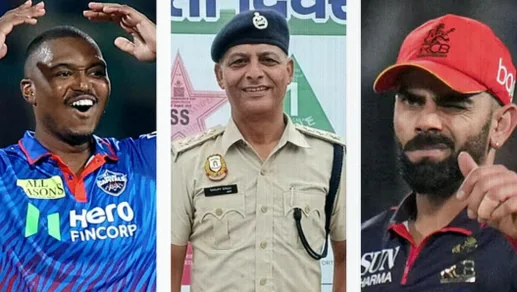
Lungi Ngidi is now stable and recovering, but the moment he went down with a serious neck injury during IPL 2026 sent a wave of fear through the stadium and far beyond it. The South African fast bowler suffered the problem after an awkward landing during the Delhi Capitals vs Punjab Kings clash at the Arun Jaitley Stadium last week. He collapsed immediately, with medical staff rushing in as his condition quickly became a major concern.
Ngidi, who is 30 years old, was left motionless and unresponsive at first, prompting an ambulance to enter the field and a neck brace to be fitted. From there, the focus was straightforward: get him to hospital as quickly as possible. However, the timing was difficult—at 6:15 PM, Delhi traffic was at its most congested.
Quick facts
- Lungi Ngidi suffered a neck injury after an awkward landing during IPL 2026 (DC vs PBKS) at Arun Jaitley Stadium.
- He was initially unresponsive, leading to an ambulance entering the field and a neck brace being applied.
- ACP Sanjay Singh coordinated a green corridor to speed up the ambulance journey to hospital.
- Although the usual Arun Jaitley Stadium to Rajendra Nagar drive takes 25–30 minutes, it was completed in 11 minutes.
- The plan was to take Ngidi to BLK Max Hospital in Rajendra Nagar.
ACP Sanjay Singh took the decision to activate the green corridor after being alerted to the incident. Singh was not inside the venue at the time of the injury; he was informed once someone watching the DC vs PBKS match on a mobile phone reported that an injured player required immediate medical attention. When he learned an ambulance had entered the ground, he moved quickly to ensure the route would be cleared for emergency access.
Singh said he is ACP Traffic of Centre District, and that the Arun Jaitley Stadium falls under his jurisdiction. While the broader match control sits with the DCP during IPL events, he is responsible for certain operational elements as well. He described how, after he was contacted, the ambulance was already near Gate No. 2, with Delhi Capitals staff present and Ngidi inside wearing an oxygen mask.
With urgency rising, Singh spoke to the driver and was told the ambulance would be heading to BLK Max Hospital in Rajendra Nagar. But to make sure the journey stayed fast despite peak-hour conditions, he first checked whether the driver knew the most efficient route. When the driver indicated he would rely on navigation via Google Maps, Singh stepped in to prevent any delay and immediately coordinated with the control room.
How the green corridor was created
Singh explained that the control room was informed of the full route from the stadium to the hospital, along with key junctions that required strict traffic police deployment. He said junctions like Mandi House needed to be handled with priority so the ambulance would not be slowed down at signals or congestion points. It was then decided that a green corridor would be established—meaning traffic signals would remain favourable along the ambulance’s travel path.
In practical terms, Singh described it as keeping signals green throughout the entire stretch the ambulance would cover. He also said the coordination worked smoothly, with traffic being cleared effectively while one Delhi Capitals official travelled in his car to monitor the situation. The distance—about 8 km—was negotiated in 11 minutes, turning a potentially slow commute into a rapid emergency transfer.
Ngidi’s injury was the kind of moment where speed matters most, and Singh noted he understood the necessity because of his own past involvement in cricket. He said he is a former cricketer who played alongside players such as Yuvraj Singh, Gautam Gambhir, and Virat Kohli, and he even referenced the cricket ecosystem around Delhi that kept many former and current stars connected through local tournaments.
Singh pointed to Delhi Police’s connection with cricket and explained that he last played in 2012. He also mentioned the DDCA League Cricket format, where matches are organised in groups, and recalled that teams like ONGC and Indian Airlines used to take part. He said Yuvraj Singh, Gautam Gambhir, Mohammad Kaif, and Virender Sehwag were regulars in that environment, and that Kohli was a youngster at the time, also participating.
That background, Singh added, helped him recognise the urgency immediately. He further said Delhi Police is trained and prepared to set up a green corridor at short notice, citing preparation and instruction that officers receive regularly. He referenced a recent Artificial Intelligence programme where officials from multiple countries had visited, saying senior leadership trained teams properly during that period as well.
Concluding the account, Singh said his department could create and implement a green corridor quickly because of that preparation. In his view, the ability to act fast and coordinate cleanly comes down to the work done by senior officials well before such emergencies occur.
