
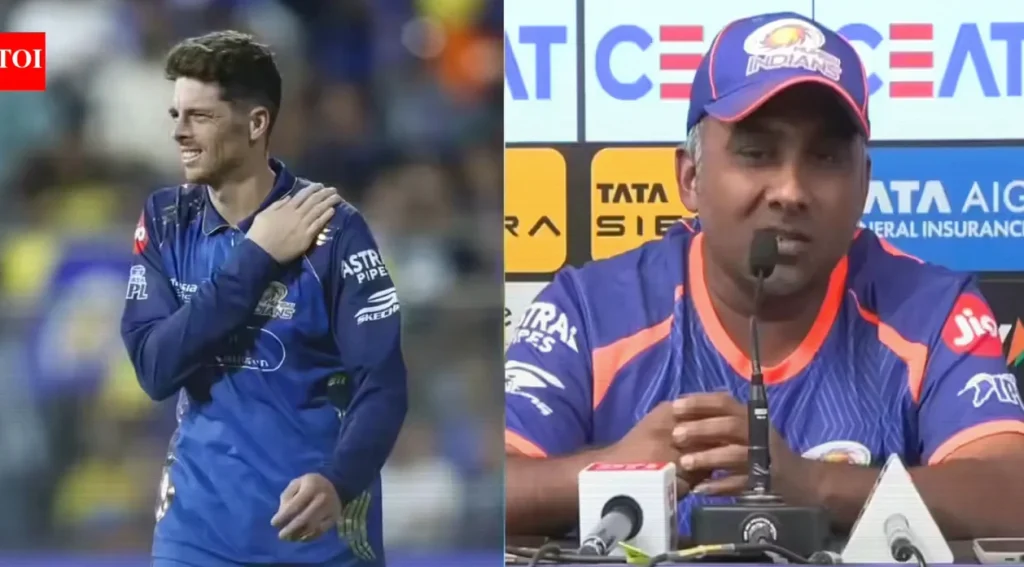
A lopsided contest at Mumbai’s Wankhede Stadium has turned into one of the biggest talking points of IPL 2026 after Mumbai Indians used a concussion substitute in an incident that sparked immediate debate. MI suffered a 103-run defeat to Chennai Super Kings, even as Sanju Samson delivered an unbeaten hundred and Akeal Hosein produced a four-wicket spell to steer CSK to a commanding win.
But while the result belonged to CSK, the late decision drew far more attention: Shardul Thakur was brought in as a concussion substitute for Mitchell Santner. The unusual nature of the call—particularly in light of later footage—has left plenty of questions hanging over how the protocol was applied in real time.
Quick facts
- Match: Mumbai Indians vs Chennai Super Kings at Wankhede Stadium (IPL 2026)
- CSK won by 103 runs
- Sanju Samson scored an unbeaten century for CSK
- Akeal Hosein took four wickets for CSK
- Controversy centred on MI’s concussion substitute: Shardul Thakur for Mitchell Santner
Santner’s injury and the moment the debate began
Santner appeared to pick up the problem in the 17th over while trying to complete a low catch, with his shoulder looking to be the key area of concern. He was then seen receiving attention after the incident, and he did not take the field again.
Replays later suggested that his head may also have come into contact with the ground. After the injury, Santner underwent scans, and MI then faced a situation where they had to decide whether a concussion replacement was appropriate under match conditions.
Jayawardene’s defence: “He felt that he wasn’t stable”
MI head coach Mahela Jayawardene addressed the controversy directly, explaining that the contact sequence and the subsequent assessment led them to request a concussion substitute. He said Santner had struck his head first, and that the impact then extended to the neck and shoulder as well.
Jayawardene added that after Santner returned from being checked, he was lying down, with ice applied to the shoulder. The coach stressed that stability was the deciding factor for MI, saying Santner did not feel fit to continue and the team therefore sought further evaluation through the concussion protocol.
“Santner hit his head first, the neck and obviously, the shoulder as well. He then went for a scan. Once he got back, he was lying down. Yes, the ice was there for the shoulder, but he felt that he wasn't stable, so we took him for a scan in that situation,” Jayawardene said.
He went on to outline the process that followed, stating that MI requested a concussion substitute and that the match referee and umpires had the final say. Jayawardene confirmed that Shardul Thakur was permitted as the replacement, and he closed by hoping Santner’s injury would not be severe.
“We requested a concussion sub. It's at the match referee and the umpires' discretion. They allowed Shardul Thakur. It is what it is. But hopefully, Santner's injury isn't too bad. Once he' s back, we'll have a look at it,” Jayawardene added.
Why the explanation didn’t end the argument
Even with Jayawardene’s reasoning, the controversy did not fade. A major point of contention among observers was whether a visible shoulder issue alone was sufficient justification for a concussion replacement, especially given how the incident looked from the stands and on early replays.
Further scrutiny grew because Santner was later seen wearing a shoulder sling. That visual detail, combined with the fact that many fans had focused on the shoulder at the time, intensified the discussion about whether the head impact evidence was clear enough to trigger the concussion pathway.
Rules versus reality: how concussion subs are supposed to work
Under IPL regulations, concussion substitutes must be pre-nominated by teams before the match. These cover specific roles such as batter, bowler, and all-rounder, ensuring that any replacement can be like-for-like in the context of the game plan.
Once the potential concussion situation arises, the final authority rests with the match referee, who oversees that the substitution aligns with the protocol. The framework is designed to reduce ambiguity, but in this case the optics of the decision—particularly with footage and the subsequent sling drawing attention—kept the argument alive.
MI’s bigger problem: the season is still slipping away
Beyond the concussion debate, Mumbai Indians also had to confront another disappointing outing. Jayawardene admitted the team’s performance has been uneven, stating that MI have managed only four points from seven matches and that the defeat was a major letdown.
He pinpointed their loss of rhythm during both powerplays—first in their bowling and then in their batting. Jayawardene said the whole unit must improve, acknowledging that the game plan and execution did not come together when it mattered most.
He also reflected on the decision to chase, noting that MI had discussed it beforehand and believed it would suit the match situation. Still, he said sometimes that approach works and sometimes it doesn’t, implying that the outcome did not reflect the confidence they had going in.
Despite everything, Jayawardene highlighted a bright spot in youngster Allah Ghazanfar. He described the young player as brave and said his maturity has been growing with time, adding that the team will continue to back him.
As CSK moved up the table with a dominant win, MI were left dealing with two fronts at once—defeat on the scoreboard and a decision that has sparked one of the season’s most discussed controversies.
