
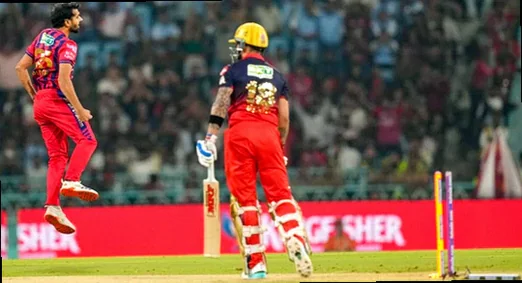
Former India top-order batter Sanjay Manjrekar is never short on opinions when it comes to interpreting cricket moments, and his latest take stood out during an IPL 2026 night in Lucknow. In the Lucknow Super Giants versus Royal Challengers Bengaluru clash at the Ekana Stadium, fast bowler Prince Yadav produced a sharp delivery that left Virat Kohli completely stranded, sending him back to the pavilion.
Prince Yadav’s strike that dismissed Virat Kohli
The key ball was a classic seam movement. The delivery landed on a straight length, then angled back into Kohli, beating his judgement and uprooting his off-stump. It was a clean, threatening outing of seam and swing/cut—one of those wickets where the batsman’s body language tells the story instantly.
For Kohli, though, the dismissal did not look like a typical “just got beaten” reaction. He appeared taken aback and repeatedly looked down toward the area where the ball had pitched, as if he believed something about the surface or bounce had played tricks.
Manjrekar’s theory: a champion’s reaction after getting out
Manjrekar believes Kohli’s body language reflects something deeper than just surprise. He argues that Kohli’s instinct to look at the pitch is tied to how elite batters process failure—especially in high-pressure moments.
In making his point, Manjrekar also brought up the example of Sachin Tendulkar, suggesting that the master blaster used to respond in a similar way late in his career.
- Manjrekar said Kohli’s clean bowled dismissal by Prince Yadav provides a “great insight” into the mindset of an accomplished batter.
- He noted that Kohli, right after being dismissed, looks down at the pitch as though something untoward occurred there.
- He compared this with Tendulkar’s habit, particularly toward the end of his playing days, when Tendulkar would also check the pitch and feel the ball had behaved differently than expected (such as keeping low).
- Manjrekar’s core argument was that the immediate reaction is not about dwelling on blame but about searching for explanations beyond personal shortcomings.
Confidence, self-belief, and handling setbacks
The Mumbai-born analyst expanded on why this reaction matters. He suggested that batters who have built success across years carry immense self-confidence, and that confidence does not collapse immediately even after a setback.
In contrast, he drew a line between “great batters” and “lesser mortals,” arguing that the latter group often sees their confidence shattered when something goes wrong—thinking they were too slow, not good enough, or unable to defend the ball.
- Manjrekar said great batters don’t quickly turn the dismissal into self-criticism; instead, they look for reasons other than themselves.
- He argued that this trait comes from years of tremendous success, which keeps their self-confidence high.
- He added that with less accomplished players, a similar moment often breaks confidence, leading them to doubt their ability to handle that delivery.
- He highlighted a key difference: top-tier players manage failures better than players who don’t sustain belief under pressure.
- He concluded that the instinct to process dismissals efficiently is a significant factor behind why great players reach the top and stay there.
Another possibility: surprise or embarrassment
While Manjrekar’s explanation was compelling, he also left room for alternative interpretations of Kohli’s reaction. The batsman’s glance at the pitch could be driven by surprise or even embarrassment—an attempt to signal that the delivery itself had something to it.
Whether it was the bounce, movement off the pitch, or simply a moment of shock, Manjrekar’s viewpoint remains a worthwhile lens through which to read how elite batters respond when they suddenly lose control of a ball.
