
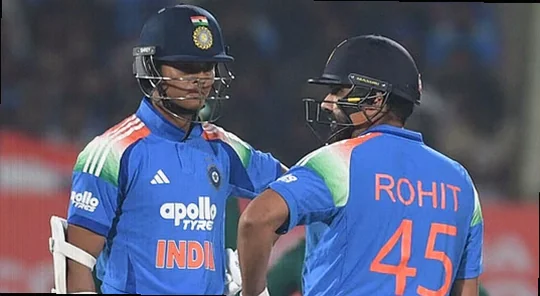
Former India batter Sanjay Manjrekar has questioned the logic used by the BCCI selection panel in choosing Rohit Sharma over Yashasvi Jaiswal for India’s upcoming three-match ODI series against Afghanistan, which begins on June 14. Speaking with sharp criticism of the Ajit Agarkar-led group, Manjrekar argued that the long-term requirements of Indian cricket point more clearly toward Jaiswal than toward Rohit.
Manjrekar also suggested that Rohit’s international career appears to be nearing its end, highlighting that the veteran’s current situation in terms of form and fitness is not reassuring. In that context, he said Jaiswal—along with the broader future plan for the national side—should have been given the nod.
At a glance
- India’s three-match ODI series vs Afghanistan starts on June 14.
- Manjrekar questioned the BCCI selectors’ choice of Rohit Sharma over Yashasvi Jaiswal.
- Manjrekar believes Jaiswal should be part of the current setup and also the 2027 World Cup plans.
- He also felt excluding Sai Sudharsan was harsh.
- Manjrekar cited Jaiswal’s Test performances and Rohit’s fitness concerns.
- He said the selectors should consider what benefits Indian ODI cricket over the next 50-over World Cup cycle.
Why Jaiswal—and not Rohit—makes more sense
Manjrekar’s argument was built around the idea that the selection panel should prioritize the players best positioned for India’s next World Cup cycle. With Rohit close to the 39-year mark, he said it is hard to justify a pick when the same spot could be used to back a younger batter who is delivering, particularly in Tests.
He went further, saying that if the selectors felt they had to compromise and still include Rohit for any reason, the least they could do would be to contact Jaiswal and apologize. Manjrekar described Jaiswal as a 24-year-old who is in his prime and has shown he can succeed at the toughest level of Test cricket.
Manjrekar made a similar point for Sai Sudharsan, arguing that players like Shubman Gill, Sudharsan and Jaiswal look well-suited to form India’s top-three batting options in ODIs. In his view, the current selection choices contradict that pathway.
ODI production ignored
Manjrekar highlighted that Sudharsan has made three fifties in four ODI innings for India, while Jaiswal’s most recent ODI knock was an unbeaten 116 against South Africa in Vizag last December. Yet, he said, those outputs did not translate into selection, which he found difficult to understand.
He questioned why the panel would instead back a veteran whose fitness remains a concern and whose recent performance is not convincing. “Now explain that to me. What is the logic behind it? What is the vision?” he asked during his comments on Sportstar’s Insight Edge podcast.
In Manjrekar’s framing, the selectors’ job is not to preserve reputations or rely on past achievements alone. It is to build the best possible ODI team for the future, rather than just justify short-term decisions with numbers.
Selectors should think beyond Kohli and Rohit
Manjrekar said Jaiswal has been waiting in the queue for a long time, pointing out that he has played only four ODI matches so far and has scored 171 runs in total, including the unbeaten 116. He also reminded viewers that Rohit has already featured in three 50-over World Cups, while India has not won the tournament since 2011.
He said it is unfortunate that India came close in each of those World Cup campaigns but did not lift the trophy, adding that Jaiswal cannot be blamed for outcomes from earlier cycles. When it comes to Virat Kohli, however, Manjrekar believes the situation is different—claiming Kohli still has form and fitness going for him, unlike Rohit.
That distinction led Manjrekar to argue that the panel should do what he called “the right thing.” He stressed that selection cannot be reduced to trying to defend decisions through statistics; it must answer whether Rohit can be a key player for India in the years ahead leading into the next 50-over World Cup, or whether the opportunity should be given now to Jaiswal or Sudharsan.
Finally, Manjrekar underlined that selectors must look past only the biggest names. Even if Virat Kohli is a player whose current readiness can be supported, the panel also has to consider the “50 or 100 other players” competing for chances to play for India—because the team’s future depends on how those opportunities are managed.
