
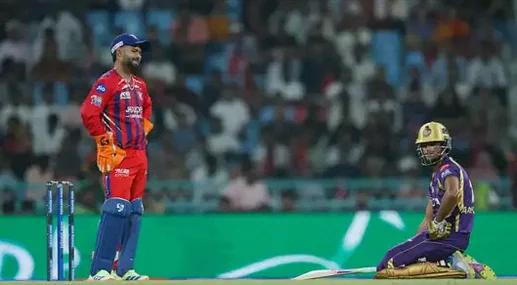
The call to dismiss Angkrish Raghuvanshi for “obstructing the field” in the IPL 2026 encounter between Kolkata Knight Riders and Lucknow Super Giants earlier this week has led to a deeper explanation from the Marylebone Cricket Club. The incident quickly became a talking point, not just because of how it ended, but because it raised questions about how Law 37 should be interpreted in real time during a running play.
Quick facts
- Raghuvanshi was given out for obstructing the field during the IPL 2026 match between KKR and Lucknow Super Giants.
- The decision was made under Law 37 after the third umpire reviewed the incident.
- Cameron Green sent Raghuvanshi back mid-run with an incoming throw.
- MCC stressed the ruling focuses on intent, not merely the end result.
- Raghuvanshi received a 20% fine of his match fee and a demerit point for breaching the IPL Code of Conduct.
In the moment, Raghuvanshi set off for a sharp single and began the run from one side of the wicket. Cameron Green, at the other end, sent him back halfway through, and as Raghuvanshi attempted to recover his crease, he altered his path across the pitch. When the throw came in, it struck him after the change of direction, prompting an appeal.
After a review, the third umpire concluded the dismissal was covered by Law 37, identifying obstruction. MCC’s clarification then laid out how the law is applied, highlighting that Law 37.1.1 treats a batter as out when they “wilfully attempt to obstruct or distract the fielding side by word or action.” The emphasis, the governing body reiterated, is on the batter’s intention behind the movement rather than the mere fact that a ball happened to hit them.
MCC also pointed to a well-established interpretation found in Tom Smith’s Cricket Umpiring and Scoring. That guidance explains that switching direction while running—particularly moving onto the playing area, even if the route taken is not the quickest one—can amount to a deliberate action. In other words, the law can be triggered by the manner of the running line, not only by whether a fielder’s attempt at a run-out or catch succeeds.
Applying that logic to Raghuvanshi’s case, MCC said he started the run from the off side but drifted toward the middle of the pitch as the throw was delivered. He then turned back on the leg side, bringing himself directly into the line between the ball and the stumps. That positioning was considered deliberate, which is why it fell within obstruction under the law.
The MCC clarification further suggested that the outcome might have been different if Raghuvanshi had stayed on the off side or returned along the same route on the leg side. The governing body noted that the key factor was the wilful crossing of the pitch, which brought him into the direct path of the incoming throw. “It is the wilful crossing of the pitch that caused his downfall,” the statement added.
Why “would he have been run out anyway?” didn’t matter
MCC also addressed another frequent argument that surfaces in obstruction debates—whether the batter would likely have been dismissed even if the ball had struck the stumps. The clarification was firm that the likelihood of a run-out is not part of the decision-making process under this law. Unless the obstruction is designed to prevent a catch, the probability of dismissal does not influence whether Law 37 is triggered.
Raghuvanshi’s dismissal had already ignited discussion about how the rule is enforced during fast-paced T20 running between wickets. After the match, he was fined 20% of his match fee and given a demerit point for his reaction, which was found to be in breach of the IPL’s Code of Conduct for players and team officials.
Footage from the game showed Raghuvanshi reacting in the aftermath by striking the boundary cushions with his bat and then throwing his helmet. The incident, now accompanied by MCC’s detailed explanation, is expected to keep Law 37 under the spotlight in upcoming IPL matches.
