
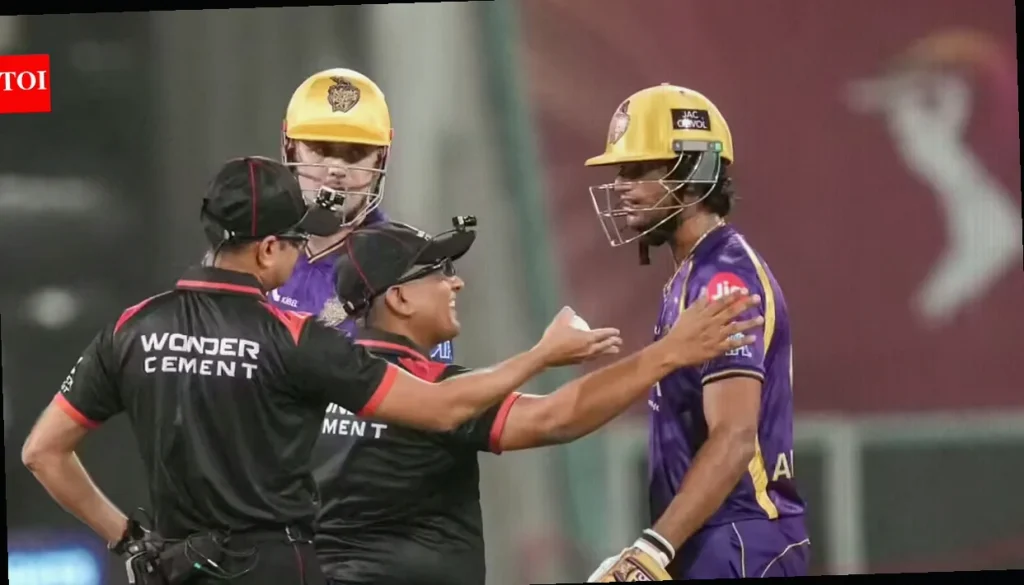
MUMBAI: The Marylebone Cricket Club (MCC) has backed the umpiring call that ruled Kolkata Knight Riders batter Angkrish Raghuvanshi out for obstructing the field during an IPL 2026 game, insisting the decision fits the sport’s Laws. In a “Law clarification” issued on Thursday, the London-based body—custodian of cricket’s playing regulations and headquartered at Lord’s—said Raghuvanshi’s dismissal satisfied the threshold for a wilful act when a batter alters his running path in a manner that interferes with the fielding side.
Incident in focus: KKR vs Lucknow at Ekana
The flashpoint came in KKR’s clash with Lucknow Super Giants at the Ekana Stadium in Lucknow last Sunday. Raghuvanshi started for what looked like a quick single and was then sent back by his batting partner. As he attempted to retreat, he turned and dived to get back in, only to be struck by the ball as the throw came in.
LSG’s defenders appealed, and the matter was referred for review. The third umpire, Rohan Pandit, upheld the dismissal, concluding that Raghuvanshi had altered the direction of his movement after noticing the throw heading toward him. Pandit specifically noted that Raghuvanshi “changed his direction of movement” once he saw the ball being thrown.
MCC “Law clarification” on obstructing the field
To address the controversy, the MCC pointed to the wording of Law 37.1.1, explaining that a batter can be out for obstructing the field if they “wilfully attempt to obstruct or distract the fielding side by word or action.” The MCC underlined that the act must be deliberate, which can sometimes be difficult to judge in real time.
- The MCC cited Law 37.1.1: either batter is out Obstructing the Field if they “wilfully attempt to obstruct or distract the fielding side by word or action.”
- The club said the obstruction has to be intentional, and that determination is often not straightforward.
- It referenced a long-standing interpretation—published in Tom Smith’s Cricket Umpiring and Scoring, MCC’s official interpretation of the Laws of Cricket and accepted for years—covering scenarios where a batter changes course as the throw arrives.
- That interpretation states: “a batter who changes direction while running, particularly one who changes direction to run on the pitch, or takes any other route that would not be the quickest way to the other end, is making a wilful act.”
Why MCC said Raghuvanshi’s action was wilful
The MCC also argued that Raghuvanshi’s run met the criteria for “wilful” obstruction. It said he shifted from the off-side to the leg-side while moving between the wickets, crossing onto the pitch in a way that placed him between the ball and the wicket.
In its explanation, the MCC described the sequence in detail:
- Raghuvanshi began the run from the off-side of the wicket.
- As the ball reached the fielder, he moved toward the center of the pitch—described by the MCC as a place he “should not be running in any event.”
- He then turned and ran back on the leg side, positioning himself between the ball and the wicket.
- The MCC said this is “by definition” a wilful act.
The MCC added that different movement choices would have altered the outcome. It stated that if Raghuvanshi had remained off the pitch on the off-side, the ball would not have hit him and there would not have been an obstruction question. It further said that if he had started down the leg side, turned, and returned to his ground on that same side before being struck, the dismissal would fall under “Not out”—because he would still be in the way, but not wilfully.
Likelihood of survival not part of the rule
Finally, the MCC clarified that an obstructing-the-field dismissal does not hinge on whether the batter would have survived without the interference. It addressed suggestions that Raghuvanshi should not have been out because he might have made his ground even if the ball had not struck him, stressing that such likelihood is not a deciding factor.
In conclusion, the MCC said: provided the obstruction is not aimed at preventing a catch, whether the dismissal was likely is not a criterion under “Obstructing the field.”
