
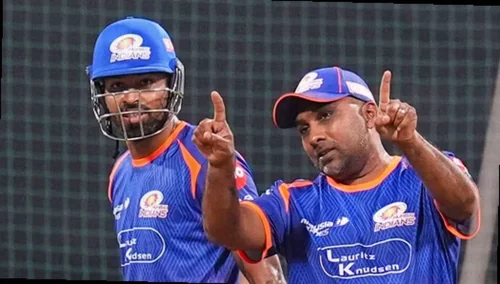
Nothing has been able to mask Mumbai Indians’ struggles in the IPL 2026 season so far. After seven matches, the franchise has managed only two wins and has suffered five defeats, leaving it down in the eighth spot on the points table. With the playoffs still in reach but far from secure, the Hardik Pandya-led group needs to win at least six of its remaining seven games to keep its campaign alive.
Quick facts
- Mumbai Indians have played seven IPL 2026 matches: five losses and two wins.
- The team is currently eighth in the points table.
- To realistically qualify, Mumbai Indians must win at least six of their remaining seven fixtures.
- On Thursday, Mumbai Indians lost to Chennai Super Kings by 103 runs at Wankhede Stadium.
- In the chase, Mumbai Indians were bowled out for 104 while targeting 208.
- Head coach Mahela Jayawardene said the main issue has been a lack of consistent performances.
- Jayawardene also pointed to problems in the powerplay and in the bowling execution.
- Mumbai Indians get a seven-day break and next play Sunrisers Hyderabad on Wednesday, April 29.
The setback against Chennai Super Kings on Thursday only deepened the concern. Mumbai Indians were defeated by 103 runs at the Wankhede Stadium, and the dressing room reaction was immediate and visibly heavy. After the match, head coach Mahela Jayawardene appeared at a loss for words to describe how badly his side had been outplayed.
Jayawardene’s assessment was blunt: the team has not been able to build steady, repeatable performances. He said that inconsistency has been at the heart of Mumbai Indians’ situation, pushing them into the lower half of the table. The CSK match illustrated that problem clearly, with Mumbai failing to mount any meaningful resistance during their chase.
Chasing 208, the Mumbai Indians folded for 104. No batter managed to apply sustained pressure, and the collapse meant the target never felt realistically reachable once the innings slipped. Jayawardene also placed the blame firmly on the early overs, arguing that the first six overs became the turning point for both departments—batting and bowling.
Even in the powerplay, Mumbai Indians conceded loose deliveries, and that early damage proved costly. Jayawardene highlighted that once a team loses such a match, it becomes difficult to dissect everything because the game’s momentum is already gone. Still, he maintained that the two powerplay phases—bowling and batting—were where Mumbai Indians lost control.
“The reality is that four points after seven games, honestly, we haven’t played good cricket. It’s been in patches. We’ve had a great game in Ahmedabad. I thought we found some rhythm, but we lost it again. Probably this game, once you lose a match like that, it’s difficult even to analyse it, but probably the two power plays where we lost both the power plays with the ball and with the bat, we just couldn’t get to the game,” Jayawardene said during the post-match press conference.
He added that the side will use the pause in fixtures to reassess quickly and prepare with purpose for the final stretch of the league. According to Jayawardene, the next seven matches represent a clear window where the team must identify what it needs to fix and respond with sharper execution.
“But as I said, we got a little break now, it gives us some time to really sit down and think about what we need to do in the next seven matches, and we know exactly what we need to do. And we’ll plan and put our best foot out,” he added.
Hole in the bowling, Jayawardene’s call
Jayawardene also pointed to a broader weakness in Mumbai Indians’ bowling across earlier games. He said the franchise has been aware of gaps in its attack and has made a deliberate change in personnel to address them. In that context, he referenced the decision to move on from options such as Deepak Chahar and Shardul Thakur.
Looking back at the season so far, Jayawardene said the team has suffered from a “hole” in its bowling and that the inclusion of fresh faces has helped, even if consistency remains the missing piece. He felt there were moments when the bowling looked effective, but he stressed that the problem is not only effort—it’s execution and the ability to sustain control over long spells.
He further explained that Mumbai Indians have conceded a high number of large overs, particularly 18-plus and beyond, which has made it hard to recover in matches. In his view, once opponents rack up 20-plus runs in those phases, the chase becomes far tougher even for teams that can perform in other parts of the innings.
“If you analyse the seven games, yes, there was a hole in our bowling and we got some fresh faces in there, Ahmedabad looked good, again here, I thought in patches we bowled well, it’s just execution-wise, consistency, I think one of the teams was given the highest number of big overs, 18-plus overs, if you look at the half-season, that number puts us in a very bad position for us to even to claw back into a game when you give that 20-plus runs, it’s tough,” Jayawardene said.
He also said the team has not managed to control the game well in away conditions, which has contributed to uneven results. Jayawardene acknowledged that there have been strong batting spells, but he insisted the batting has also come in fragments rather than as a consistent pattern. Importantly, he underlined that the responsibility is collective—improvements are needed across the group, not through one individual fix.
“So these are areas that we need to improve. We haven’t managed to control things in away conditions and stuff like that. That’s an overall thing. If you look at it in batting as well, we have been good, but we have had some patches where we haven’t been consistent. It’s not one individual. As a team, we all have to improve,” he added.
Mumbai Indians will now step away for seven days before returning to action. Their next match is against Sunrisers Hyderabad on Wednesday, April 29, with the franchise needing an immediate improvement in performance to keep its playoff hopes within reach.
