
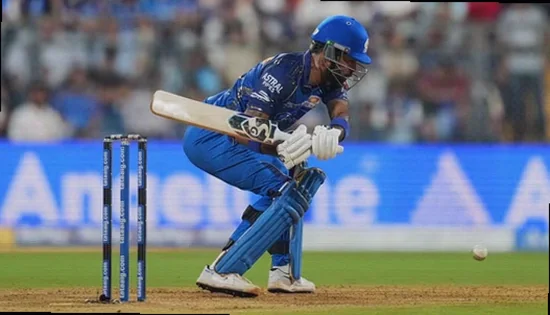
Mumbai Indians endured another tough outing in IPL 2026 on Wednesday, suffering their sixth loss in just eight matches. The defeat has intensified scrutiny around captain Hardik Pandya, who has recently found himself under unusually heavy fire. With questions mounting on his batting output, the pressure is now not only on his form, but also on his role as MI’s leader.
Hardik Pandya’s IPL 2026 numbers under spotlight
In the seven games Pandya has played so far, his returns have not matched the expectations that come with his reputation as an Indian all-rounder. The criticism has grown sharper because his output has been both modest and slow relative to modern T20 standards.
- Pandya has scored 128 runs in seven matches.
- His batting average stands at 21.33.
- His strike rate is 152.38.
- The figures have been seen as insufficient to reflect his talent.
- He did manage a recovery moment on Wednesday with a 15-ball 31 against SRH, which prevented the numbers from looking even worse.
Saba Karim points to a clear tactical issue
Former India wicketkeeper Saba Karim believes the challenge for Pandya is not simply confidence or timing, but the planning coming from opposing bowlers. Karim suggested that teams have identified a specific pattern of deliveries and are forcing Pandya into a limited range of scoring options.
Karim argued that the opposition has mapped out a method to disrupt him, noting that few balls are being offered in the “slot” he prefers. He further explained that outside the off-stump, Pandya has struggled to play freely—especially compared to what he can do when deliveries are presented in the right area.
- Karim said opponents have worked out a plan targeting Pandya’s batting setup.
- He noted that very few deliveries are bowled in the slot Pandya looks for.
- Karim added that Pandya’s stance and preparation appear designed for those slot-length balls.
- He claimed that balls short and outside the off-stump have been difficult for Pandya to handle with freedom.
“Reinventing” the game in overs 17–20
Karim also compared Pandya’s recent strike-rate profile with other batters who have improved their approach in the death overs. His view was that many players have adapted to contemporary T20 demands by widening their shot range—both to handle short balls and to attack higher-risk areas more effectively.
Karim stressed that if Pandya is to score consistently, he needs to further evolve his batting, particularly in the late-innings phases where modern T20 batting requires versatility.
- Karim suggested Pandya should reinvent his approach as a batter.
- He referenced a comparison of players with the lowest strike rates in overs 17–20 since 2024 (with a minimum of 100 deliveries).
- Karim said those batters have already reworked their games and become more multidimensional.
- He added that while Pandya’s strike rate at 173 is still better than theirs, the broader issue is the need to play modern T20 with a wider range.
- Karim’s point was that the others can handle both short deliveries and the “upper shot,” reflecting the kind of skill expansion required today.
Captaincy pressure and MI’s situation
While Karim focused heavily on technique and tactics, he also acknowledged the external pressure that comes with leading a struggling side. For Pandya, the captain’s role adds an additional layer—especially when results are not going MI’s way.
- Karim said the pressure of captaining MI weighs on Pandya.
- He cited the added burden of the team not performing well.
- He described these factors as “weighing heavily” on Pandya.
Karim then balanced the critique by reiterating Pandya’s quality. He emphasised that Hardik is an exceptional talent who has previously delivered for India and for MI, including in difficult situations. Still, Karim maintained that opposing bowlers have managed to get the better of him by choosing the right length consistently for the current stage.
- Karim praised Pandya’s record for India and MI in challenging circumstances.
- He said opposition bowlers have got his number—particularly in terms of the length they are bowling to him.
What Mumbai Indians must do next
With Mumbai Indians facing an uphill task after another defeat, the next steps are straightforward in one sense but complicated in practice. MI need to win their remaining games, while also banking on other results to fall in their favour.
Looking ahead, they will face Chennai Super Kings next on May 2 at the Chidambaram Stadium.
