
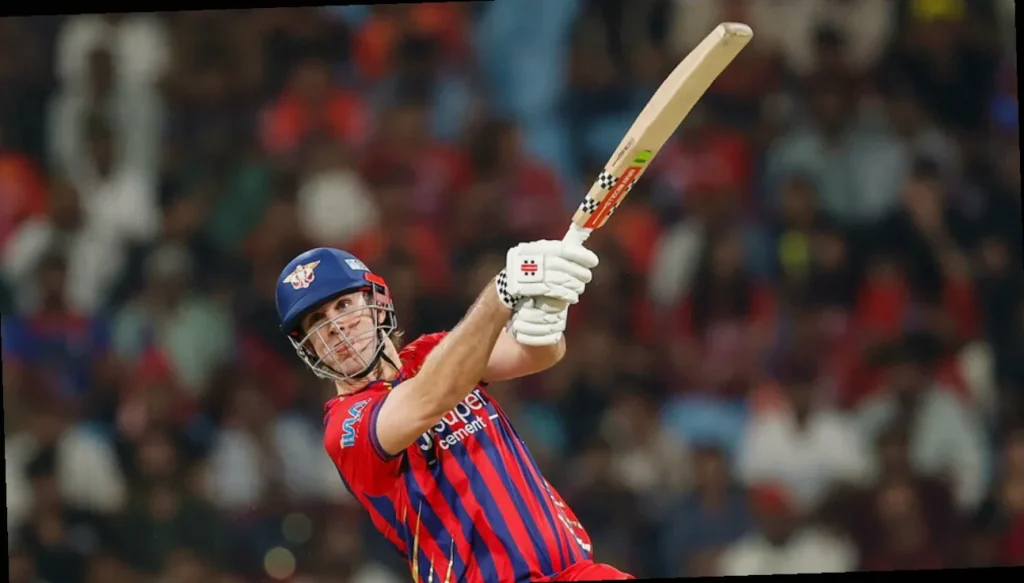
Mitchell Marsh’s opening burst for Lucknow Super Giants (LSG) was built on precision rather than ordinary power-hitting. His first three sixes on the way to the quickest century for LSG weren’t the result of wild slogs or reckless charging; they came off well-placed deliveries from Royal Challengers Bengaluru (RCB) bowlers Josh Hazlewood and Bhuvneshwar Kumar—both of whom are known for their tight, repeatable lengths.
Key takeaways
- Marsh’s opening three maximums that helped him reach LSG’s fastest century came off Hazlewood and Bhuvneshwar Kumar.
- Each of those sixes was struck from deliveries pitched around the 7-metre mark, right in the middle of the good-length zone.
- The boundaries were extensions of the off-drive rather than pulls or swing-and-miss slogs.
- LSG had previously struggled at this venue context, failing to chase 156 in their prior game and often posting low totals at home.
- Marsh said team discussions suggested the wicket looked better than the last time they played there, prompting him to maximise the powerplay.
Why those sixes looked different
The first three sixes Marsh struck were not “risk shots” in the usual sense. They weren’t pulled away into the leg-side and they weren’t the product of an aggressive battering of a half-volley. There was also no sign that the bowlers had made it easy with a loose pitch, nor did Marsh need to rush the bowler to get his timing right. Instead, all three deliveries were pitched at a length close to 7 metres—squarely in the sweet spot of the good-length range—and the scoring strokes were off the off-drive line.
LSG’s context, the pitch, and Marsh’s mindset
This was heavy, high-class batting from LSG because they had been sent in first after a previous match where they were unable to chase 156. Lucknow’s home record in this IPL context has been inconsistent, with the team often producing subdued totals and not giving their overseas power-hitters enough confidence in how the surface would behave.
Marsh, whose strike rate heading into the innings stood at 139 in the tournament, still found a rhythm that depended on more than raw talent. Speaking to the broadcasters after the knock, he explained that some of the Indian players had flagged that the track appeared slightly improved compared to the last time LSG played on it. He added that his plan was to make the most of the powerplay window and convert that time into as many runs as possible.
Marsh may make it look straightforward, but the mechanics behind it are the kind that only come from a blend of natural gifts, repeated practice, and deliberate work on timing and balance.
The reach, the training, and the Hazlewood challenge
As one of the taller openers in the league, Marsh’s physical reach gives him access to scoring areas that are harder to reach for others. That ability to play at good lengths is a key reason he can be such a dangerous customer—and a valuable acquisition for LSG.
Years of net work, range hitting, and strength training have also gone into refining the clean, efficient way he swings the bat. Those sessions likely included facing Hazlewood, too. Before this contest, Marsh had only faced his fellow countryman 15 balls in competitive cricket, scoring 16 runs off that sample. Taking Hazlewood apart was therefore a defined objective, because once the bowler gets established and finds his line and length, he becomes notoriously difficult to unsettle.
Marsh showed intent immediately. He went after Hazlewood on the very first delivery he faced, with Hazlewood trying to shorten his length and drifting slightly too far away outside off. On the next attempt, Hazlewood returned to a more effective length, but Marsh continued to come forward—confident that the pitch would hold up, based on what he had heard from team-mates and what he saw early in the innings, even if the bowler didn’t overpitch.
Hazlewood didn’t overpitch, yet Marsh still scored. The backdrop mattered as well: the outfield in this IPL context was one of the bigger ones, turning well-timed strikes into long, clean boundaries. The result was controlled, sharp hitting—exactly the kind of relief Rishabh Pant and his teammates would have felt during a season in which they had managed just two wins from nine matches leading into this game.
Pant at the toss and the bigger batting picture
At the toss, Pant spoke with clarity about planning toward the next season. While there were already positives to build on through the emergence of Indian fast bowlers, the batting remained a persistent question mark.
Marsh’s capacity to clear the ropes even when the ball is good for him—without surrendering a stable base or losing his shape—is a major part of that puzzle being solved.
