
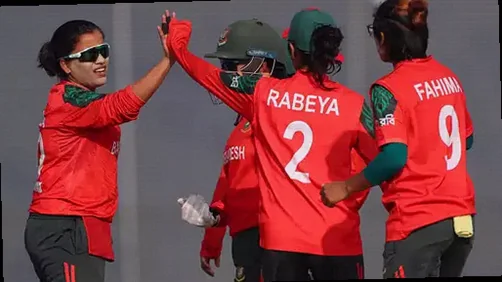
Bangladesh left-arm spinner Nahida Akter believes her team is struggling to settle into the windy conditions during the current tri-nation series in Edinburgh, a problem that has quickly turned into match-day pressure for the touring side. Bangladesh opened the series with a defeat to Scotland, losing by eight wickets, before suffering another setback as the Netherlands edged them out by eight runs, leaving concerns growing as the World Cup approaches.
Wind troubles in Edinburgh
- Nahida Akter said adapting to the weather has been difficult because Bangladesh do not regularly play in conditions affected by direct, strong wind.
- She acknowledged the wind is a real factor and stressed that although it is not something the team can blame, it does complicate execution.
- According to her, gusts can arrive suddenly and take bowlers and batters out of rhythm, making control harder than usual.
- She gave an example from her own bowling: attempting to deliver a ball toward the off-stump, only for the wind to carry it well away from the intended line after it caught the airflow.
- Nahida also pointed out that the only time her side faces these kinds of conditions is when they travel to places like Scotland, so the learning curve has come quickly.
With two games remaining that Bangladesh must win to reach the final, Nahida described adaptation as the central challenge. She argued that while the weather cannot be managed, the speed at which a team adjusts can determine whether it gets out of a poor spell. In her view, the sooner Bangladesh get comfortable with what Edinburgh offers, the better they will perform in the remaining matches because they will have a clearer idea of how these conditions behave.
No panic yet for the World Cup
Nahida Akter added that she is not ready to treat the tri-series results as a sign of deeper issues ahead of the ICC Women’s T20 World Cup. She expects the pitches in the global event to be different from those seen so far in Scotland. In particular, she said there is little to no turn on the current wickets and that they are largely batting-friendly, with the ball coming onto the bat smoothly.
For the bowlers, that means the challenge is different—less about exploiting grip and more about managing a surface that offers pace and timing opportunities. Still, she believes Bangladesh are doing their best to handle those demands during the tri-series.
Most importantly, Nahida warned against reacting too strongly after only a couple of matches. She expects the upcoming ICC tournament wickets to be “beautiful” and more balanced, offering something for both batters and bowlers. Her message was that Bangladesh should treat the tri-series as preparation while keeping confidence that the conditions in the World Cup will change.
