
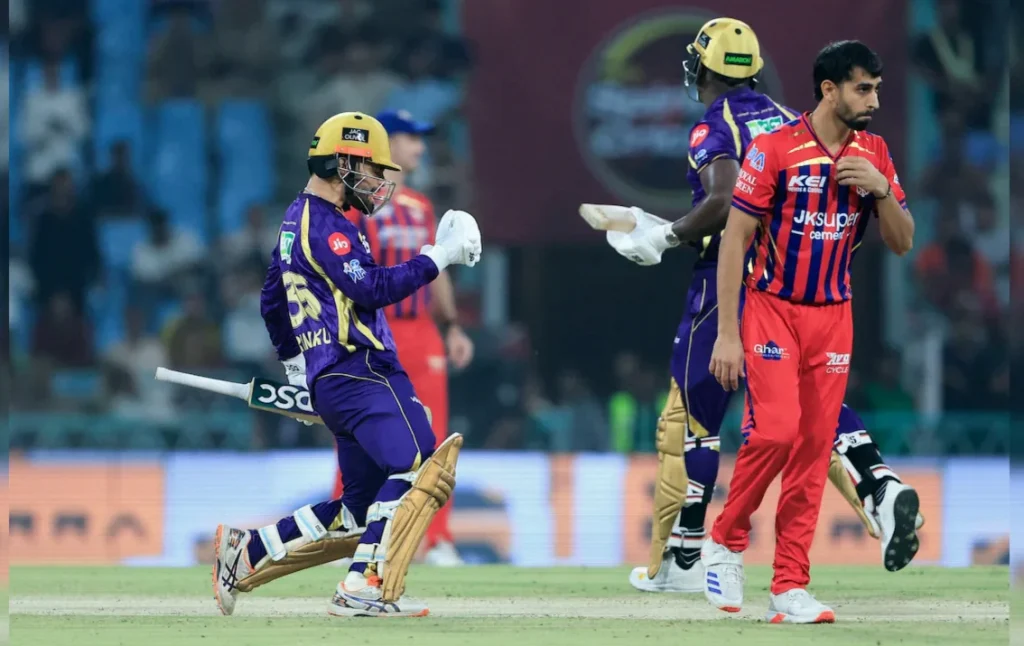
Lucknow Super Giants and Kolkata Knight Riders served up IPL 2026’s first Super Over of the campaign in a thriller on Sunday. After both sides finished regulation play level on 155, Sunil Narine produced the decisive moment in the extra-innings as KKR edged past LSG. The match swung repeatedly, but the Super Over ultimately belonged to Narine.
At a glance
- Sunday’s IPL 2026 clash went to a Super Over after both teams ended on 155 in 40 overs.
- Sunil Narine led KKR’s Super Over success, dismissing Nicholas Pooran and Aiden Markram to restrict LSG to 1/2.
- That 1/2 was also the lowest Super Over score in IPL history.
- Rinku Singh struck the winning runs in the Super Over and finished with 83* (51) in the main innings as KKR made 155/7.
- LSG’s chase was pushed into the Super Over after Mohammed Shami’s last-ball six.
KKR’s path to the title of “hard-earned” looked anything but smooth. In the regular match, Lucknow kept pushing for breakthroughs, while Kolkata relied on late acceleration to reach a defendable number. Once the Super Giants restricted KKR to 155/7, they seemed to have the framework for a rare home win.
Instead, a slow black-soil pitch and Kolkata’s sharper execution disrupted Lucknow’s chase rhythm. Rishabh Pant and Markram gave LSG a promising start before the momentum fractured, and the hosts ultimately fell short in the tie-breaker.
How the Super Over turned
With the scores level, Narine took charge of the Super Over and changed the contest instantly. He removed Nicholas Pooran and Aiden Markram in successive dismissals to leave Lucknow stranded at 1/2—the lowest total ever recorded in a Super Over. KKR then made the chase look routine, with Rinku Singh delivering when it mattered most.
Pooran’s struggles had been visible before that moment. Prior to Sunday, his IPL 2026 scores were 8, 1, 13, 19, 1, 9, 22, and he was dismissed for 9 in this match. Even so, LSG chose to send him into Narine’s first Super Over over—where he was beaten on the opening ball and the pressure quickly snowballed for Lucknow.
KKR’s main innings: late surge, Rinku at the centre
Kolkata did not waste the chance once they got set. Rinku Singh’s innings became the platform, and his 83 not out off 51 balls underpinned a total of 155/7 that arrived after a tense, twist-filled build-up.
Lucknow’s bowling had already taken control earlier. Mohsin Khan struck five wickets, dismantling a KKR batting unit that had looked under pressure, and his 5 for 23 included the scalps of Ajinkya Rahane, Tim Seifert, Cameron Green, Rovman Powell, and Anukul Roy.
Still, Kolkata found rhythm at the end. Rinku punished Shami in the 19th over with 6, 4, 4, and then launched spinner Digvesh Rathi for four consecutive sixes. That burst helped KKR pile up 43 runs in the last two overs, pushing them beyond the 150 mark.
Even with the late fireworks, Mohsin was the standout force, built on straightforward tactics for the conditions: hitting the black-soil surface to generate bounce, or changing pace with cutters to keep batters uncertain. His variety showed as he struck with both length and pace changes across his spells.
One example came when he followed Rahane with a fuller delivery aimed at a lofted attempt over the covers. Instead of a big outcome, the ball’s flight forced Rahane’s partner into a simple slice for Markram to take. Earlier in the innings, when Green—who had been comfortable after smashing George Linde for back-to-back sixes—cranked up the aggression, Mohsin stayed composed and responded with a big maximum of his own in the dismissal sequence.
Two balls later, Mohsin also used a short ball to tempt Green (who made 34) into a pull. Green played the shot, but the “into-the-body” angle did its job, and the Australian all-rounder ended up skying the ball to wicketkeeper Pant. That wicket broke a fifth-wicket stand worth 42 between Green and Rinku.
Fielding disruption and a rare dismissal
KKR’s day included an unusual complication involving Angkrish Raghuvanshi. With the match already in turmoil, Raghuvanshi was dismissed in a way that also involved him obstructing the field at the moment of the play.
In the final ball of the fifth over from Prince Yadav, Raghuvanshi nudged the ball towards mid-on and set off for a single, only for Cameron Green to reject the attempt. Raghuvanshi dived to protect himself, but he ended up in the path of Shami’s throw.
After that, third umpire Rohit Pandit accepted Lucknow’s appeal and determined that Raghuvanshi’s turning radius was more than required, leading to the batter’s dismissal in a rare manner. The decision added another layer to an already chaotic phase of the innings.
LSG’s chase: early foundation, late collapse into Super Over
Lucknow’s batting began with promise. Pant scored 42 and Markram made 31, and together they stitched a 57-run stand for the second wicket after Mitchell Marsh departed early. The pair looked set to carry LSG over the line.
But the chase shifted quickly. Markram fell to the pace-off delivery from Cameron Green, and Pant’s attempt at a reverse scoop against Narine ended with a catch to wicketkeeper Tim Seifert. From there, the responsibility for seeing out the chase fell on younger domestic names such as Ayush Badoni, Himmat Singh, and Mukul Choudhary.
Luck and composure kept LSG in the fight deep into the final over. With 17 needed off the last over, two successive no-balls by Kartik Tyagi reduced the equation to 12 off five. Even after those waist-high no-balls, the bowler was allowed to continue because the second illegal delivery was ruled non-dangerous by the officials.
Tyagi then removed Himmat Singh, leaving Lucknow needing 8 off 3. But Shami’s impact was immediate—his last-ball six pushed the game into the season’s first Super Over.
The final standings in the points table reflected the swing of emotions. KKR moved to eighth with five points, while LSG slipped to the bottom with four points. For Kolkata, it was a victory powered by Rinku’s control in the main innings and Narine’s ruthlessness in the tie-breaker.
