
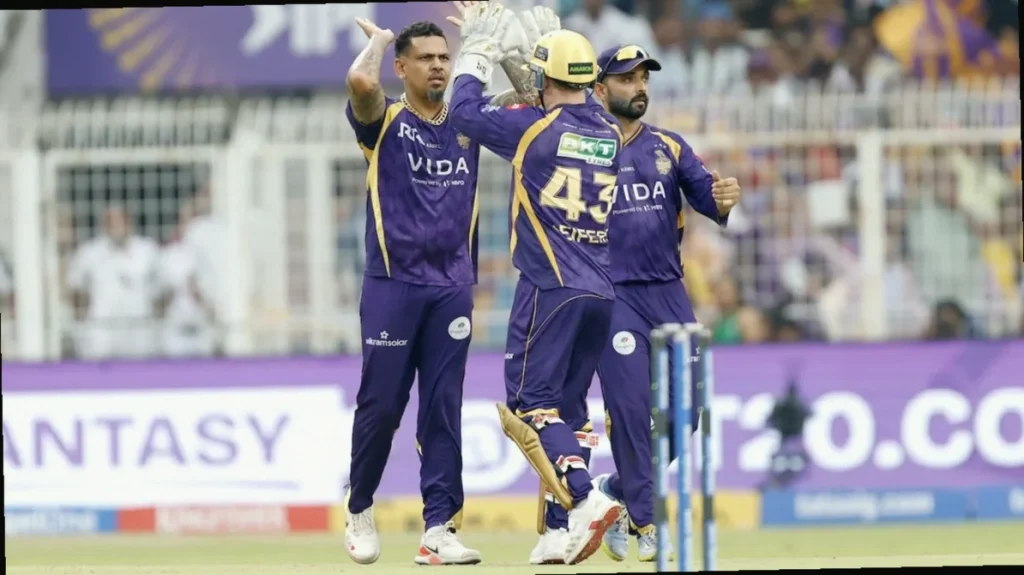
The delivery had just slipped past Salil Arora’s tentative attempt, clipping the top of off stump and carving out a slice of IPL history in the process. It was Sunil Narine’s 200th wicket in the tournament—an achievement no overseas bowler had managed to reach before.
A ball that belonged to a milestone. Yet Narine’s expression, as usual, offered no hint of celebration. There was no raised fist, no loud reaction, not even a quick look toward the big screen to check the replay of a ball he would almost certainly have taken pride in. For him, it was simply another entry in the book of his craft.
Over the years, Narine’s mystique has never been about the sheer range of variations he can produce. The real intrigue lies in how little he gives away before unleashing them.
On paper, there ought to be little left to decode. For fifteen IPL seasons, batters have tried to dissect him through endless replays, slow-motion angles, studying the way his hand releases, exploring match-ups and the numbers—along with his length, speed and every possible cue. There is no part of his bowling that hasn’t been broken down in minute detail.
Still, once the ball hits the pitch and grips just enough to turn back, once the length is pulled even slightly into the right zone or the pace is nudged through quicker, certainty drains away and careful plans unravel. The one constant is Narine’s poker-faced approach. Captains, over time, have stopped expecting him to celebrate his wickets.
Even Ishan Kishan—who was reading the situation quickly and picking lengths with confidence—got caught between instinct and inability. Narine predicted that Kishan would give him the charge, then steered the ball away. Kishan couldn’t account for the dip, and ended up slicing a catch straight to long-off.
There was a period when Narine’s role looked far simpler: the riddle of the middle overs, a reliable four-over option that captains deployed almost like a cheat code. Hitters struggled to line him up, and many simply tried to survive until they could play him out.
These days, the only genuine uncertainty heading into a game is how Narine will be used by his captain. There is no fixed blueprint. He can start as the new-ball option in the powerplay, as he did against Sunrisers Hyderabad on Sunday. He can be held back to squeeze the scoring in the middle stages, which has defined much of his IPL career. Or he can be saved as a Super Over specialist, the kind of trump card that played a role in the win over Lucknow Super Giants. Opening batter, pinch-hitter—he has taken on too many identities to count.
And Narine has served all of those roles, sometimes even within the same match. That versatility is part of why Kolkata Knight Riders (KKR) still treat him as indispensable—something only a handful of players have managed for any franchise. After fifteen seasons, KKR continue to look to him as the go-to problem-solver, the leading spinner alongside Varun Chakravarthy, who is working to regain rhythm after a dip in form.
When momentum begins to slip, Narine is called upon. When control is needed, Narine is brought into the attack. And when KKR have to deliver the opening over against a destructive partnership—Travis Head and Abhishek Sharma, the most damaging duo in the competition by numbers—Narine becomes part of the plan again.
His path through the league has never been straightforward. Questions have shadowed him at different stages: about his action, which he has had to adjust more than once; about how long he could continue, especially after the mystery around him was once believed to be fading; and about his place in a format that has kept moving forward, particularly with the Impact Player era changing the rhythm of matches. Every time, Narine has answered in the only way he knows—by evolving and delivering performances.
Over time, he has changed his pace, reshaped his lengths for different surfaces, and accepted unfamiliar assignments. Perhaps that is why 200 wickets still feels almost routine rather than extraordinary.
On Sunday, facing Head and Abhishek, Narine started with a reminder of how quickly T20 can turn. Abhishek struck him for runs over wide long-on in his first over. Yet Narine’s expression stayed the same. There was no visible shift in mindset—only a subtle alteration in length, with a slightly slower approach designed to get the ball to dip.
His face remained impossible to read throughout. In his first two wicketless overs, he conceded 20 runs, but he finished with figures of 2 for 31 in four overs. In the process, he played his part in engineering an emphatic SRH collapse: the side slipped to 8 for 48 after beginning the 11th over on 117 for 2.
Across a decade and a half, what Narine has built is among the most remarkable careers in IPL history. His statistics stand as proof of his endurance, his consistency, and his ability to remain relevant in a league that is designed to expose weaknesses—and then discard them.
For KKR, these kinds of displays have arrived at exactly the right moments. At the halfway stage of the season, their campaign looked like it could unravel. In 2024, no team managed a comeback comparable to what RCB produced after starting with just one victory in eight matches. From there, they surged through a run of six straight wins to book their place in the playoffs.
KKR, who won that season, find themselves in a remarkably similar position in 2026. After being down at the bottom, they have now strung together three consecutive victories. Narine has featured in crucial moments in each of those wins, even if a quick glance at the scorecards doesn’t always make his impact scream from the page.
Maybe that is how it was always meant to be. Narine likes it this way—no fuss, no fireworks, just results.
