
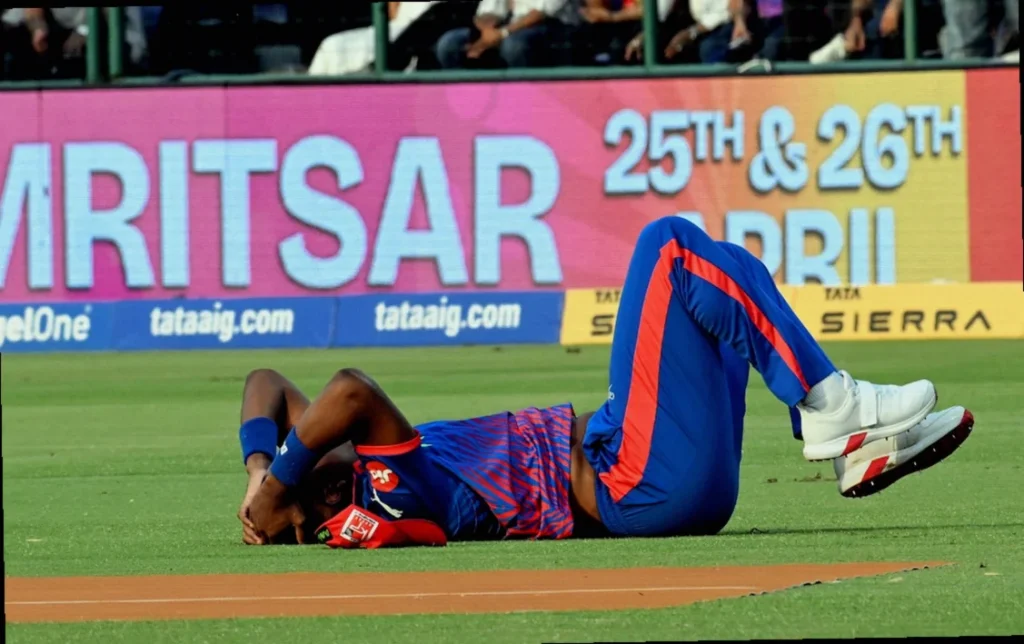
Saturday’s IPL action delivered both batting brilliance and a moment of real concern for Delhi Capitals, with fast bowler Lungi Ngidi forced to leave the field after a blow to his head during a catch attempt. Despite KL Rahul’s milestone knock and a strong start from DC, Punjab Kings powered home an all-time record chase of 265 at the Arun Jaitley Stadium, with skipper Shreyas Iyer finishing unbeaten to keep PBKS on track in the standings.
Ngidi stretchered off after collision during a catch
Delhi Capitals suffered a major setback in the third over of Punjab Kings’ innings when Ngidi’s attempt at a catch went wrong. Bowling for DC was Axar Patel, and the ball came off a lofted shot from Priyansh Arya.
- Ngidi moved back while tracking the ball, but the chance never looked fully under control.
- He stretched backward trying to take it, yet could not get a fingertip on the ball.
- In the process, he landed heavily on his head, prompting immediate concern among players and officials.
- Play was halted for more than 10 minutes as a concussion substitute was brought in.
- Vipraj Nigam was introduced as the substitute during the stoppage.
Why DC didn’t bring in Chameera as the like-for-like concussion replacement
Many viewers expected Dushmantha Chameera to be the concussion substitute, but the final decision saw Vipraj Nigam take the field instead. Former IPL batter Aakash Chopra explained the underlying reason: squad composition rules restrict overseas selections in the playing XI, so a concussion like-for-like swap cannot always be made if it would breach the foreign-player cap.
Chopra’s point was simple: if four overseas players are already present in the XI, then even replacing an injured overseas player through concussion protocols does not automatically allow another overseas cricketer to come in. In that scenario, the replacement has to be an Indian.
Update on Ngidi’s health and DC’s concerns after the loss
After the incident, Ngidi was later discharged from hospital in Delhi. The Proteas pacer had suffered a heavy landing on the back of his head and neck and was released from BLK-Max Super Speciality Hospital within hours of the scare. Kiran Kumar Grandhi, Chairman and co-owner of Delhi Capitals, visited the venue to meet Ngidi.
Following the injury, the IPL also issued an update stating that Ngidi was “stable and due to be discharged from the hospital today,” which came to pass later that same day.
Speaking in the post-match press conference, Venugopal said the team believed the injury was not serious. He added that updates would follow but insisted the situation was under control.
Venugopal also drew attention to DC’s fielding shortcomings, pointing out that the side dropped “almost six catches.” He singled out two chances of captain Shreyas Iyer that fell to Karun Nair, and argued that such missed opportunities reduce the chances of defending any total in close contests.
- Venugopal stressed that DC must improve catching, especially in crucial phases.
- He argued that when catches are dropped at key moments, defending totals becomes extremely difficult.
- He specifically called for taking chances involving Prabhsimran, Priyansh Arya, and Shreyas.
Looking ahead, Venugopal said the team would respond in the next match, highlighting two clear areas for improvement: powerplay bowling and catching.
Rahul’s 152* and PBKS’ record chase
Punjab Kings’ victory came despite DC’s impressive batting effort anchored by KL Rahul. Rahul smashed a record-breaking 152* and became the third-highest scorer overall and the first Indian ever to join the IPL’s 150-run club. It was also the highest T20 score by an Indian.
Venugopal linked the chase to the responsibility Rahul showed after setting a target of 264. He suggested that although DC tried, they could not defend once the pitch’s behaviour and the opposition’s execution shifted the contest.
- Rahul’s innings was described as a continued, responsible batting effort through the final over.
- Venugopal said the pitch dynamics were unknown, but Rahul kept striking effectively.
- He emphasised that in T20 cricket, the batting side cannot relax after setting a target.
- He added that Rahul, as a senior player, took charge and his impact was visible during this season.
Match summary: DC’s 264/2 and PBKS’ chase in 18.5 overs
After DC won the right to bat first, the innings featured an entertaining 220-run partnership for the second wicket between KL Rahul and Nitish Rana. Rahul made 152* off 67 balls, striking 16 fours and nine sixes, while Rana contributed 91* off 44 balls with 11 boundaries and four sixes as DC reached 264/2.
Punjab Kings then responded with aggressive batting. In the powerplay, Priyansh Arya (43 off 17 balls, including two fours and five sixes) and Prabhsimran Singh (76 off 26 balls, with nine fours and five sixes) helped the chase climb by shaving off 116 runs during the first six overs.
Later, Shreyas Iyer played the finishing role, remaining unbeaten on 71* off 36 balls with three fours and seven sixes. He built key partnerships with Nehal Wadhera (25) and Shashank Singh (19*), and PBKS completed the target in 18.5 overs with six wickets to spare.
Standings and record for PBKS
The result kept Punjab Kings unbeaten, with six wins and one no result, giving them 13 points. Delhi Capitals slipped to sixth place, with three wins and four defeats for six points.
PBKS also set a new benchmark in chase history, surpassing their previous best of 262—previously chased against Kolkata Knight Riders in the 2024 season—by reaching 265 this time.
