
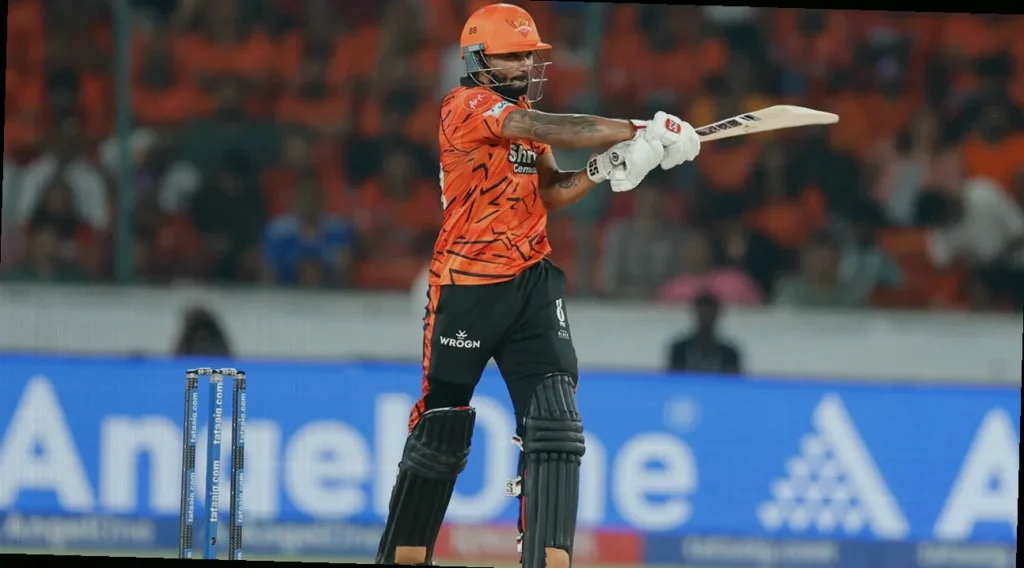
Nitish Kumar Reddy’s IPL 2026 might not be built around the headlines, but his impact for Sunrisers Hyderabad has been impossible to ignore. He is the kind of player who doesn’t fit neatly into a single label—neither a specialist batter nor a conventional bowler—yet he’s contributing meaningfully in both departments as a genuine allrounder. In Deep Dasgupta’s view, that makes him a rare presence in a league that has been moving toward impact-focused tactics, which many believed would dilute the traditional allrounder’s role.
Reddy’s value with the bat and in the bowling attack
At the moment, SRH’s batting attention has naturally been drawn to the “top four” at the top of the order—Abhishek Sharma, Travis Head, Ishan Kishan and Heinrich Klaasen. Those four have combined for 1,739 runs so far, with everyone except Head surpassing 400. Klaasen and Abhishek are also closing in on the 500-run mark. Reddy, however, is not matching that run volume yet, and that is where his role becomes more nuanced.
Instead of being asked to dominate from the start, he’s delivering the kind of innings that matter most at No. 5—arriving once the first phase of batting has been set, and then accelerating at a strike rate of 166.91. He has scored 222 runs in that position, offering SRH a crucial platform and late-overs momentum.
- Against Punjab Kings (PBKS) on Wednesday, Reddy finished with 29 not out off 13 balls during the death overs.
- Earlier, his 56 off 33 balls versus Lucknow Super Giants (LSG) stood out for the way it helped revive SRH after they were reduced to 11 for 3.
- In that chase-and-recovery phase against LSG, he partnered with Heinrich Klaasen, with both batters playing a key role in turning the innings around.
Reddy’s batting has been matched by his bowling effectiveness in a season that has generally turned into a run fest. He has taken seven wickets at an economy rate of 10.39—numbers that underline why SRH are treating him as a multi-dimensional option rather than a part-time contributor.
Why SRH see him as a functional allrounder
James Franklin, SRH’s assistant coach, has pointed to the broader team benefit of having an allrounder who can contribute with both bat and ball. Franklin’s argument is that when the side has a player in that mould who performs consistently, the overall team structure works more smoothly, especially in T20’s fast-changing match phases.
At a press conference after SRH beat PBKS by 33 runs to move to the top of the table, Franklin described Reddy’s current form in detail: confidence with the bat, an aggressive mindset immediately after coming to the crease, and a bowling spell that has improved in key moments. Franklin also suggested Reddy has managed to “bring up” his pace this season, enabling him to swing the new ball when he gets the powerplay opportunity, while also creating wicket-taking chances.
Franklin’s praise aligns with what SRH have been trying to build in the background around Reddy. There has been talk of a “Project NKR” setup, with Reddy working with Steffan Jones—former county cricketer and now a pace and high-performance coach. The stated aim has been to raise Reddy’s bowling speed toward roughly 140 kph, a transformation that would make his allround role even more credible at the IPL’s highest intensity.
Crucial wickets and the impact-allrounder debate
Some of the wickets Reddy has provided have arrived at moments that swing momentum. Deep Dasgupta highlighted instances including Sanju Samson and Ayush Mhatre being dismissed in the powerplay when Chennai Super Kings (CSK) were chasing 195 to beat SRH, only for CSK to fall short. Dasgupta also pointed to a key spell involving Will Jacks in the eighth over, when Jacks and Ryan Rickelton had combined for 93 runs across seven overs—work that threatened to accelerate the chase, before the contest shifted back in SRH’s favour.
Dasgupta believes the way the league views an allrounder is still evolving. On ESPNcricinfo’s TimeOut show, he argued that perceptions of “impact” are changing, and he hopes the role of the allrounder continues to be recognised more strongly as the years go on. He also suggested that even with the impact-player framework, Reddy has found a clear niche as a true allrounder—someone who bats in the middle order and bowls regularly, typically at least three or four overs.
In Dasgupta’s words, the tournament doesn’t feature too many players who fit that complete profile. He summarised Reddy’s balance as the reason he stands out so clearly: a proper allrounder who can be trusted with both phases of the game.
How Reddy helps SRH balance their high-risk style
Dasgupta’s satisfaction goes beyond individual performances. He feels Reddy has helped SRH maintain the team balance needed in modern IPL cricket, where many sides lean into high-risk, high-reward strategies. He also linked Reddy’s development to the reality that impact rules can potentially narrow the allrounder’s traditional influence.
Despite that, Dasgupta described how Reddy has done substantial behind-the-scenes work over recent months to ensure everything clicks. He explained SRH’s approach in terms of options: starting with five bowling possibilities—often anchored by allrounders like Reddy—then assessing how the game unfolds. That structure, Dasgupta argued, effectively increases the batting depth the team can deploy, because SRH can include an additional batter with confidence that Reddy can still deliver four overs if required.
