
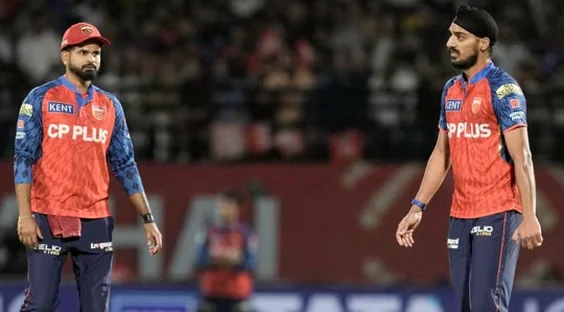
Punjab Kings’ IPL 2026 campaign has taken a sharp turn for the worse in the span of just a few weeks. After an unbeaten stretch earlier in the tournament, the franchise has now dropped five matches in a row, putting its qualification hopes under serious pressure. The slide has coincided with a difficult scheduling phase: PBKS have shifted their final three home fixtures to Dharamshala, and the move has come at precisely the wrong time, with two defeats already suffered in the Himalayan conditions and another game on the horizon against league leaders Royal Challengers Bengaluru on Sunday afternoon.
There is no single explanation for why PBKS have stumbled so badly, but one storyline has gained traction: the decision to switch home venues midseason. The team found success at their main base in Mullanpur, winning three of their matches there and losing only one. However, once they travelled to Dharamshala, the results flipped, with the side losing both games so far in that setting and facing a third challenge there against RCB. For Ravichandran Ashwin, who has watched similar collapses from PBKS before, the pattern points to the value of maintaining a consistent home ground rather than relying on multiple venues.
Speaking on his YouTube channel, the former India spinner pushed the argument that teams with the strongest trophy records tend to build their success around familiar conditions. He said, “Look at KKR, CSK, and MI—three franchises that have won a lot of trophies. In 19 seasons, those sides have won 13. SRH and Deccan Chargers together have won two, so the total becomes 15. Have these teams ever changed their home venues?” His point was not simply about travel or logistics, but about how comfort with pitch behaviour, boundaries, and match rhythm can shape performances over time.
Ashwin also referenced how legendary grounds often become engines of consistency. Venues such as the Wankhede, Chepauk and Eden Gardens are widely regarded as iconic in their own right, and teams that can lean on them regularly have historically benefited. He noted that CSK and MI, in particular, have produced outstanding home records across the years, suggesting that stability at home can matter as much as squad quality when a tournament enters its decisive phase.
To underline his wider claim, Ashwin looked back at Punjab’s 2018 season. He recalled that the team had strung together multiple victories at the IS Bindra Stadium in Mohali, before a late-season collapse derailed their momentum. “We can say that Punjab, having been there personally, it is wrong,” he said. “We won five games in Mohali, went to Indore and we got eliminated from the tournament.” He added that the defeat streak did not happen while they were playing in Mullanpur, but rather when conditions changed: “So I’m saying that Punjab have lost in a row, but not in Mullanpur. They’re playing in Dharamshala, where batting isn’t that good to bat, ball is staying low. So it will take some time to get used to it.”
In Ashwin’s view, PBKS’ recent issues cannot be blamed on lack of support. The franchise has grown into a more popular and widely backed side in recent seasons, and fan presence alone rarely determines results in T20 cricket. Still, he believes the constraints of adapting to a new home environment have affected the team’s batting rhythm. “Their batting order is scoring 20 to 30 to 40 runs lesser because they’re having to adapt,” he said, pointing to a measurable dip in output. His conclusion was that while teams can certainly manage venue changes, the advantage of having a settled home base remains real: “We can say Punjab is struggling, but they have played two of those games in a changed home venue. If 15 trophy-winning teams can play in one venue, there is some value in that.”
Not all evidence, however, supports Ashwin’s thesis. Royal Challengers Bengaluru have also faced late-season venue changes, yet both of their matches in Raipur have ended in victories. That could provide the counterpoint to his argument, and it may also be tested by Rajasthan Royals, who have bounced between Guwahati and Jaipur during the year. For Punjab, though, the coming match against RCB in Dharamshala will be another immediate test of whether they can adapt quickly enough to stop the slide and keep their IPL 2026 dream alive.
