
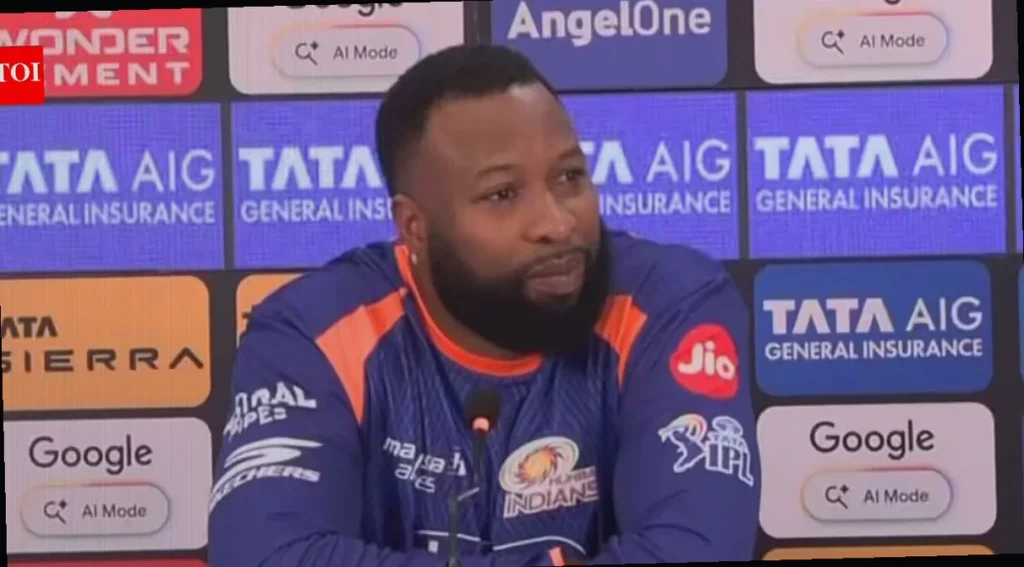
The discussion around the Impact Player rule in the IPL has only intensified, with Kieron Pollard becoming one of the more prominent voices to question its long-term effect on cricket. Pollard, who currently works as Mumbai Indians’ batting coach, said plainly that he is not convinced by the concept. “If you ask me personally whether I like it or not, I can say straight away: I’m not a fan,” he remarked, adding that the rule appears to tilt the balance away from the traditional value of all-rounders.
Pollard, a former MI all-rounder who has been connected with the league since the 2010 season in different roles, argued that the Impact Player option can leave key skills underused. In his view, this could ultimately influence how international teams think and build squads, because the IPL environment encourages tactical reshuffles that don’t exist in the same way at the highest level of the sport. The rule, he suggested, enables sides to swap personnel depending on the match situation, and that flexibility can reduce the opportunities for all-rounders to contribute across phases—batting, bowling, and fielding—rather than being treated as interchangeable pieces.
While Pollard acknowledged that removing the rule is not something he can directly control, he also recognised that the regulation has changed the scoring environment in T20 cricket. He pointed to the fact that the rule has helped drive totals upward and supported more aggressive gameplay. At the same time, he questioned whether the same benefits translate to international cricket, where match contexts and constraints are different. “As I said, it has definitely pushed up scores in T20 cricket,” he said, before adding that assessing its international impact requires deeper thought, since league matches often allow teams a cushion to recover after early setbacks. With the Impact Player rule, he suggested, certain skill sets may not be fully leveraged outside the IPL. Still, he stopped short of calling for immediate change, noting that if the regulations remain, teams and players must adapt. “Hopefully, they will review whether it’s truly beneficial. If not—and if the rules remain—you just have to get on with it,” he added.
Pollard’s concerns have echoed wider criticism from several leading cricketers. Axar Patel has previously stated that the rule weakens the role of all-rounders, because squads increasingly lean toward specialists to fit the new tactical framework. Shubman Gill has also taken a critical stance, arguing that the Impact Player model can make the contest feel more one-dimensional and less competitive, especially during run chases where teams may seek specific matchups rather than maintaining a broader balance of skills.
Beyond the younger generation, senior figures have also shown reservations at various points. Rohit Sharma, Virat Kohli, and MS Dhoni have all voiced their concerns about the Impact Player rule, reflecting the view that while it may improve certain entertainment and tactical elements, it could come at the cost of how the game develops for players whose value traditionally extends beyond a single discipline.
Introduced in 2023, the Impact Player rule has certainly contributed to higher scores and a more attacking style of play in the IPL. Yet despite the growing debate, the governing bodies and IPL administrators have indicated that the rule is set to stay at least for another season. That decision follows recent conversations with team management groups, suggesting the league is prepared to continue with the current structure even as prominent voices continue to question its wider consequences.
For fans following every twist in the tournament, the latest IPL coverage includes live score updates, breaking IPL news, the IPL schedule, the points table, and the race for the Orange Cap and Purple Cap.
