
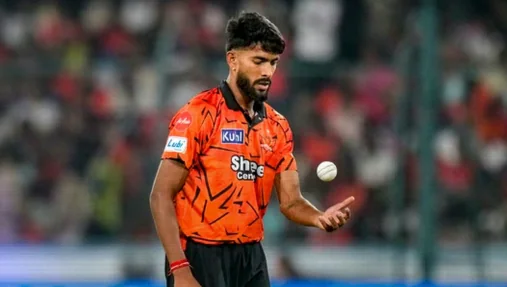
It looked like Praful Hinge’s IPL story might have been delayed by a whisker, but it turned into one of those rare “right place, right time” breakthroughs. The 24-year-old Vidarbha quick was originally expected to make his debut for Sunrisers Hyderabad against Punjab Kings last week. At the toss, Ishan Kishan confirmed his name, yet at the final moment the franchise opted for Jaydev Unadkat as the impact substitute—leaving Hinge visibly disappointed. Two days later, he finally got his chance, and he seized it in spectacular fashion.
Hinge’s dream start: three wickets in the first over
- Sunrisers Hyderabad handed Praful Hinge his IPL debut two days after the earlier toss-day disappointment.
- In what became the defining moment of his first match, Hinge struck in the opening over by removing three batters—an achievement no bowler had managed in IPL history up to that point.
- Vaibhav Sooryavanshi, Dhruv Jurel, and Lhuan-dre Pretorius were all sent back due to the pace and bounce Hinge generated.
- He finished with figures of 4/34, earning the Player of the Match award.
- The spell helped Sunrisers collect their second win of the season.
- During his TV interaction, Hinge projected real belief, saying he had imagined taking four or five wickets on his debut.
- He also disclosed that he had specifically planned to get Sooryavanshi out on the first ball.
Four wickets on debut naturally paints a bright picture, but the journey to that outcome was anything but instant. Before this breakthrough, Hinge had appeared in only one T20 match—against Andhra—where he returned 1/23. A lower-back problem then threatened to derail his career, forcing him to seek help at the MRF Pace Foundation in Chennai in an effort to get his bowling back on track.
The work behind the scenes at MRF Pace Foundation
A day after Hinge’s remarkable performance, M Senthilnathan, a coach at the MRF Pace Foundation, spoke about the support and adjustments the pacer received to manage his injury and sharpen his craft. Senthilnathan explained that the foundation had identified Hinge in 2023, when the back issue first surfaced, and that the process began with rehab and fitness before moving into deeper technical changes.
- In 2023, Hinge was selected despite having a back injury at the time.
- The initial stage focused on rehabilitation—aimed at building strength and improving overall fitness.
- After that, the foundation studied why the back problem had occurred and concluded it was linked to a technical issue.
- Hinge’s technique was fine-tuned to help him work more efficiently, with the aim of preventing the injury from returning.
- The programme, as described by Senthilnathan, runs from March to August.
- In August, once he returned to his state setup, he did so in match-ready condition.
- When he came back for the 2024 cycle, the emphasis shifted toward maintaining readiness and further strengthening his fitness.
- Bowling areas and technique were reinforced, and he was instructed to consistently execute his plans—especially because falling awkwardly could trigger back troubles.
- Senthilnathan added that Hinge also worked hard on his conditioning in 2025 and arrived fully fit, which helped him finally get the right opportunity and deliver.
Senthilnathan also highlighted what he considers Hinge’s key strength: the ability to bowl a tight line and length. He said that when Hinge hits the correct area, the ball shows movement off the batters, creating discomfort while still allowing him to maintain a strong length repeatedly. The foundation, he noted, also broadened Hinge’s exposure by sending him to Brisbane—where the High-Performance Centre operates—along with collaboration involving Cricket Australia through an MoU and exchange programme.
Glenn McGrath’s involvement formed another important part of the development plan. The former Australia fast bowler, now director of coaching at the foundation, had multiple interactions with Hinge to improve his awareness and help him understand how lengths change across different match situations. Senthilnathan said McGrath shared guidance drawn from experience across formats—emphasising the importance of targeting the right zones, building pressure, and understanding that wickets do not come on every ball. He also stressed how to respond when the game reaches high-pressure moments, something McGrath knows firsthand.
Senthilnathan concluded that such learning can provide even a small spark on the field. In his view, if the work at the foundation contributes just one percent of extra confidence or effectiveness, it can still be enough to make a meaningful difference when a young bowler battles through spells in real match conditions.
