
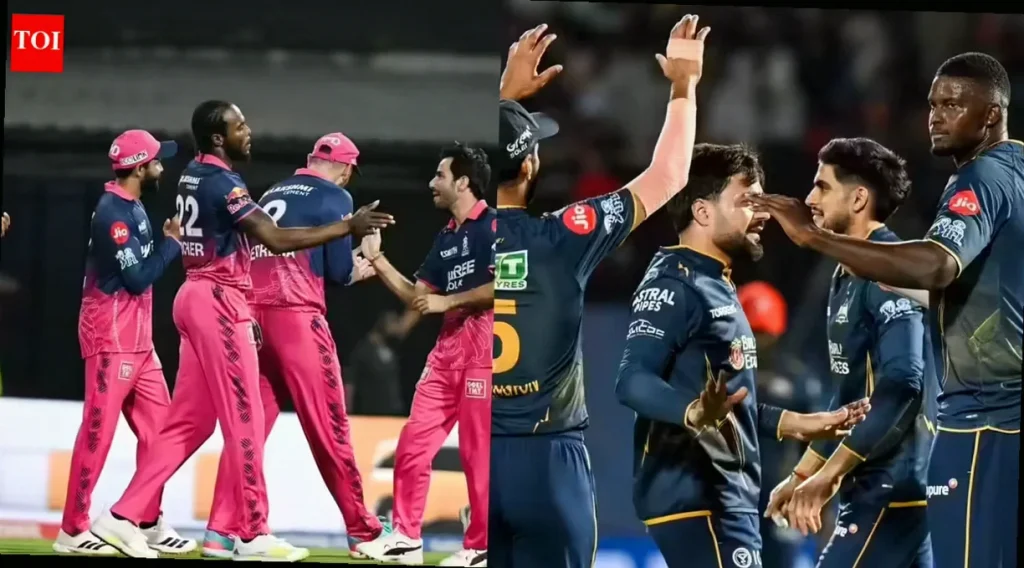
After two months, 72 matches and plenty of drama, IPL 2026 is now in its decisive phase. Royal Challengers Bengaluru, the defending champions, have already secured their spot in the final. The team now waits to see who will meet them after Friday’s high-stakes Qualifier 2, where Gujarat Titans take on Rajasthan Royals.
On paper, it’s a clash between two well-matched squads: both are stacked with batting options capable of taking the game away quickly, and both feature pace attacks that can trouble even the most confident line-ups. Yet with knockout cricket underway, one story has dominated every conversation—Vaibhav Sooryavanshi. The 15-year-old Rajasthan Royals opener has gone from exciting prospect to the defining force of IPL 2026. His blistering 97 off just 29 balls against Sunrisers Hyderabad in the Eliminator left opponents searching for answers and fans wondering whether anyone can truly slow him down before Sunday’s title match.
That innings fell just three runs short of a hundred, but it underlined a worrying truth for bowlers: Sooryavanshi can swing a T20 contest almost entirely from the powerplay. For Friday’s Qualifier 2, the key tactical question becomes clear—can Gujarat Titans strike early and unsettle him, or will Rajasthan’s fearless batting once again overpower a top-tier bowling unit?
Sooryavanshi: the biggest swing factor in Qualifier 2
Sooryavanshi’s season numbers are extraordinary, even for the modern T20 era. He leads the Orange Cap charts with 680 runs from 15 matches, striking at 242.85. His haul includes one hundred and four fifties, along with 65 sixes—an IPL single-season record.
What makes his impact even more dangerous is the timing of those runs. An astonishing 490 of his 680 have been scored during the powerplay, meaning nearly 72% of his total runs have come in the first six overs alone. In practical terms, if the opposition doesn’t remove him early, Rajasthan often accelerate into the middle overs with the match already tilting in their favour.
Interestingly, Gujarat Titans have had glimpses of success against him earlier in the tournament. In their two league encounters, Sooryavanshi got off to explosive starts but couldn’t convert them into decisive innings—producing 31 off 18 balls in Ahmedabad and 36 off 16 in Jaipur. Even though those knocks didn’t end in big scores, they still illustrated the difficulty Gujarat faces: when a batter is striking near 200 for even a short spell, knockout momentum can shift rapidly.
Another element in Rajasthan’s favour is the venue factor. Mullanpur has become a happy hunting ground for the Royals’ top-order, with the franchise winning all four matches they’ve played there, including two in the current season.
Sooryavanshi’s powerplay output
- Matches: 15
- Total Runs: 680
- Runs in Powerplay: 490
- Runs Outside Powerplay: 190
- Strike Rate: 242.85
Rabada and Siraj: the new-ball responsibility
If Gujarat Titans want to stop Sooryavanshi, much of the burden will likely fall on Kagiso Rabada and Mohammed Siraj. Both pacers have been among the most effective operators with the new ball this season. Rabada, who is currently level at the top of the Purple Cap race with 26 wickets, has taken 18 wickets in the powerplay. Siraj, meanwhile, has 17 wickets overall, with 13 coming in the first six overs.
Together, they form one of the most threatening opening bowling combinations in IPL 2026. Still, Gujarat must weigh a key concern: Sooryavanshi has already shown that he isn’t easily intimidated by either of them. This season, he has struck 25 runs off 14 balls against Rabada and 38 off 20 balls against Siraj. His attacking approach has stayed consistent regardless of the bowler or the match situation.
Even so, Gujarat may believe it has found a possible route to success. In their earlier meeting, Siraj dismissed Sooryavanshi with a sharp short-ball. The teenager has shown occasional vulnerability to pace aimed tightly at the body, particularly early in the innings. That suggests Gujarat’s fast bowlers could look to target that area aggressively on Friday.
The risk with that plan is obvious. On a good batting track, one mistimed bouncer attempt can go badly and repeatedly, landing in the stands. And Sooryavanshi has demonstrated throughout the season that once he starts swinging freely, his reputation offers little protection to opponents.
Rabada and Siraj’s powerplay wicket stats
- Kagiso Rabada: 26 total wickets, 18 in powerplay, 8 outside powerplay
- Mohammed Siraj: 17 total wickets, 13 in powerplay, 4 outside powerplay
Bigger tactical battle: top-orders versus new-ball attacks
Beyond the Sooryavanshi spotlight, Qualifier 2 also sets up an intriguing tactical contest between two batting-heavy line-ups and two pace units that can enforce pressure from the outset. Rajasthan’s batting strength isn’t limited to the teenager. Yashasvi Jaiswal may have been overshadowed at times by Sooryavanshi’s fireworks, but he still has 426 runs at a strike rate above 153. Dhruv Jurel has also emerged as a dependable middle-order contributor, accumulating more than 500 runs this season.
For Rajasthan, the central issue is whether this top-heavy unit can withstand Gujarat’s relentless pace attack. The ability to survive the early overs could determine how much freedom the Royals have later in the chase or the set.
Top Rajasthan batters in IPL 2026
- Vaibhav Sooryavanshi: 680 runs, 15 matches, average 45.33, strike rate 242.85, 1 century/4 fifties
- Dhruv Jurel: 508 runs, 15 matches, average 39.08, strike rate 159.35, 1 century/5 fifties
- Yashasvi Jaiswal: 426 runs, 15 matches, average 32.77, strike rate 153.23, 0 centuries/3 fifties
- Riyan Parag: 298 runs, 13 matches, average 24.83, strike rate 156.84, 0 centuries/2 fifties
- Donovan Ferreira: 279 runs, 14 matches, average 31.00, strike rate 168.07, 0 centuries/2 fifties
For Gujarat, the wicket-taking threat doesn’t stop with Rabada and Siraj. Prasidh Krishna and Jason Holder also add pace-bowling options, while Rashid Khan leads the spin department with 19 wickets—the highest tally by a spinner in a tournament still dominated by pace.
Gujarat also appear to have favourable match-ups. Rabada has dismissed Jaiswal three times while conceding only 27 runs in 27 balls. Rashid has similarly kept Rajasthan’s middle-order key scorers relatively quiet through the middle overs. That gives Gujarat a small structural advantage: unlike several other teams, they can keep pressing for wickets even after the powerplay ends.
Rajasthan, on the other hand, may need extra output from players lower down the batting order, particularly Riyan Parag and Donovan Ferreira, if the top-order doesn’t dominate early.
Top Gujarat bowlers in IPL 2026
- Kagiso Rabada: 26 wickets, 15 matches, average 21.03, economy 9.48
- Rashid Khan: 19 wickets, 15 matches, average 23.47, economy 8.77
- Mohammed Siraj: 17 wickets, 15 matches, average 24.78, economy 8.96
- Jason Holder: 15 wickets, 16 matches, average 16.46, economy 7.63
- Prasidh Krishna: 15 wickets, 10 matches, average 23.86, economy 10.52
Gujarat’s top three: just as dangerous for Rajasthan
Rajasthan may lean heavily on Sooryavanshi, but Gujarat Titans are similarly dependent on their top trio: Shubman Gill, Sai Sudharsan and Jos Buttler. Gill and Sudharsan have been among the most dependable batters during the season, scoring 618 and 652 runs respectively. Buttler has also contributed close to 500 runs and remains one of the most dangerous white-ball hitters anywhere in world cricket.
Unlike Rajasthan’s more explosive style, Gujarat’s top-order is built around steady accumulation paired with calculated bursts of aggression. Their top group rarely collapses, but that stability comes with a trade-off: if those three don’t deliver enough, the lower order doesn’t always carry the same firepower. That imbalance in batting depth is viewed as Gujarat’s biggest weakness as they head into Qualifier 2.
Washington Sundar has 311 runs as the next-highest scorer after the top three. Rahul Tewatia has produced cameo moments, but Gujarat do not offer the same batting depth that Rajasthan possess.
Top Gujarat batters in IPL 2026
- Sai Sudharsan: 652 runs, 15 matches, average 46.57, strike rate 157.86, 1 century/7 fifties
- Shubman Gill: 618 runs, 14 matches, average 44.14, strike rate 159.27, 0 centuries/6 fifties
- Jos Buttler: 448 runs, 15 matches, average 38.31, strike rate 159.10, 0 centuries/4 fifties
- Washington Sundar: 311 runs, 15 matches, average 34.56, strike rate 151.70, 0 centuries/2 fifties
- Rahul Tewatia: 166 runs, 14 matches, average 27.67, strike rate 140.67, 0 centuries/1 fifty
Where Jofra Archer could swing the game
This is also where Jofra Archer becomes pivotal for Rajasthan. The fast bowler has enjoyed a standout campaign with 24 wickets in 15 matches, and he appears to be peaking at exactly the right time. He has taken nine wickets in his last four outings, including two three-wicket hauls in knockout-style games against Mumbai Indians and Sunrisers Hyderabad.
Archer also has a notable record against Gill, dismissing him three times in only 30 deliveries. If Gujarat’s top order is to be disrupted, that matchup could matter more than most.
However, Rajasthan’s wider challenge is getting consistent support from the other end. Nandre Burger and Brijesh Sharma have been a little inconsistent, even though they have taken wickets in phases. Rajasthan will also want Ravi Bishnoi and Ravindra Jadeja to add more control and wicket-taking in the middle overs to keep Gujarat’s disciplined accumulation in check.
There is one interesting counterpoint: Sai Sudharsan has handled Archer reasonably well, scoring 44 runs off 33 balls without being dismissed. Buttler, meanwhile, has historically had the better of Archer in T20 cricket, posting a strike rate close to 195 against him.
Top Rajasthan bowlers in IPL 2026
- Jofra Archer: 24 wickets, 15 matches, average 21.41, economy 9.17
- Brijesh Sharma: 13 wickets, 12 matches, average 31.23, economy 9.70
- Nandre Burger: 13 wickets, 12 matches, average 31.15, economy 10.25
- Ravi Bishnoi: 11 wickets, 9 matches, average 36.93, economy 6.88
- Ravindra Jadeja: 10 wickets, 13 matches, average 24.90, economy 8.03
Sooryavanshi remains the defining X-factor
Step away from the Vaibhav Sooryavanshi storyline and the picture still looks tightly balanced. Both sides have high-quality top orders and both bring genuinely dangerous attacks. Rajasthan may hold a slight edge in batting depth thanks to Parag and Ferreira, while Gujarat likely have the more even spread across their bowling resources.
But knockout cricket often comes down to a single uncontrollable factor—and in IPL 2026, that factor is Sooryavanshi. If Gujarat can remove him early, the contest immediately becomes more tactical, more conventional. If they can’t, Qualifier 2 could turn into another display of fearless hitting from a teenager who has already changed what many thought was possible in an IPL season.
