
Ajinkya Rahane’s call at the toss carried the kind of tension that only shows up in T20 cricket: you can sense the instinct behind it, yet the numbers keep whispering a different story. Ahmedabad has, in recent seasons, pushed captains toward batting first, with eight of the last ten league matches at the venue falling to teams that chose to set a target. But the data comes with an important rider—this ground has rarely rewarded average totals. When teams start first, they generally need to post something emphatic; figures below 190 have often slipped away under pressure, while even-par has typically hovered just above the 210 mark. On paper, the Gujarat Titans–style matchup made Rahane’s gamble look sensible, and the early spell from the Titans quickly suggested the plan would hold up.
Gujarat’s new-ball numbers had been unusually sharp before this game. In the four matches leading in, they had taken just three wickets in the Powerplay phase, but the bigger context was how controlled that period had been—an average of 81.33 across those Powerplay overs. Mohammed Siraj, the senior pacer, had also been finding structure rather than drama, with only one wicket during the Powerplay in his previous eight innings. Kagiso Rabada’s returns at this venue had followed a similar pattern, reinforcing the idea that their early success was built on discipline more than chaos. Still, conditions have a way of refusing to follow scripts written elsewhere.
Pitch #6—described by its red-and-black soil base—offered just enough seam movement to make “typical” thinking relevant again. In other words, the surface wasn’t asking for a different language; it was rewarding the familiar one. Siraj generated swing by getting the ball up, and Rahane, possibly already locked into the tempo he wanted to establish, stepped out and mistimed a slog that ended up going toward mid-on. If Rahane’s strengths from the longer formats were ever likely to translate into value, this was the scenario: a wicket that gave the seamers something, combined with a new-ball pair that made risk feel expensive.
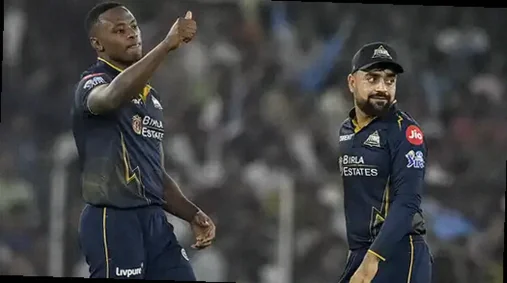
Rabada then followed a similar blueprint. A length delivery that straightened slightly enough took the edge of Angkrish Raghuvanshi’s bat, setting the tone for dismissals that didn’t look accidental. The pattern continued when Tim Seifert was sent back as well—this time, a wide ball that was just a touch off the typical line deviated enough to catch the toe rather than the middle of the bat. Three wickets arrived with three different looks, but the common thread was control: Gujarat’s bowlers were targeting consistent areas, and the batter errors that followed were the kind you usually see when plans land early.
For the first time in the season, the new-ball duo ran through the Powerplay without changing their approach, and it paid off not only with wickets but with restraint. Siraj and Rabada forced false shots at a rate of 48.6%, the highest figure in the Powerplay phase for Gujarat this season. The shape of their work was unmistakably “red-ball” in origin—most balls sat outside off stump, delivered on a good length or shorter, with just enough movement to make batters hesitate. By the time KKR were reduced to 37 for 3, the toss decision had already lost much of its immediate advantage.
Cameron Green’s innings helped keep the match alive, pushing KKR to 180. That total was competitive, but it didn’t fully match the original logic behind batting first at Ahmedabad—because defending 180 still demanded early access to Gujarat’s middle overs. Gujarat’s top three have not always offered the same certainty, and that uncertainty became relevant quickly here. KKR opted for a defensive spin-heavy start after the early damage, with three overs of spin in the Powerplay costing 39 runs—neither containing the innings effectively nor creating the sort of pressure that forces a collapse. When the seamers came on after that, the direction of risk shifted. Instead of hitting the corridor with length and movement, KKR’s pacers pitched up too often and tended to go straighter, inadvertently feeding the hitting arcs that batters look for when the ball sits in the slot.
Once Gujarat reached 71 for 1, the contest moved beyond tactical chess and into a sense of inevitability. Still, the story for Gujarat wasn’t limited to one result. Prasidh Krishna has been carrying forward the same craft that made him stand out last season, particularly in how he manages overs in key middle phases. Rashid Khan’s return to rhythm has also restored a crucial balance in Gujarat’s flow—an extra layer that helps them avoid going too flat after the early burst.
And that’s where the bigger takeaway emerges. If Siraj and Rabada can reproduce even portions of this new-ball display—swinging at the right moments, holding length under pressure, and turning marginal movement into dismissals—then the Titans start to look like a more complete bowling outfit. Not just a side that wins phases, but one capable of shaping matches right from the opening overs.
