
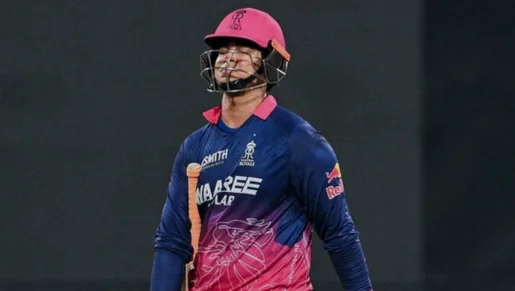
A day after Kumar Sangakkara questioned whether Vaibhav Sooryavanshi has delivered the kind of returns Rajasthan Royals would want, RR batting coach Vikram Rathour pushed back on the criticism. While Sooryavanshi’s early burst in the Indian Premier League has gradually cooled, Rathour argued that the youngster is still giving the franchise exactly what it needs at the top of the order—fast starts—even if the big scores have not yet followed. Since April 25, Sooryavanshi has not reached a fifty, though he has continued to produce a steady stream of contributions in the 30s and 40s. In the match last evening against the Delhi Capitals, he fell four runs short of another half-century, getting out to a slower delivery from Madhav Tiwari.
Rathour on the “slow ball” debate
Rathour dismissed any idea that Sooryavanshi is losing ground because of pace or variation. Instead, he suggested that bowlers should keep using slower balls against him so the batter can sharpen his response. Rathour noted that the Arun Jaitley Stadium track can offer help to cutters and changes in tempo, which can unsettle batters, but he insisted there is no long-term weakness in Sooryavanshi’s game.
“Nobody is perfect. Everyone has a weakness at some point. A slow ball isn’t Vaibhav’s problem. I’ll actually want bowlers to keep trying it against him,” Rathour said after Rajasthan’s five-wicket defeat to Delhi. “On a wicket like this, where the ball is gripping a bit, a shift in pace is useful against anyone.”
He also urged patience, pointing out that one innings converting into a bigger score is often the next logical step for batters who are showing the right signs consistently. Rathour added that the coaching staff is encouraged by both Sooryavanshi’s preparation and the manner of his batting.
“It’s not only Vaibhav who is special. Enough has already been said about his ability and how good he is. He has given us a strong start—especially when you look at the surface again. I just hope he converts one innings and goes deeper. From how he is batting and how he prepares, I’m confident it won’t be far off. We’ll see one of those knocks where he really converts and plays a big one. For now, we’re pretty happy with the way he’s batting, and we want him to keep doing exactly that,” Rathour said.
Playing to strengths
Rathour further reinforced that Sooryavanshi is not expected to mirror anyone else’s batting pattern, even if comparisons are being made. He pointed to the Capitals game as an example of how Sooryavanshi’s approach can still be highly effective. Against Delhi, Sooryavanshi faced only 26 balls and struck at a strike rate above 200.
- Sooryavanshi’s quick-fire start continued even as his conversion into a fifty has been delayed.
- In the same chase, his partnership with Dhruv Jurel provided momentum, with the duo adding 80 runs for the second wicket.
- Jurel contributed 53 off 40 balls during that stand.
- Riyan Parag then took charge, smashing 51 off 26 deliveries as the innings accelerated.
- Despite the combined impact of the top-order trio, the Royals were unable to secure victory.
Rathour also stressed that each batter has a natural route to runs and should not be forced into someone else’s style. To explain his thinking, he referenced Virat Kohli, arguing that even in T20 cricket, success does not require identical hitting methods.
“If you back your strengths and play to them, you can score runs. Dhruv [Jurel] doesn’t have to bat like Vaibhav, and Vaibhav shouldn’t try to bat like Dhruv. They each have their own way of finding runs. If they keep believing in their ability and stick to what they do best, it should work out,” Rathour said.
“You’ve seen that happen. Take someone like Virat—he has remained extremely successful in this format. I wouldn’t call him an outright power-hitter. That shows there’s space for everyone to succeed, as long as they have belief in their own game,” he added.
