
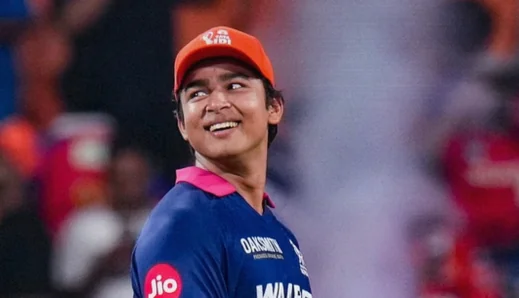
Rajasthan Royals have sealed their place in the IPL 2026 Qualifier 2, and it happened with such speed that the contest barely reached three overs. A 15-year-old from Samastipur played a starring role, ensuring the game swung decisively long before it could become a real contest.
Sunrisers Hyderabad won the toss and opted to field first, a call that briefly looked sensible given the context. With Pat Cummins charging in and the tie carrying knockout pressure, there was a teenager at the other end who hadn’t even completed his Class 10 examinations. Yet the match shifted almost immediately: Praful Hinge trapped Vaibhav Sooryavanshi at long-on in the eighth over, but by then the outcome was already effectively decided.
RR posted 243/8 from their 20 overs, but the chase was essentially over well before the innings reached its midpoint. During the powerplay, the Royals raced to 80 without losing a wicket—an early foundation built largely by one left-handed opener who handles 140 kph deliveries with the calm of routine practice.
Sooryavanshi eventually perished for 97 off 29 balls, caught on the boundary by Hinge with the team’s score reading 125/1. His innings came with 12 maximums and five fours, and he finished with a strike rate of 334.
With a target of 244, SRH never managed to get close. They were bowled out for 196, falling short by 47 runs, and RR moved into the next stage of the knockout pathway.
However, the headline numbers—97, 334, and 47—are not the only figures worth scrutiny. The most striking detail is the price tag attached to the innings: ₹5.15 crore.
What the money says
Rajasthan Royals retained Vaibhav Sooryavanshi for ₹1.10 crore ahead of IPL 2026. That fee covers the season and all 16 matches RR could potentially play, including a minimum path through Qualifier 2—so the cost is spread across a full window of 16 games. On that basis, the franchise’s per-match outlay works out to ₹6.88 lakh.
A match-impact framework that tracks win probability swing ball by ball across IPL 2026 credited Sooryavanshi with ₹5.22 crore in total value during this Eliminator. After accounting for his match cost, his net profit for the Tuesday night fixture comes to ₹5.15 crore. He topped the scoring across the match—clearly—in both total value created and net return, with his return multiple landing at 76 times his match cost.
These are not numbers built for sentiment. They reflect how rapidly win probability can change when a batter keeps delivering decisive shifts in momentum—again and again—over the course of 29 deliveries.
Breaking the ₹5.15 crore net figure across Sooryavanshi’s 29-ball contribution yields ₹17.78 lakh of model value per ball.
For context, India’s Ministry of Statistics published figures in March 2026 showing that the average monthly earnings for a regular male salaried worker in the country stood at ₹24,217. By that yardstick, each ball Sooryavanshi faced on Tuesday produced more than six years’ worth of that average salary. In the roughly 20 seconds it takes a fast bowler to complete a run-up and release the ball, the teenager generated what many working Indians earn over half a decade.
Over 29 deliveries, the ₹5.15 crore total corresponds to 177 months of that average wage—presented another way, it also equates to the price of five brand-new Mercedes-Benz GLE models at current market rates.
Also Read: Vaibhav Sooryavanshi misses fastest IPL 100 by a whisker but mows down hat-trick of records with 12 breathtaking sixes
The contract pays itself back, four times over
Even sharper than the per-ball estimate is the simplest comparison: RR spent ₹1.10 crore to secure Sooryavanshi for the entire season. In just one innings of one knockout game, the win-probability model attributes a net profit worth 4.7 times that contract value. RR weren’t merely signing a player; they were, in effect, backing a franchise multiplier.
Sooryavanshi is 15 years old, yet he bats as though he has been doing it for years. In Bihar, he has effectively been living that rhythm—so the per-delivery valuation is extraordinary, and the per-year valuation is the sort of figure that will keep financial modellers and cricket analysts debating long after the season ends.
On Tuesday night in New Chandigarh, Sooryavanshi walked out to face Pat Cummins in an Eliminator and left the crease with RR already in a completely different match state from everyone else—well before the halfway mark of the first innings. The money, in this case, is simply the model’s way of agreeing with what viewers likely sensed as the innings unfolded.
Methodology note
The financial numbers in this piece come from a match-impact model created specifically for this analysis. The model assigns a monetary value to a player’s contribution in a match by measuring how their batting, bowling, and fielding affect the team’s chances of winning over every delivery. Those win-probability movements are converted into a performance score, which is then compared with the player’s match cost. That match cost is calculated by spreading their IPL auction price across the team’s possible active match window for the season.
The resulting figure represents how much value a player produced relative to what it cost to use them in that fixture. It is not intended to represent actual wages or earnings. Instead, it offers an analytical angle on a straightforward question: if a franchise paid a certain amount, what did it get back in performance value?
All monetary outputs here are model results and do not reflect real transactions, player income, or franchise revenue. The win-probability approach uses match context and historical information to estimate shifts in game state, and it carries the inherent limits of any forecasting system. When consumer-product comparisons are made, they use verified market prices available at the time of publication. Readers should treat the figures as illustrative of performance value rather than literal financial valuations.
