
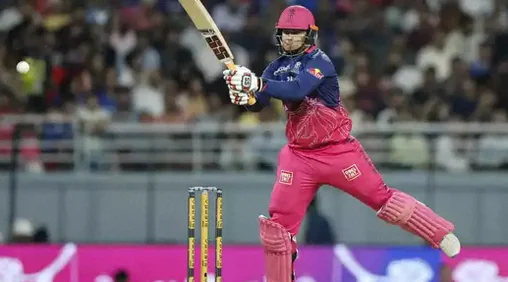
Among all franchises in the IPL’s 19-season journey, Rajasthan Royals have arguably developed teenage hitters better than anyone. The list of youngsters who have earned their opportunities there includes Ravindra Jadeja, Sanju Samson, Riyan Parag and Yashasvi Jaiswal, with each stepping through a clear pathway to prominence. Still, even within that strong tradition, Vaibhav Sooryavanshi stands out as something out of the ordinary. After first showing glimpses of his talent in 2025, the 15-year-old has taken his game to heights that look unprecedented in the league—never mind for someone so young. At 15, he isn’t only chasing milestones; he’s rewriting what the format previously treated as “benchmark” territory.
More volume, greater impact
In IPL 2026, Sooryavanshi finished with 776 runs while striking at 237.30. He cleared the rope 135 times in boundaries from just 327 balls, including 72 sixes. He produced six scores of 50 or more, and one of those came as a 36-ball century. Even more strikingly, four of his fifty-plus knocks were completed in 16 balls or less. Those are the headline numbers from his IPL 2026 campaign.
Across the previous 18 IPL seasons, only four batter seasons have featured more runs in a single campaign than Sooryavanshi’s total. In addition, only four batters (Sooryavanshi included) have scored over 500 runs in a T20 competition with a strike rate above 200, yet none matched the sheer volume he produced at 15. His 776 runs are 38% higher than the next-best mark in that elite grouping—Abhishek Sharma’s 563 at 204.72, also in IPL 2026. The other seasons in the set belong to Andre Russell (510 at 204.81 in IPL 2019) and Alex Hales (507 at 204.43 in the 2017 T20 Blast). The closest strike-rate comparison to Sooryavanshi came from Jake Fraser-McGurk, whose 330 runs in IPL 2024 came at 234.04.
There have been 20 instances in T20 history of batters piling up 300-plus runs in a tournament while maintaining a strike rate above 200. Only one player has done that at a higher strike rate than Sooryavanshi—Abhishek Sharma’s 304 runs at 247.15 in the 2026 Syed Mushtaq Ali Trophy. Yet even with that context, no batter has managed to keep a strike rate of 230-plus while batting at least 10 times in the competition. What made the IPL 2026 season even more extraordinary was not just his personal output, but the distance between his performance and everyone around him, including within his own team.
Sooryavanshi’s strike-rate differential with Rajasthan Royals was 87.03 (his strike rate minus the rest of the team’s strike rate)—the largest ever among the 480 cases of a batter reaching 300-plus runs in a single edition.
Highest strike rate differential with teammates in a season
Sooryavanshi’s debut in 2025 delivered sparks, but the real test was whether he could sustain the level when opponents adjust and expectations naturally rise. He answered that question decisively in year two. He played a key role in Rajasthan Royals beginning IPL 2026 with four consecutive victories. He also became the first batter to score a century in each of his first two IPL seasons—following a 35-ball hundred against Gujarat Titans in 2025 with a 36-ball century against Sunrisers Hyderabad in 2026.
On top of that, he became the first uncapped player to reach two IPL hundreds. He then surpassed Jaiswal’s three-year-old benchmark for the most runs by an uncapped batter in an IPL season, doing so by a margin of 151 runs.
Most runs in an IPL season
Most runs by an uncapped batter in an IPL season
In IPL 2026, Sooryavanshi struck four fifties in 16 balls or fewer. That tally is two more than any batter has managed across an entire IPL career. Only Travis Head and Nicholas Pooran—both in 2024—had previously achieved it multiple times in a single season. His 16-ball fifty against Sunrisers Hyderabad in the Eliminator matched the fastest fifty ever recorded in an IPL playoff or knockout match. The 36-ball hundred he scored against the same opponent in Jaipur was the third-fastest century in IPL history, with the second spot also occupied by him. Even in the Eliminator, he was on course to top the record before falling for 97 off 29 balls.
In the final innings of the league season, Sooryavanshi became both the youngest batter and the quickest by balls faced to reach 1,000 IPL runs. He took just 440 balls to get there—105 fewer than the previous record held by Andre Russell. He also achieved the milestone in 23 innings, which made it the joint second-fastest mark in the league and the fastest by an Indian batter.
Dominating the Powerplay
The phase where Sooryavanshi’s impact looked most dominant was the Powerplay. Out of his 776 runs, 521 came in the first six overs—the most by any batter in that segment in an IPL season, eclipsing David Warner’s 467 from 2016. He reached fifty within the Powerplay four times, equalling Travis Head’s 2024 record for the most such instances in a season. Over the years, Sooryavanshi has done this five times in the IPL, second only to Warner’s six.
The six-hitting numbers in that opening phase were even more startling. Sooryavanshi struck 46 sixes in the Powerplay from just 223 balls—comfortably the highest total for this period in a season. For context, until the end of 2023 no IPL side had managed that many Powerplay sixes in an entire season. In 2026 alone, he out-hit five teams in the Powerplay in terms of number of sixes: CSK (38), RCB (36), KKR (35), GT (33) and DC (28).
Most runs in overs 1-6 in an IPL season
Rewriting six-hitting benchmarks
If Chris Gayle set the tone for T20 power hitting in the early 2010s, Sooryavanshi has completely redrawn the same narrative. Gayle’s 59 IPL sixes in 2012 came off 456 balls—one maximum every 7.7 deliveries. Sooryavanshi’s 72 sixes in 2026 came from 327 balls, meaning a six every 4.5 deliveries. The longest stretch between two of his sixes across the entire season was only 20 balls.
Looking across all IPL seasons with 30-plus sixes, only three batters have had a shorter average gap between maximums. Two of those players were middle-order hitters. Abhishek Sharma in IPL 2024 is the only opener among them, and even his “gap” was marginally larger—19 balls—without a six.
Most sixes in an IPL season
Sooryavanshi struck 10 or more sixes in an innings three times during the season, becoming the first player to do it. The only other batter to manage that feat more than once in a season was Finn Allen, also in 2026. Overall, Sooryavanshi has four such innings in the IPL—matching Gayle’s number. He struck 12 sixes twice in the season, the most by an Indian batter in an IPL innings, surpassing his own 11 from 2025. That 11 had previously been jointly held with Murali Vijay.
His 12 sixes against Sunrisers Hyderabad in the Eliminator were the most in an IPL playoff or knockout match. Eight of those maximums arrived inside the Powerplay—again a record. During his century against SRH in Jaipur, he also became the fastest batter to reach 50 IPL sixes, doing it by innings (15) and by balls faced (250). The earlier marks belonged to Gayle (21 innings) and Priyansh Arya (361 balls). Cow corner remained his favourite scoring channel, accounting for 18 of his sixes. Across the season, 50 of his 72 maximums came on the leg side, including 34 struck in the arc between square leg and midwicket.
Sooryavanshi wagon wheel in IPL 2026
No bowler spared
Jasprit Bumrah. Pat Cummins. Josh Hazlewood. Matt Henry. Mitchell Starc. Lungi Ngidi. These are all elite, all-format names, but their reputations offered no real protection against Sooryavanshi this IPL. Every one of those bowlers conceded a boundary on the first ball he faced from them in IPL 2026. Against pace, he collected 648 runs at a strike rate of 239.11, hitting a boundary almost every second delivery. Even versus spin, he struck at 228.57 from 56 balls.
He dominated nearly every length offered by seamers, with only brief patches of resistance coming when yorkers and full tosses were attempted. He faced 12 yorkers, scoring just two runs total and being dismissed once. Against 17 full toss deliveries, he managed 16 runs. Anything shorter than yorker length tended to disappear quickly from the bat. When he struck length balls, his strike rate was 268 compared to the season average of 148. Bouncers traveled at 300-plus, and they accounted for nearly a third of his sixes.
Sooryavanshi faced 46 bowlers in IPL 2026 and hit sixes off 34 of them. Of the 12 who managed to avoid conceding a maximum, only four bowled more than three deliveries to him: Mohsin Khan (12), Kartik Tyagi (9), Prasidh Krishna (8), and Vaibhav Arora (6). Mohsin Khan looked the toughest opponent among that group, conceding only two runs off 12 balls. In Lucknow, he became the first bowler to deliver a maiden to Sooryavanshi in the IPL before dismissing him at the end of the over.
Outside Mohsin, only Sunil Narine bowled more than one over to him while keeping Sooryavanshi’s strike rate under 100—7 runs off 8 balls. The most severe punishment, though, came for SRH debutants Praful Hinge and Sakib Hussain, who had combined for eight wickets against Rajasthan earlier. Sooryavanshi was the first batter to go after Hinge on the opening ball of his over in the IPL—an over in which Hinge also became the first bowler to take three wickets in his maiden IPL over.
50+ runs at 300+ SR against a bowler in an IPL season
In the return meeting, Sooryavanshi answered that earlier setback by smashing Hinge for four consecutive sixes in the first over of the innings—the first time that has happened in IPL history. Over the season, he struck 57 runs off the 17 balls he faced from Hinge at a strike rate of 335.29. Against his Bihar teammate Sakib, he scored 59 off 19 balls at 310.52.
Against the eventual top 10 names on the Purple Cap list, Sooryavanshi amassed 241 runs from 113 balls at a strike rate of 213, and he struck above 160 against each of them individually. In a season that arrived after India’s T20 World Cup success—when the IPL needed a defining storyline—Sooryavanshi’s raw talent stood above everything else. IPL 2026 belonged to him, and the frightening part is that he is still only 15. The best may yet be waiting to arrive.
