
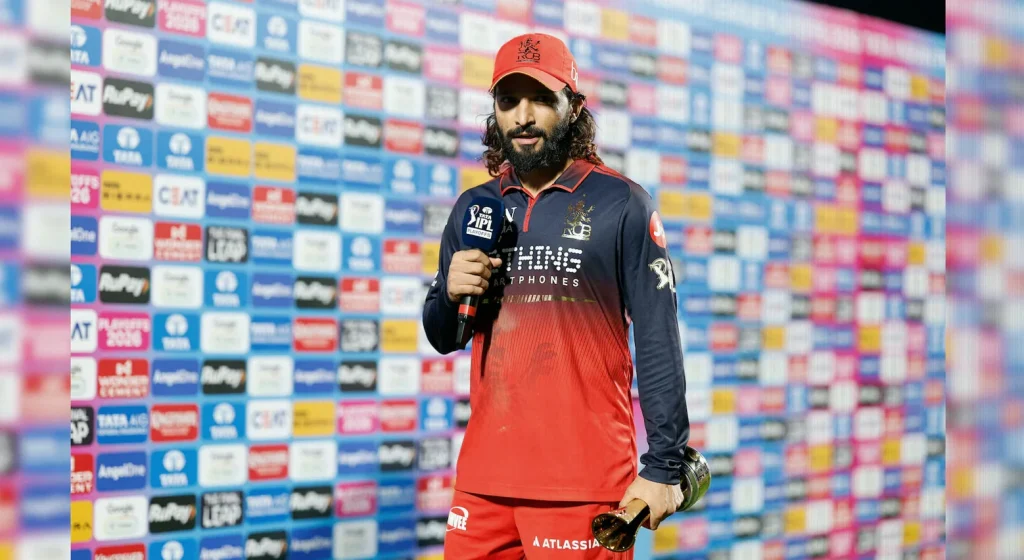
After Royal Challengers Bengaluru’s victory over Gujarat Titans, captain Rajat Patidar praised his batters for their fearless approach and said he enjoys the role of forcing bowlers to make difficult decisions—without letting the risk of his own wicket weigh on him. RCB’s run under Patidar has continued to delight its long-time supporters: the franchise finally lifted its first IPL trophy last year in Ahmedabad, ending a 17-year wait, and now it has reached its second straight final following a commanding 92-run win against GT.
Patidar led the charge with a brilliant unbeaten 93 off 33 deliveries, helping RCB post a formidable 254 for 5. Gujarat Titans never really looked set to chase the total, even with some resistance offered by Jos Buttler and Rahul Tewatia. The early damage was done by Jacob Duffy and Bhuvneshwar Kumar, who struck within the powerplay to remove the top three batters and disrupt GT’s momentum from the outset.
Speaking after the match, Patidar highlighted the importance of attacking intent and positive on-field body language, pointing out that it carried through the team’s batting. He said: “It was a super game for us, and especially the way the batsmen have dominated in this game—the way everyone was striking with intent, I think that was good for us. It is not a clear plan (to go after the GT bowlers), but I think we are ready for it because you have to show some body language that we are coming for you. So I think that was there in every batsman. So we had a chat in the meeting. We have to give a good body language and the attacking mindset. It was a big stage, qualifier 1, and the way we played, the way we dominated in this game, I think that was superb.”
Patidar is having what he described as a career-best season so far. He has scored 486 runs in 13 innings at an average of 44.18, striking at 196.76. His haul includes five fifties and 41 sixes, underlining how consistently he has been finishing innings with impact.
On his batting approach, Patidar explained that his rhythm resembles the rest of the RCB lineup. “I think the way of my batting is similar (to the rest of his team). I think starting, I take a few balls, 8-10 balls, to see how the wicket is behaving and what the ball is doing. And after that, I think I have a clear mind about how I have to go about it, and I am not worried about my wicket. I always like to put the bowler under pressure.”
He also noted that the pitch conditions were not straightforward, with bounce that allowed batters to get under the ball and still clear the boundary with long sixes. Patidar praised RCB’s bowlers as well, saying they were exceptional in their stump-to-stump execution.
Patidar added that the game plan, while not rigid, was rooted in removing GT’s key top-order batters early. “The way GT played till now, I think the three main batsmen were top three (Gill, Sudharsan and Buttler), and we were clear that we have to get them out in the powerplay, and hopefully it worked. I think it will be a good recovery and let us go for the finals,” he concluded.
RCB’s 254 for 5 was shaped by several blistering contributions, with Patidar’s unbeaten 93 off 33 balls anchoring the innings. Virat Kohli made 43 off 25 deliveries, striking through boundaries with five fours and one six, while Krunal Pandya added 43 off 28 balls, including five fours and two maximums.
In reply, GT’s chase unraveled quickly. Rahul Tewatia scored 68 off 43 balls, smashing eight fours and four sixes, and Jos Buttler made 29 off 11 with three fours and two sixes, but those were the only knocks above the 20-run mark. GT were eventually bowled out for 162.
Jacob Duffy finished with figures of 3/39, while Bhuvneshwar Kumar took 2/28 as both bowlers dismantled GT’s top order and ensured the chase only went one way—downward for the Titans.
The result extends RCB’s impressive finals record in the tournament. It is the fifth time the side has reached the IPL final, placing them third overall—behind Mumbai Indians, who have made six appearances and won five titles, and Chennai Super Kings, with 10 appearances and five title wins.
It was also one of the most decisive wins in IPL knockout history. RCB’s 92-run margin ranks as the second-biggest in knockout matches, behind Rajasthan Royals’ 105-run victory over Delhi Capitals in 2008.
