
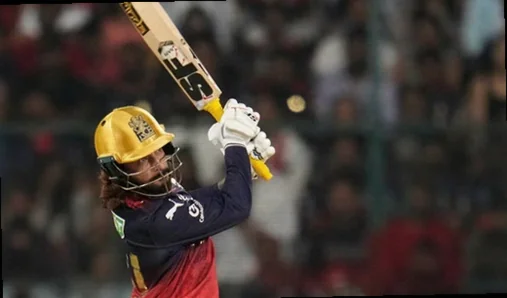
Rajat Patidar arrived at RCB’s clash with Lucknow Super Giants with his side already riding momentum in IPL 2026, while his own campaign was starting to look unmistakably defined. Against LSG, Virat Kohli naturally grabbed plenty of attention during the chase, but Patidar delivered the kind of innings that keeps RCB comfortably positioned in the upper half of the standings. The wider message from his season is becoming harder to ignore: he is consistently taking charge when the match is most prone to swing.
Quick facts
- Rajat Patidar has 222 runs in IPL 2026 from 104 balls across five matches, with a strike rate of 213.46 and an average of 55.5.
- Powerplay output: 4 runs from 7 balls.
- Overs 7–11: 53 runs off 30 balls.
- Overs 12–16: 144 runs off 58 balls (strike rate 248.28).
- Boundary count in five innings: 12 fours and 21 sixes (174 of 222 runs via boundaries; over 78% through fours and sixes).
- Runs by pace category: 86 off 37 vs pace, 67 off 32 vs medium pace, 69 off 35 vs spin.
- Match-by-match scores: 31 (vs SRH), 48 (vs CSK), 63 (vs RR), 53 (vs MI), 27 (vs LSG).
- Impact model: total final score of 402.28 across five matches, averaging 80.46 per game; Patidar has the highest captain score in the tournament so far as graded by the model.
His leadership at the crease isn’t about trying to dominate from the start in the traditional sense. In modern T20 cricket, the most valuable skill is knowing when to enter the most unstable stretch of an innings and then steering it toward your team’s needs. Patidar’s runs have carried that extra weight because he isn’t merely cashing in during safe phases; he is repeatedly arriving in the window where games are usually shaped or decided.
In practical terms, he has also avoided the role labels that often come with high strike rates. He is not opening, and he isn’t waiting for the slog end to assemble quick cameos. His rhythm starts once the field expands and the bowling side’s plans start to shift from containment to recovery—exactly when the middle overs begin to define the innings.
Where his season really turns on
The cleanest split of his output shows why his numbers are so persuasive. Patidar has managed only 4 runs from 7 balls in the powerplay, which immediately signals he isn’t approaching the tournament as a new-ball batter. His main work begins once overs 7–11 arrive, where he has made 53 runs off 30 deliveries.
Then comes the phase that sets the season alight. Between overs 12 and 16, Patidar has piled up 144 runs from 58 balls, striking at 248.28. For T20 sides, that middle portion is meant to be the tactical pause—where bowlers lean on spin, pace-off, and matchup planning to squeeze the rate. Patidar has repeatedly taken that exact zone and converted it into a launch corridor, denying the bowling side the chance to slow the tempo.
That’s what marks him out as a captain leading from the front. He isn’t only adding runs; he is attacking the tactical center of the opposition plan, accelerating through the overs where teams typically try to claw back momentum.
Boundaries that change the equation
Patidar’s boundary profile reinforces the same story. In five innings, he has struck 12 fours and 21 sixes. That means 174 of his 222 runs have come from boundaries, translating to more than 78% of his total output arriving via fours and sixes.
These figures don’t look like padding during periods of comfort. They suggest a batter determined to create damage quickly and repeatedly. Even more telling is the balance: he has hit significantly more sixes than fours, pointing to an aggressive target on the middle phase rather than just picking off gaps.
This matters for RCB because middle-order aggression often decides whether a good start becomes a match-winning total or remains a competitive but ordinary one. Patidar has repeatedly ensured that when RCB find themselves in a strong position, it doesn’t stay “good”—it becomes dangerous.
Not just a one-style batter
One easy way to dismiss an attacking middle-order season is to claim it is only built on success against spin. Patidar’s numbers don’t support that narrow reading. He has scored 86 runs off 37 balls against pace, 67 off 32 versus medium pace, and 69 off 35 against spin.
That spread suggests he doesn’t have a single comfort zone that he relies on. Yes, the middle overs remain his territory, but his effectiveness stretches across different bowling styles. The result is that his season carries more substance than matchup luck alone—his approach appears to be repeatable, not accidental.
It also explains why his innings hold value across changing match scenarios. When a batter can attack pace and spin alike, captains have fewer options to reshuffle the bowling plan to contain him. Once Patidar finds rhythm, he becomes difficult to fence in.
Impact across games, not a one-off spike
His influence shows up in the match-by-match sequence as well. Patidar has made 31 off 12 against SRH, 48 off 19 versus CSK, 63 off 40 against RR, 53 off 20 against MI, and 27 off 13 against LSG.
Each innings carried its own kind of value. The 53 off 20 against Mumbai Indians stands out as a statement knock, the type of innings that can turn an already strong position into something destructive. The 63 off 40 versus Rajasthan Royals looked different—more repair work and responsibility—because RCB had lost wickets and Patidar needed to rebuild before accelerating.
Against LSG, the contribution was shorter, but it still fit the central pattern of his season: arrive, add pace to the innings, keep it moving, and leave the team in control.
That’s why the captaincy dimension feels real rather than decorative. He hasn’t lived off one explosive fifty. Instead, he has repeatedly entered decisive moments and altered what the opposition could realistically execute next.
Also Read: Virat Kohli opens up on fitness after RCB vs LSG, reveals ‘soreness’ ahead of the game: ‘Still not 100 percent’
The impact model backs the eye test
Beyond the visible momentum swings, the impact calculation aligns with what Patidar has been doing in matches. Using the impact model, he has been credited with a total final score of 402.28 across five games, averaging 80.46 per match. The framework also includes a captaincy component, and Patidar has registered the highest captain score in the tournament so far as assessed by the model.
That outcome doesn’t read like chance. The system is essentially rewarding what the season already shows on the field: Patidar isn’t only producing runs, he is producing them in high-pressure, high-leverage situations, and doing it with a high tempo. That combination is often what separates a player who looks impressive on the scorecard from one who is strategically indispensable.
Zooming out, the conclusion becomes clear. Rajat Patidar has functioned as RCB’s dynamic, attacking captain in IPL 2026. He has owned the most volatile stretch of the innings, turned the middle overs into a scoring zone, and paired leadership responsibility with elite intent. His 222 runs matter, but the deeper story is the way those runs have arrived—at the exact point where a captain’s innings carries maximum influence.
How the impact is calculated
The impact total is not built from runs alone. First, the model creates a core performance score by combining batting, bowling, and fielding contributions. For Patidar, batting forms the vast majority of that number, with only small additions from fielding where relevant.
Next, a manual bonus layer is added. This component captures contextual match impact through a manual rating and ranking mechanism—rewarding innings that carry more weight in the flow of the game rather than simply topping the raw scorecard.
After that, the model includes a captaincy bonus. Since Patidar is leading RCB, the framework assigns a separate leadership-related score in each match.
In simple terms, the overall structure is: Final Score = Batting Score + Bowling Score + Fielding Score + Manual Bonus + Captaincy Bonus. That is how his season number reaches 402.28, with an average of 80.46 per match—an attempt to quantify influence. So far in IPL 2026, Patidar’s impact has clearly stretched beyond everyone else’s.
