
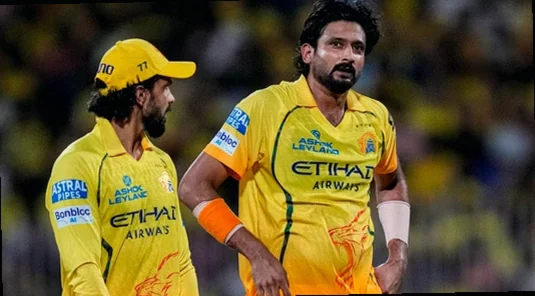
Intense summer heat and high humidity have been taking a toll on players across the Indian Premier League, with cramps forcing several batters and bowlers to stop mid-contest. Over the past week, teams have responded to these sudden fitness scares in markedly different ways, and the contrast has quickly become a talking point.
Quick facts
Heat, cramps and medical stoppages in focus
- Khaleel Ahmed was forced to pause late in the second innings during Chennai Super Kings’ win over Kolkata Knight Riders on Tuesday evening.
- Khaleel received initial treatment, tried to complete his over, then had to hobble off after further care was needed; Gurjapneet Singh finished the over.
- Ravi Shastri referenced a similar situation from the RCB vs MI match, calling out time lost through repeated medical intervention.
- In the Bengaluru bowling innings on Sunday night, seamer Rasikh Dar received treatment three separate times during a single over.
- Fans and commentators have criticised IPL pace of play, with matches frequently running beyond four hours.
- The RCB–MI game at Wankhede is cited as the longest regulation 40-over match in IPL history, lasting 4 hours 22 minutes and ending just before midnight.
- Sunil Gavaskar also criticised the repeated physio appearances during the RCB–MI match.
In CSK’s win over KKR on Tuesday evening, fast bowler Khaleel Ahmed appeared to tighten up late in the second innings. He received minor treatment at one stage and attempted to continue his run-up, but the discomfort worsened quickly enough that he had to stop mid-stride.
After that interruption, Khaleel hobbled off the field for additional treatment. Gurjapneet Singh then stepped in and completed the remainder of the over, keeping the innings moving despite the fitness scare.
Shastri draws a comparison on broadcast
Seeing Khaleel’s stoppage, Ravi Shastri—working on broadcast—couldn’t help but recall another incident from just a few days earlier involving RCB and MI. With the game already moving forward after Khaleel’s late exit, Shastri suggested that walking off rather than repeatedly delaying the restart made more sense.
“Rather than calling the physio and wasting 10 minutes, then doing the same thing again, he has decided to walk off,” Shastri said as Khaleel left the pitch, allowing play to continue.
Shastri’s point also highlighted a different rhythm from the Sunday night match in which Bengaluru’s bowling spell dragged on. During that segment, seamer Rasikh Dar required treatment three separate times across the course of a single over, turning what should have been a straightforward spell into a prolonged sequence of delays.
IPL duration and pace-of-play concerns
The Khaleel incident struck a nerve with fans and commentators because it sits within the broader debate over IPL pace of play. With many matches running for four hours or more, the sport’s scheduling and broadcast timing have come under increasing scrutiny.
The RCB–MI fixture at the Wankhede has been highlighted as the longest regulation 40-over match in IPL history, clocking a total duration of 4 hours 22 minutes and finishing just before midnight. While extra-time formats like super overs naturally extend contests, the discussion online has largely centred on the length of reviews and medical disruptions during regulation overs.
Social media buzz around the match also spread rapidly, with posts comparing its run-time to the duration of a popular Bollywood film. Lengthy reviews and multiple injury stoppages were central to the criticism, and even experienced voices on commentary were seen losing their patience.
Sunil Gavaskar, frustrated during the RCB–MI game, questioned the repeated nature of the physio entries. “Just go off the field, get treatment, and then come back… This is what, the third time the physio has come in. Are we going to see the same thing over and over again?” he said on air.
On Tuesday, Shastri’s sly reference to the earlier episode served as an echo of that frustration—underscoring that while injuries and cramps are part of the sport, the manner and timing of medical stoppages are increasingly shaping how the IPL is experienced by viewers.
