
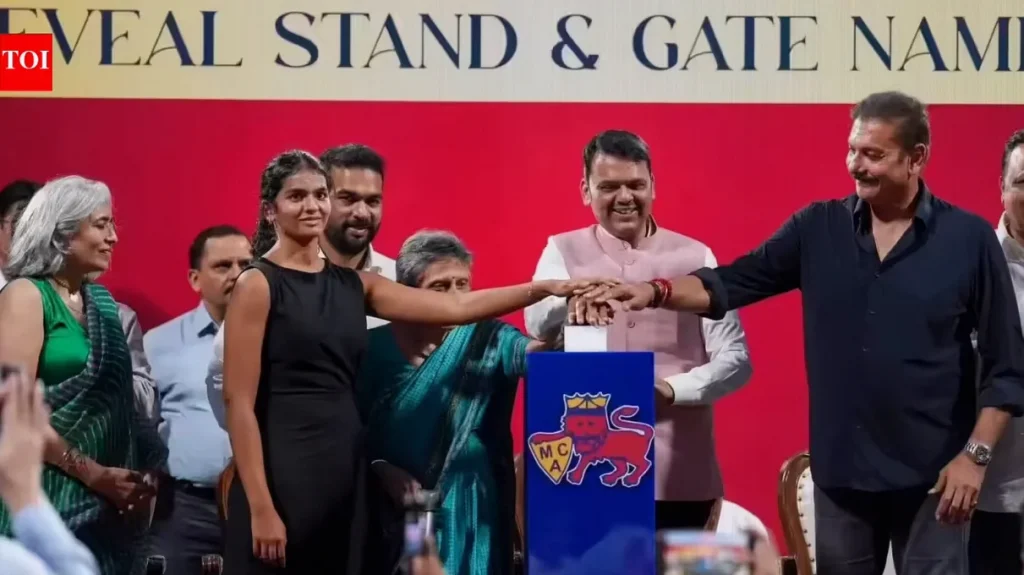
Mumbai: Ravi Shastri may have received recognition a little later than expected, but when it arrived, it did so in true grand style. On Thursday, the Mumbai Cricket Association (MCA) unveiled a memorial stand at Wankhede Stadium named in honour of the former India all-rounder, head coach and well-known commentator. The new stand, positioned directly beneath the media box, was formally opened in the presence of prominent figures from the cricketing world, including Suryakumar Yadav, the captain of the 2026 ICC T20 World Cup-winning side, along with former India leaders Sunil Gavaskar, Dilip Vengsarkar and Diana Edulji, as well as Shastri himself.
The programme also included the naming of gates at the venue after former India captain Diana Edulji, along with tributes to late cricket greats Dilip Sardesai and Eknath Solkar. Maharashtra chief minister Devendra Fadnavis, state minister Ashish Shelar and MCA president Ajinkya Naik attended the ceremony as well.
In his address, Shastri spoke passionately about the aggressive, never-say-die mindset that he said defined Mumbai cricket throughout his playing days. He highlighted the club’s deep sense of tradition and paid tribute to teammates and contemporaries who helped shape that culture. “With the MCA, you see history running through everything. And the two names I’ve brought up here—Sunny and Dilip, who played with me—you won’t find two larger cricketers than them,” he said. “Because we didn’t like losing. They were ‘khadoos’—tenacious—and so was I. Any side that came against us, no matter the standard, if they felt they had won, they would still have to go to two or three temples—or even five. And even then, they wouldn’t win until it was over. That was Mumbai cricket. That was the character of Mumbai cricket—and it showed up again and again over the years.”
Shastri also looked back fondly at his final first-class season, when he guided a young Mumbai team to the Ranji Trophy title in 1993-94. He said that one of the most cherished moments of his career came on that very ground. “One of the biggest games—or the happiest moments of my career—again came on this ground,” he recalled. “It was 1994, the Ranji Trophy final. We were playing Bengal… and we won the Ranji Trophy. What makes me proud even today is that many of those players went on to continue for another decade. One of them, Amol Muzumdar, later became the coach of the women’s team that won the World Cup,” he added.
Another highlight from Shastri’s memories came from the 1984-85 Ranji Trophy final against Delhi, where he made a decisive impact with the ball. He shared a detailed anecdote from that match. “One of the best stories I have at the Wankhede is about a Ranji Trophy final. On the fifth day, the secretary of the Delhi Cricket Association, Sunil Dev, announced Rs 10,000 for the Delhi team if they won the Ranji Trophy. Delhi needed another 140 or 150 runs to win, and they still had all their wickets intact. Chetan Chauhan was batting, I think with Manoj Prabhakar, and I was sitting in the dressing room. Right opposite me was Kiran Mukashi. Someone from the Delhi team—another World Cup-winning player, an India colleague of mine, Kirti Azad—walked past and said, ‘keep the trophy nice and polished.’ So I said, ‘okay.’ What happened the next day became history. We hammered Delhi and won the Ranji Trophy. We smashed Delhi. And when I passed by him, I told him, ‘the trophy is nice now—can you pass on that Rs 10,000 reward as well?’ Those are the memories,” Shastri said.
Turning to his early journey, Shastri spoke about his first visit to Wankhede as a spectator back in 1976, before later returning there as a player. He also referred to how his path rose through school and college cricket. He then recalled key milestones during his India career, including his Test debut against England in 1981 and memorable partnerships with Syed Kirmani and Vengsarkar. “So, the memories go on and on,” he said.
‘We’ll always celebrate cricket at Wankhede’
Fadnavis underlined the importance of Wankhede Stadium retaining its legendary identity even as plans for a new venue in Navi Mumbai continue. He said the city’s cricketing heritage would not be replaced by new infrastructure. “It doesn’t matter how many new stadia we create, Wankhede is still Wankhede. It will forever remain an iconic cricket stadium in Mumbai and we’ll always celebrate cricket at Wankhede. So we will always do our best to empower MCA and cricket,” he remarked.
Reiterating the need for a larger arena to host big occasions, Fadnavis added, “Everyone feels that Mumbai should host the big final, that’s why Mumbai needs a bigger stadium… I am sure we will come up with the best stadium in the country.”
Stay updated with the latest IPL Live Score, IPL news, the IPL Schedule, the IPL Points Table, and the race for the IPL Orange Cap and IPL Purple Cap.
