
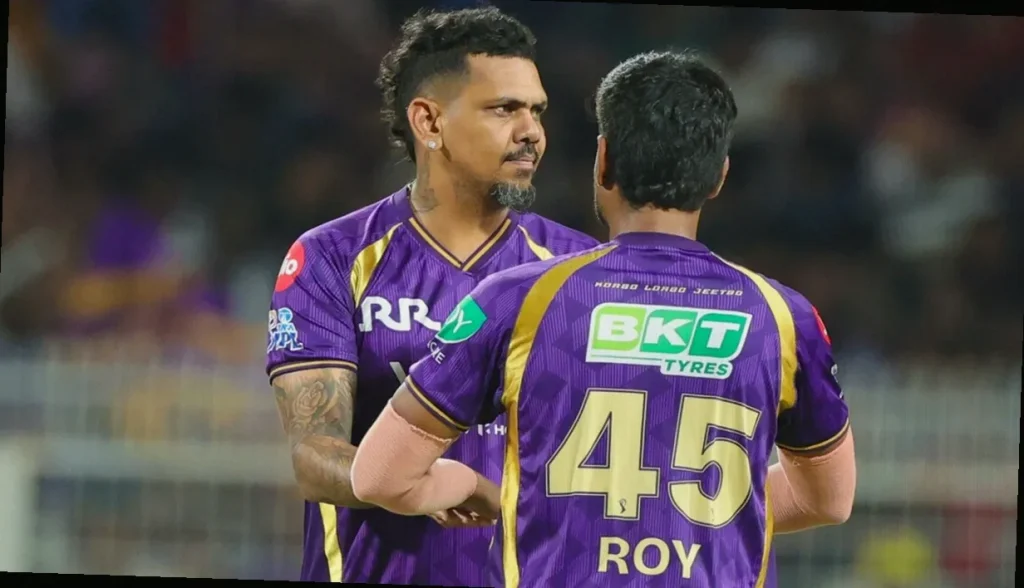
Ambati Rayudu has no hesitation in ranking Sunil Narine as the best IPL performer of all time. The Kolkata Knight Riders (KKR) stalwart’s case only grew stronger after the left-arm spinner delivered 2 wickets for 29 runs in his four overs against Gujarat Titans (GT), helping KKR secure a 29-run victory in IPL 2026. With Narine continuing to influence matches season after season, it’s hard to see why anyone would argue against his impact.
Speaking on ESPNcricinfo’s TimeOut show, Rayudu said Narine is “a proper match-winner” not only with the ball but also with the bat. After Narine was named Player of the Match for his 200th IPL appearance, Rayudu added that while many great names have graced the tournament, Narine always stands out and tops his personal list.
Sanjay Bangar, seated alongside Rayudu, was a touch less dramatic in his praise, but still placed Narine among the top five greatest IPL players. Bangar went further to call Narine “a legend of the league,” highlighting how longevity and adaptability have shaped his career.
Bangar noted that staying at the top for so long is a major factor. He also pointed out that Narine had faced repeated scrutiny over his action at various times, yet appeared to have found another way to continue delivering the same kind of overspin. Bangar stressed that Narine’s ability to make the ball turn in both directions creates persistent pressure on batters, and believes those traits are precisely why he has earned legend status in the competition.
Narine’s wicket tally underlines his standing: he sits behind Yuzvendra Chahal, who has 230 wickets, and Bhuvneshwar Kumar, on 220, as the third-highest wicket-taker in IPL history. Narine has taken 205 wickets in total.
He is also the most capped overseas player in the IPL, a one-franchise man who has represented KKR in every season since 2012. That year marked KKR’s first IPL title, and Narine contributed with 24 wickets at an economy rate of 5.47. When KKR lifted the trophy again in 2014, Narine returned to the forefront with 21 wickets, conceding at 6.35. A decade later, in 2024, as KKR won the title for a third time, Narine claimed 17 wickets at an economy rate of 6.69. In the current season, his figures stand at 6.79.
Throughout all those campaigns, Narine has never allowed his economy rate to move past the eight-runs-per-over threshold. That’s why the 7.25 he delivered on Saturday sounded, to Bangar, almost “regulation” for him. Bangar explained that these were normal numbers for Narine—he hasn’t been doing anything wildly out of the ordinary, just consistently executing what he is known for.
Bangar also recalled a conversation he had with Rayudu away from the microphones about Narine. In that discussion, Bangar said Rayudu questioned him—drawing on his own experience as a former batter for Mumbai Indians (MI) and Chennai Super Kings (CSK)—about the plan of action when those sides faced Narine. Rayudu’s combined experience against Narine’s style came across 175 matches over 12 seasons.
Bangar said Rayudu told him that he typically batted defensively against Narine, with singles and twos being the approach. However, Bangar also referenced how some batters have attempted to attack by using shots like slog-sweeps, or by looking to play through the off side off the back foot. Even so, Bangar felt that nobody has been able to dismantle Narine in the same way that certain other spinner threats have been neutralised in the IPL.
Bangar added that, in his view, Narine has been a revelation over the last 12 or 13 years—meaning that across Narine’s 15th year in IPL cricket, batters have not managed to dominate him in a sustained manner.
Rayudu further offered an explanation for why Narine often manages to thrive when other spinners struggle to stay consistent in a batter-dominated era. He pointed specifically to Rashid Khan as an example, noting that Rashid had returned figures of 0 for 57 on Saturday.
Rayudu said Rashid Khan faces a distinct challenge on certain surfaces, particularly those where the ball behaves like a top-spinner. On such pitches, Rayudu explained, the ball tends to come quickly onto the bat. With Sunil Narine, though, Rayudu believes the ball seems to grip and hold on the pitch after pitching, and it doesn’t skid onto the bat in the way batters expect.
That difference, Rayudu argued, makes Narine harder to line up against. As a batter, Rayudu said, it becomes difficult to maintain shape because the ball holds its characteristics for longer, which often disrupts timing and footwork more than many other deliveries do.
