
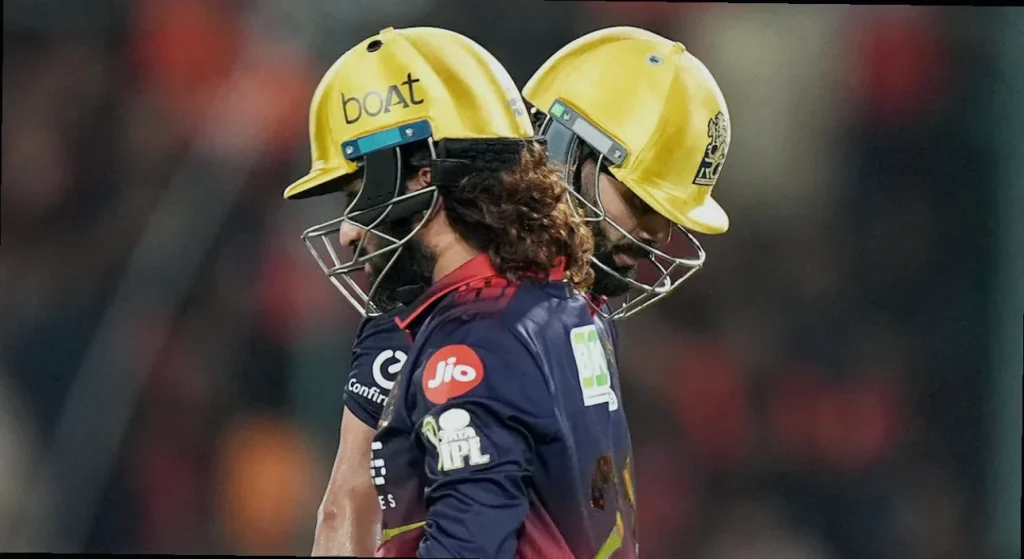
Mo Bobat, the director of cricket at Royal Challengers Bengaluru, summed up last year’s emotional title celebration with a simple instruction: “Let’s be like the hunters.” The message was meant to cut through the weight of finally breaking through—and, with RCB now on the brink of another IPL final, Bobat says the words have only grown louder with time.
Eleven months on, RCB are again close to a championship decider, and Bobat has had a chance to revisit the meaning behind that line from the Royal Challengers Bengaluru Labs Innovation Summit last week.
“Because it was such a long wait for us to win that first title, I didn’t want it to feel like we had climbed our Everest,” Bobat said. “I want us to feel like we’re not clinging on to anything. We wanted to just keep climbing, keep hunting.”
As RCB regrouped for the next phase, Bobat also posed a challenge to the group: “Why can’t we be the third team to do it?”
Only two franchises in IPL history have managed to defend their crown—Chennai Super Kings in 2010-11 and Mumbai Indians in 2019-20—and Bobat’s point was clear: RCB can chase that same standard rather than treating back-to-back dreams as a fairytale.
From early doubts to a repeat-title blueprint
The confidence behind RCB’s push for consecutive titles did not arrive instantly. It traces back to the back half of IPL 2024, when Bobat and Andy Flower began working together for the first time as a pair.
Flower joined with an outstanding record in T20 coaching and the experience to reshape a side quickly. He had received better offers elsewhere, but the chance to help RCB achieve something they had never managed drew him in. Yet the early signs were far from smooth: eight games into that first joint season, RCB sat at the bottom of the table with just one win from their first eight matches.
RCB’s leadership later described that stretch as a moment when doubt became unavoidable. CEO Rajesh Menon recalled the internal questions: “There were questions asked—do we have the right team, do we have the right staff. I said the culture is good. The players are good. It’s just a matter of time.”
That patience turned into action. RCB then won six matches in a row to reach the playoffs, and while their campaign ended in the Eliminator, the side left that season with a clearer identity than the one they carried at the start.
Bobat pointed to a cultural shift as the foundation. “One of the first things that struck me when I got involved with RCB was a phrase used about the England football team—the shirt weighs heavy,” he explained. “One of the key tasks was really unburdening them as much as you can, taking that weight off them.
“Instead of thinking, ‘when are we going to win this?’, the narrative changed to: ‘why not us?’ My obsession has just been around how we want to play our cricket. If you can immerse yourself in that, you trust success will become inevitable.”
****
How RCB built a batting template—and changed Kohli’s role
RCB’s mid-season transformation in IPL 2024 began after a brutal defeat. After being hammered for 287 by Sunrisers Hyderabad (SRH), they responded by posting 262, and Bobat and Flower immediately recognised a new batting direction.
It was a plan that required buy-in from their senior icon, and Virat Kohli’s acceptance was not seen as difficult once the intent was clear.
During the opening half of IPL 2024, Kohli still operated largely as a traditional anchor. From the SRH game onwards, he deliberately swapped comfort for greater impact, lifting his strike rate from 141 across RCB’s first six matches to 166 during the remainder of the tournament—an indicator of the batting identity RCB would come to rely on.
Last season, Kohli finished with 657 runs at a strike rate just under 150. This year, he has amassed 557 runs at close to 164, which stands as his best strike rate across an IPL season. Just as important, RCB have won each of the seven matches in which Kohli has batted beyond the powerplay.
Padikkal’s aggressive evolution
Kohli’s reinvention spread through the batting group, and Devdutt Padikkal has become one of the clearest expressions of that shift—especially in the No. 3 position.
At the mega auction in November 2024, RCB brought Padikkal back. He was coming off a difficult spell with Lucknow Super Giants (LSG), where he managed 38 runs in seven innings, and he admitted he was unsure whether franchises still viewed him as a serious T20 option.
At that time, many viewed him as a backup. RCB had chased Venkatesh Iyer up to INR 23 crore, only for Kolkata Knight Riders (KKR) to pip them for his signature. In hindsight, missing out on that deal helped shape the eventual squad RCB have today.
For roughly the same amount they had prepared to spend on one player, RCB instead secured Josh Hazlewood (INR 12.50 crore), Bhuvneshwar Kumar (INR 10.75 crore) and Padikkal (INR 2 crore). Those additions have since become central to their plans.
Before the 2025 season, RCB saw Padikkal as a left-hand batter who could strike from the start. “That has been the role for the last two years,” he said. “I have to continue the momentum in the powerplay. You cannot afford to slow down after a wicket.”
After striking at only 123 across his IPL career before 2025, Padikkal leaned into a far more aggressive role last season, scoring at over 150 before injury ended his campaign. This year, he made another step forward: he has scored 433 runs at a strike rate touching 172—his most influential IPL season yet.
Padikkal credited the team management’s belief and the off-season groundwork with Dinesh Karthik, their batting mentor, for accelerating his growth as a T20 batter. “Because it’s such a major shift, it’s very easy to accept maybe that’s not your game,” he said. “But the conversations were mainly about them giving me the belief that I’m capable of doing that. I’m not really trying to focus on strike rate. It’s about making sure I have that intent from ball one.”
Salt and Patidar’s roles, and the captaincy-free style
RCB’s other top-order batters, Phil Salt and Rajat Patidar, already held similar task definitions. Salt had delivered strongly during KKR’s title run in 2024, and Patidar was earmarked as the spin-destroyer.
Still, there was a question around Patidar: could he keep performing exactly how RCB needed without the burden of leadership weighing on him? IPL 2025 offered some answers, but this season has confirmed the direction. He has nearly 400 runs this season at a strike rate of 184.
Bobat contrasted Patidar’s approach with the habits of his predecessor, Faf du Plessis, who had been deeply involved in almost every aspect—from auction planning to the team’s culture. Patidar, in comparison, leads differently.
“Rajat’s quite a unique character,” Bobat said. “I don’t know anyone quite like him.”
Bobat described Patidar as more trusting and less hands-on away from the field. Instead of trying to manage everything, he prefers to focus almost entirely on cricket—tactics, bowling changes and in-game decision-making.
“He wants to have an input on the team that takes the field,” Bobat said, “and then he thinks that when he crosses the line, that’s when his job starts.”
That trust has become a defining feature of RCB’s current structure: Patidar backs the management to build the environment around him, and the management backs Patidar to control the contest once the match begins.
“He’s got a stronger sense [now] of how he wants the team to play,” Bobat said. “He is certainly becoming an even better decision-maker out in the middle when it comes to tactics and bowling changes.”
Support around Patidar: Jitesh, Krunal and match-winning moments
RCB have also strengthened their backing cast around Patidar. Jitesh Sharma has emerged as a reliable sounding board and deputy, while Krunal Pandya has contributed across phases with both bat and ball.
The most memorable impact came through Krunal’s match-winning 73 in this season, where he battled cramps and exhaustion against MI in Raipur.
Krunal was one of RCB’s standout match-winners in 2025, and the version seen in 2026 represents a further upgrade, shaped by his sharper use of variations, bouncers and effective work across multiple phases.
Since the start of IPL 2025, no left-arm finger spinner has bowled as many deliveries to left-hand batters as Krunal has—or taken more wickets against them. Alongside that workload, his economy has stayed below 10. His victims include Priyansh Arya, Venkatesh Iyer, Rinku Singh, Vaibhav Sooryavanshi and Shimron Hetmyer.
Meanwhile, Bhuvneshwar Kumar—who had once hurt RCB in the 2016 final while playing for SRH—is now their bowling leader. His performances this season have even revived discussion of an India return at the age of 36.
****
Culture changes, auction logic, and building balance
Bobat said much of this turnaround is rooted in culture.
“When an organisation hasn’t achieved its main goal for 17 years, you have to ask why,” he noted. “And you have to have the humility to look at your own failings.
“RCB had a history of always having a small number of icon players, and the performance of the team was kind of contingent on those few players doing well. We wanted to have a more even distribution of talent, even distribution of experience, to give ourselves a better chance of having a championship-winning team.”
This thinking was clearly reflected in how RCB approached auctions.
While teams such as MI, CSK and SRH locked away close to INR 75 crore by retaining established match-winners ahead of the IPL 2025 mega auction, RCB opted for a partial reset. They retained only two match-winners—Kohli and Patidar—for a combined INR 32 crore (Yash Dayal was the third retained player), giving them flexibility that others did not have.
Their four biggest signings—Josh Hazlewood (INR 12.50 crore), Salt (INR 11.50 crore), Jitesh (INR 11 crore) and Bhuvneshwar (INR 10.75 crore)—totalled INR 45.75 crore. Even after that, RCB still had room to add proven performers such as Krunal, Tim David and Padikkal.
In earlier cycles, RCB often looked top-heavy, with a few star names supported by back-ups who carried less experience. In 2025 and with IPL 2026 also in mind, they focused on spreading proven quality across the playing group. They also eventually secured Venkatesh as a back-up batter for INR 7 crore—slightly less than what they were willing to spend on him back in 2025.
Venkatesh’s impact and RCB’s ability to absorb changes
Venkatesh spent substantial parts of IPL 2026 outside the XI because RCB did not disrupt a settled combination. He first appeared as an impact player twice early in the season, but he had to wait until the 13th match to make his heavier contribution.
When Patidar was sidelined with injury, Venkatesh took the moment and produced an unbeaten 73 off 40 balls in RCB’s 23-run win over Punjab Kings (PBKS).
Then, in the final league fixture, Venkatesh moved into the top order after Jacob Bethell was injured, scoring 44 off 19 balls in RCB’s chase of 256. RCB did not even go for the full chase target, instead prioritising net run-rate to finish at the summit of the table.
“RCB is the champion side,” Venkatesh said. “We’re defending champions. So to tinker with a combination that has won you a championship is not always the smartest move. As someone who places the team above everything else, it’s my duty to adhere to the environment.”
Even while waiting for opportunities, Venkatesh said the management ensured transparency around what was expected and what his role would be. “Mo, Andy and DK have been amazing when it comes to conversations about what my role in the team is. They’ve given me absolute clarity.”
That clarity, Bobat suggested, helps RCB absorb late adjustments when circumstances demand it.
One example was RCB withdrawing Dayal from this season due to legal issues. Dayal had been a key part of RCB’s three-pronged pace attack during their title triumph, but with his contract retained, RCB effectively operated with fewer resources than usual.
His absence—combined with Hazlewood missing the early games—could have posed difficulties. Instead, RCB’s auction pick Jacob Duffy stepped in for Hazlewood and, in his debut match, claimed 3 for 22 against SRH to be named Player of the Match.
Duffy has not featured in every game since Hazlewood’s arrival, but his use has been tactical. A case in point was the league match in Dharamsala against PBKS, where pace and a hit-the-deck approach have historically carried more weight than spin.
In a similar manner, Rasikh Salam—previously identified as Dayal’s back-up last year—has played 10 matches this season and already surpassed Dayal’s wicket tally from the previous year. RCB invested in Salam’s training camps, and Krunal even supported a move for him from Jammu & Kashmir to Baroda to open up more opportunities.
Rewriting the home advantage myth
Flexibility has not only shown up in personnel and tactics. Over two seasons, RCB also had to challenge one of the oldest assumptions in IPL: that sustained success is impossible without dominating at home.
Last season, RCB won just two matches at home but were exceptional on the road, winning nine times away from Bengaluru. This year brought a different problem—scheduling changes reduced the number of league games at the Chinnaswamy to five, with two fixtures labelled “home” moved to Raipur, a venue that had not hosted IPL action since 2015.
Before the meeting with MI, RCB travelled directly from a flight, while MI had already trained twice in Raipur. RCB went as far as studying scorecards from the Chhattisgarh Premier League to understand how surfaces behave.
Bobat admitted that when he first joined RCB, he viewed the Chinnaswamy as merely a high-scoring ground where teams “fill their boots.” It took time to realise that home advantage had often escaped RCB.
“A lot of people said if you’re not dominant at home, you won’t win the IPL,” he said. “Part of me thought, well, let’s just win all our away games then.”
In many ways, that became the message. RCB stopped obsessing over where the wins were coming from and instead focused on getting on top of conditions quickly, adapting better, and carrying a squad capable of winning in different ways.
“You’ve got to be humble enough to know when you’re not doing well,” Bobat said. “We weren’t playing well enough at home initially. But because we were honest in how we reviewed things, we worked out how we wanted to bowl here, what type of bowlers succeed here and how we wanted to bat.
“The results have followed. RCB have won six of their seven home games this season—including the two in Raipur—while continuing to adapt in unfamiliar surroundings like Dharamsala, with the Himalayas towering in the distance and Mt Everest geographically closer than it had been in Bengaluru.”
When teams spend a generation waiting for a title, they often treat the first taste of glory as the finish line. Almost a year later, the hunters are clearly still hungry for more.
