
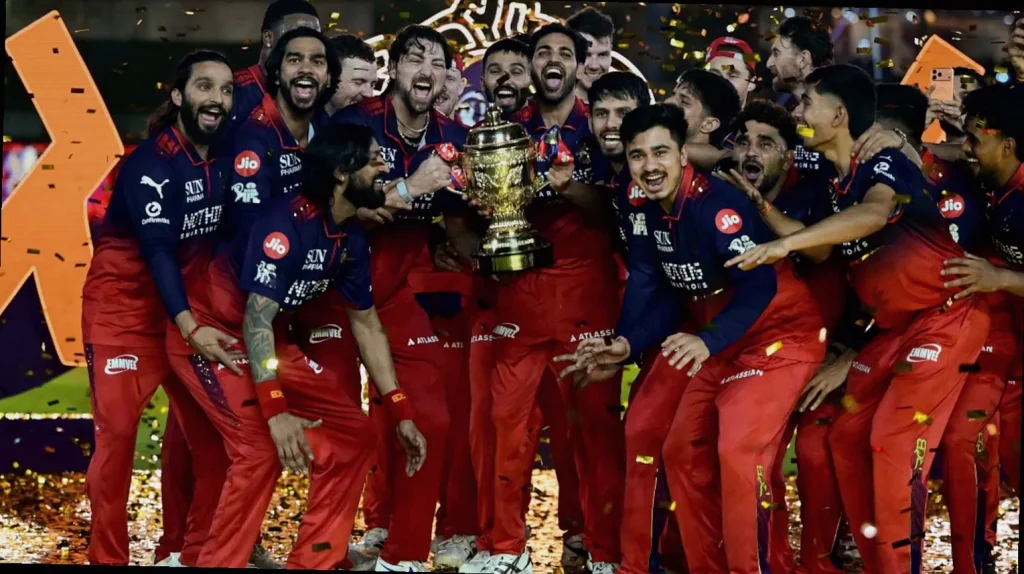
Royal Challengers Bengaluru’s squad and support staff are expected to break ranks and head to their respective homes and holiday plans from Ahmedabad, rather than returning straight to Bengaluru, even after winning the Indian Premier League title for the second year in a row. Speaking in a virtual media interaction on Monday, RCB’s Director of Cricket Mo Bobat said the celebration will be stretched a little longer as players manage travel and personal commitments.
“First of all, I don’t think any of us are going to Bangalore, unfortunately. I’m traveling back to the UK tomorrow. Rajat, I’m sure, will be heading home to his family and I think Andy’s got a holiday planned,” Bobat said. He added that the franchise will wait a bit before reuniting with fans and sharing the joy of the championship moment.
Quick facts
- RCB players and support staff will disperse from Ahmedabad and not return immediately to Bengaluru to celebrate.
- Mo Bobat highlighted travel and holiday plans, including himself heading to the UK.
- Bobat and skipper Rajat Patidar credited a balanced data-and-analytics approach, with Freddie Wilde as lead analyst, for the turnaround since 2025.
- RCB became the third IPL franchise to win back-to-back titles, after being long seen as underachievers.
- Flower pointed to data-led work as a driver behind Patidar’s development into a more aggressive pace hitter.
With the championship high still present, Bobat and captain Rajat Patidar stressed that RCB’s method—combining analytics with cricket judgment—has been central to their transformation since 2025. They said the franchise’s evolution was not driven by one flashy recruitment or a sudden overhaul, but by a structured, evidence-led way of building the team and preparing for matches.
For a long stretch, RCB were often branded the league’s most prominent “nearly” outfit: a side loaded with talent that repeatedly fell short when it mattered most. That storyline has changed dramatically since 2025, when the franchise shifted into a rare bracket by becoming only the third team in IPL history to secure consecutive league titles.
Bobat said the change at RCB has been rooted in how decisions are made—especially under his oversight, alongside lead analyst Freddie Wilde, head coach Andy Flower, and batting coach-cum-mentor Dinesh Karthik. In that framework, data and analytics have moved to the heart of how the franchise operates, helping them shed the “nearly men” label that haunted them for years.
He also clarified that the culture isn’t about worshipping numbers. “In terms of the sort of data-related questions, both Andy and I are very similar in our views in that we don’t overly focus on data,” Bobat said. He argued that while elite sport is filled with analytics discussions, what matters most is making decisions with evidence to support them.
According to Bobat, the franchise values judgment just as much as information. “We really value and we recognize the importance of our judgment as decision makers,” he said, adding that their choices affect players’ careers, ambitions, and livelihoods—so those decisions must be made with discipline and rigour.
Bobat described the approach as balanced and philosophical: evidence can come through objective numbers, but it should also incorporate what experienced people observe on the ground. He said expert eyes and ears—along with context—turn data into a fuller picture, enabling “evidence-based decisions” rather than relying on one narrow lens.
He further explained that the team’s working style blends data-informed insights with instinct. “So very balanced view in our sort of ways of working,” Bobat said, noting that Patidar’s experience as captain is expected to connect with these insights—pairing analytics with “gut feel and intuition.”
Bobat said Dinesh Karthik was brought into the setup partly because of his tactical awareness. “A part of the reason why we engaged DK… is that he has a very active tactical mind,” he added, suggesting the franchise can learn from his experiences and perspective in addition to the numbers.
Why Freddie Wilde is central to the shift
Wilde, who now works as lead analyst for Desert Vipers in ILT20 and London Spirit in The Hundred, previously had a role with the England men’s team. He also came into wider attention after contributing a chapter to the book “Cricket 2.0: Inside the T20 Revolution,” titled “Why CSK win and why RCB lose.”
Bobat said Wilde’s impact has been tangible in reshaping RCB’s fortunes. He praised Wilde’s ability to move between analyst thinking and the way coaches operate, calling it a useful overlap. “We’ve worked with Freddie for a few years now,” Bobat said, adding that Wilde can communicate effectively with players and groups in a way that not all analysts are positioned to do.
He also credited Wilde’s practical mindset, pointing out that the numbers do not always provide the full story. Bobat said Wilde understands the subjectivity and context that can shape analytics, and that his contributions are especially important in squad-building and auction planning—areas where RCB invests significant preparation time.
As the season progresses, Bobat said RCB runs a rigorous planning and review process, with Wilde leading a large part of the work alongside Flower. “He’s been excellent and a real value add for the franchise,” Bobat said, describing Wilde as helping across multiple levels for players, support staff, and coaches. The headline, he insisted, is balance: “the human and the machine” both matter in RCB’s process.
Flower, who has added another IPL title to his collection of winning franchise T20 trophies as head coach, offered a glimpse of how data support helped Patidar evolve into a sharper, more ferocious pace hitter during the tournament. “I’m not going to answer anything, but I really want to hear Rajat’s answer about the use of data,” Flower said.
Cricket-21 statistics were cited to show that Patidar has emerged as one of the most damaging batters against pace in IPL 2026. The numbers were described as a notable jump from the previous season, with Patidar’s 2025 record against pacers reading as 190 runs in 13 innings, at an average of 23.8 and a strike rate of 143. In that stretch he hit six sixes and posted a boundary percentage of 58.9, while his boundary per ball (BPB) ratio sat at 5.3.
In 2026, the improvement was framed as emphatic. Over the same number of innings, Patidar reportedly scored 377 runs against pacers, averaging 62.8 with a strike rate of 189. He cleared the boundary ropes 28 times, with BPB improving to 3.6 and boundary percentage rising to 73.2. Patidar credited Wilde’s expertise for helping him sharpen his batting versus pacers, while also retaining his ability to take on spinners.
Patidar then gave a personal account of how Wilde’s work translated into his preparation. “To be honest, it was beautifully explained by Mo regarding Freddie,” he said. Patidar added that on several occasions in the IPL, he had called Wilde and asked for video material focused on specific bowlers—especially spinners such as Rashid Khan, Sunil Narine, and Varun Chakaravarthy—where the key challenge is picking the ball out of the hand.
He explained that there were moments when he struggled to read those deliveries from footage. “So I called Freddie by saying… ‘Freddie, please help me. What’s the difference in these bowlers who are bowling two or three deliveries, or different deliveries and from where I can pick him?’” Patidar said. He credited Wilde for breaking down the differences and helping him understand what to look for.
Patidar said people often label him as a spin basher, but he believes his preference is to play fast bowling. Still, when it comes to spin and learning to pick up bowlers from their hands, he gave the credit to Wilde for helping him a lot. “So people always used to say to me that Rajat is a spin basher… the credit goes to Freddie,” Patidar concluded.
