
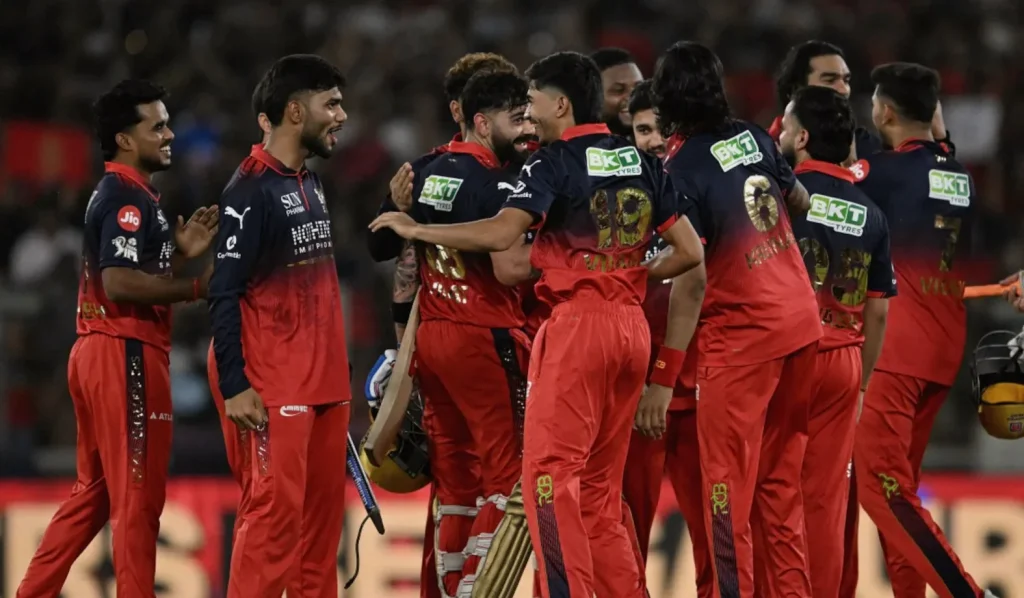
Royal Challengers Bengaluru again showed the kind of ruthless rhythm that defines title contenders, while Gujarat Titans proved their ability to stay in the playoff mix with startling consistency. At the other end, Mumbai Indians’ disappointing campaign and Lucknow Super Giants’ underwhelming run signalled that the IPL’s 2026 cycle was already beginning to reshape itself even before the 2026 season had fully closed. In a format where outcomes can swing on a single over, the league stage delivered that familiar reminder that no team is ever safe from an upset. Play-off places were finally decided on the last day, with RCB, Gujarat Titans and Sunrisers Hyderabad already through beforehand. Rajasthan Royals, however, secured the fourth spot by beating Mumbai Indians on May 24, and their win also knocked Punjab Kings out on the final day in a season that produced plenty of twists right to the end.
Royal Challengers Bengaluru: Champions’ mindset, not just champions’ results
For a franchise that had waited 18 years for an IPL trophy, this season felt like the continuation of a new identity built after last year’s breakthrough. Under the guidance of Andy Flower and Mo Bobat, RCB assembled a squad capable of delivering week after week, and they translated that strength into performances that looked increasingly complete. If there’s one wish the franchise can reasonably hold onto, it’s that the major reshuffle at the auction table doesn’t arrive soon—because many of their players appear to be leveling up with each passing campaign.
RCB’s intent this season wasn’t about defending a title; it was about chasing another one with bold, aggressive decision-making. Virat Kohli kept adjusting his game even in the later stages of his career, finding ways to stay competitive against “the super young.” Bhuvneshwar Kumar, meanwhile, looked like he’d stepped back into his prime with a high-impact display featuring “wobbly seam” movement, a description famously echoed by Sachin Tendulkar. Josh Hazlewood added extra bite in the latter part of the tournament, while Krunal Pandya offered a surprise element through his variations as RCB chased a fifth title ambition of their own. Rasikh Dar also came into his own as the season progressed.
There was also an evolution in the batting. Devdutt Padikkal made clear adjustments to his usually more traditional approach to match the demands of modern T20. Captain Rajat Patidar forced national selectors to pay closer attention after producing match-winning contributions when it mattered most. Venkatesh Iyer was brought in as the impact player late in the tournament and still delivered when called upon, leaving RCB looking like the most rounded side in the competition—playing like a unit, not a collection of stars.
Gujarat Titans, Sunrisers Hyderabad and Rajasthan Royals: Consistency, brilliance and dependence
While RCB have made winning feel routine, Gujarat Titans have built a reputation for reliability in their relatively short IPL journey. They reached three finals in just five attempts, including the triumph in their debut season. At the top, Shubman Gill, Sai Sudharsan and Jos Buttler kept piling on runs, giving the team a platform that made their chase and set totals far more effective. When those rare moments didn’t go their way, their middle order didn’t always inspire the same level of confidence—an area Titans are expected to revisit at the next auction.
Their bowling, widely viewed as among the best in the tournament, still couldn’t carry them past the final hurdle. The prevailing view is that Titans may not have enough of a “Plan B” when their superb top order and the new-ball bowlers are off target at the same time. That scenario seldom appeared across the season, but when it did, they struggled to recover and couldn’t find a route back into the contest.
Sunrisers Hyderabad, led by Pat Cummins, didn’t do much wrong over the course of the campaign after a slow start. Their exit in the Eliminator came down to the individual brilliance of Vaibhav Sooryavanshi and Jofra Archer, who outshone SRH at a crucial moment. Among the positives was the growth of pacers such as Praful Hinge and Sakib Hussain, adding depth to their bowling options. Nitish Reddy, after a disappointing previous season, contributed in timely bursts with both bat and ball.
SRH’s destructive top order—featuring Abhishek Sharma, Travis Head and Ishan Kishan—was again central to many of their innings, even though the Australian’s output didn’t match the high standards he typically sets for himself. Heinrich Klaasen at number four stood out as the best batter of his long IPL career, finishing with 624 runs at a strike rate of 160. The broader pattern was clear: SRH performed strongly on flat tracks, yet their results suffered when they travelled beyond Hyderabad.
Rajasthan Royals’ qualification came later than many expected, and captain Riyan Parag himself admitted the team should have booked a playoff berth earlier than the final day of the league stage. Their season was heavily linked to the impact of Vaibhav Sooryavanshi, a 15-year-old sensation who ended up as the leading run-scorer in his first full season, tallying 776 runs at an astonishing strike rate of 237.30. Archer also featured among the top wicket-takers with 25 scalps, providing regular breakthroughs during his opening burst.
When Sooryavanshi and Archer didn’t fire together, Rajasthan had difficulty finding the same level of control. Dhruv Jurel had a phenomenal year as a batter, while Yash Raj Punja emerged as their leading spin option ahead of Ravi Bishnoi. Sam Curran was absent due to injury, which added another layer to their challenges. Parag did manage to reach the playoffs in his first season as captain, but his batting wasn’t consistent enough to carry the team across every stretch. Off the field, the campaign also saw headlines: team manager Romi Bhinder was fined Rs one lakh for using a cellphone in the dugout, and Parag was caught vaping in the dressing room on national television.
Punjab Kings, a side that looked like the most dominant outfit during the opening half of the IPL, somehow squandered their playoff chances after the middle point, losing six games in a row. Their batting form initially masked issues in the bowling unit, but as the season moved forward, their dip spread across all three departments, including the fielding. Captain Shreyas Iyer had a decent season with the bat, yet the team will likely need to strengthen its bowling at the auction. Arshdeep Singh’s up-and-down performances also hurt the overall balance.
Delhi Capitals failed to reach the play-offs for the second season in succession under Axar Patel. KL Rahul again produced a 500-plus run haul, though it ultimately carried limited weight in the standings when the team couldn’t convert totals into deeper tournament progress. The squad lacked batting firepower and included too many players who were effectively one-dimensional. On the bowling side, the unit didn’t have the potency required, and the problem was compounded by the absence of Mitchell Starc during the first half of the competition. Kuldeep Yadav had a season to forget, while Lungi Ngidi, despite being in form, couldn’t do enough on his own. DC are among the franchises expected to reconsider their leadership direction going forward.
Kolkata Knight Riders finished seventh out of 10 teams after losing their first six matches. There remains a strong possibility that Ajinkya Rahane has played his last IPL season. The team struggled across departments and is expected to undergo a major reshuffle. Cameron Green also couldn’t justify expectations after being bought for a record Rs 25.20 crore at the auction, as the campaign never quite came together.
Chennai Super Kings, five-time champions, didn’t reach the play-offs for the first time since the title run that began in 2023. Ruturaj Gaikwad’s side needs a change in approach, starting with clarity around MS Dhoni. Dhoni didn’t play a single match this season due to an injury, but what comes next is known only to him. With Hardik Pandya reportedly set to leave Mumbai Indians, CSK could consider bringing him in for a leadership role. Another option on the table is Sanju Samson, who would be a ready captaincy choice if the franchise decides to go down that path.
Mumbai Indians had their most disappointing season in this cycle, despite being a team packed with India-level talent. Jasprit Bumrah, Hardik Pandya, Suryakumar Yadav and Tilak Verma all endured a campaign to forget, while Rohit Sharma managed a respectable season at the top, even though his overall output was affected by injury. Throughout the tournament, there were murmurs of division within the leadership group, with Hardik left to fight the battles largely on his own. What happens next season—especially who is chosen for captaincy by the team management and owner—remains unclear, though Bumrah, one of the most accomplished members of the squad, could be a natural candidate.
For Lucknow Super Giants, preparations for next year were already underway after captain Rishabh Pant stepped down following two forgettable seasons. Their batting collapsed badly in the first half, although the bowling—led by Mohammed Shami, Mohsin Khan and Prince Yadav—impressed. Mohsin was the only bowler to deliver an unprecedented maiden over to Sooryavanshi, highlighting how bright spots existed even in a struggling campaign. In the second half, bowling standards dropped and the batting never found rhythm in unison. Pant again had an ordinary season, and Nicholas Pooran was disappointing at best. Justin Langer and Tom Moody, along with Sanjiv Goenka, are expected to enter “captain shopping” during the mini-auction at the end of this year as part of a broader overhaul.
