
New Delhi: For years, Royal Challengers Bengaluru carried the aura of Indian cricket’s most enduring romantics. They could draw crowds with ease, they could light up nights with star talent, and they could manufacture moments that felt larger than the sport itself. Yet the one thing supporters kept chasing was the trophy. RCB reached the IPL final in 2009, 2011 and 2016, only to watch the finish line move away at the last hurdle. For nearly two decades, fans lived with the strange mix of belief and frustration—watching squads built around icons such as Chris Gayle and Virat Kohli come agonisingly close, again and again, before the title slipped out of reach. In that era, the franchise often stood for promise rather than achievement, for passion rather than silverware. Which is why what has unfolded in the last three years has felt so different.
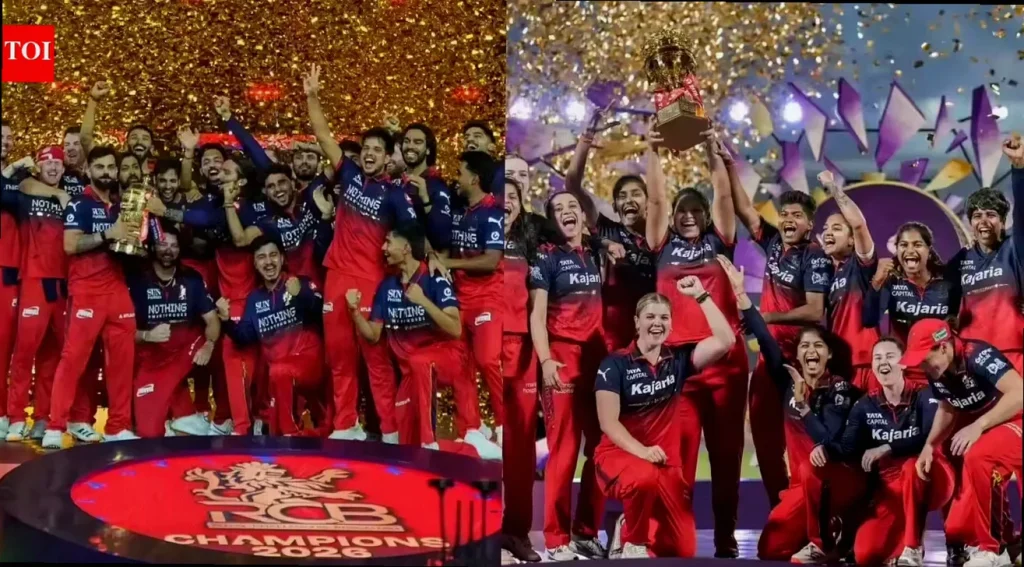
With the IPL 2026 crown secured in Ahmedabad on Sunday, RCB have now captured back-to-back titles. The turnaround did not begin and end with the men’s team, either. Their women’s side has also played a defining role in reshaping the franchise’s identity, delivering the 2024 Women’s Premier League (WPL) title under Smriti Mandhana’s leadership. That success helped the franchise add two trophies in three years when the women sealed their campaign in February. By May 31, the same organisation that once carried the weight of underachievement now finds itself sitting at the top of both of India’s leading T20 competitions.
This change has not been sudden. It has been deliberate, almost structural. The older RCB often looked like a group assembled around big names and bigger reputations. The newer RCB, in contrast, resembles a side constructed around planning—clear roles, smarter recruitment, and a clearer sense of how every player fits into the bigger design. The reliance on one or two marquee performers has eased. Outcomes are no longer treated as something that must be delivered only through individual brilliance; instead, success is built through squad depth, continuity, and the kind of preparation that makes winning feel repeatable rather than accidental.
That shift is visible across both teams. The women’s unit arrived first at the destination. In the early seasons of the WPL, many franchises were still figuring out how to assemble squads, and even how to judge the competition’s rhythm and shelf life. RCB, however, built a base steadily—forming a core, backing leadership, and creating an environment where players could improve without constant disruption. When titles followed, they felt like the reward for patience and process rather than the payoff of short-term thinking.
The men’s team has followed a comparable route since Rajat Patidar stepped into the leadership role after Virat Kohli. Winning the IPL title in 2025 carried enormous emotional weight, and it would have been easy for that high to turn into complacency. Instead, it became the starting point for sustained excellence. Defending a championship is usually a tougher test than winning one, and yet RCB returned in 2026 with an attitude that looked less like a team trying to protect a crown and more like a squad fully convinced it belonged at the very top. That mindset is often the line separating champions from dynasties.
Football has offered similar lessons. FC Barcelona’s most celebrated periods with both the men’s team and the women’s side were not defined by a single trophy, but by a culture that kept producing winning teams. More recently, Manchester City’s men’s and women’s squads have become consistent title contenders because the club’s philosophy runs through the organisation rather than remaining confined to one particular dressing room or one standout season. RCB’s rise feels closer to that blueprint than to the old story of isolated bursts of brilliance.
Perhaps for the first time in the franchise’s history, there is a genuine alignment between the men’s and women’s teams. Both sides reflect similar principles: confidence in long-term planning, strong leadership groups, and a willingness to value balance over glamour. For much of their existence, RCB lived under the shadow of their own narrative. Every season seemed accompanied by reminders of heartbreaks, near misses, and the frustration of unrealised potential. The franchise became a talking point for rival fans and a loyalty test for supporters. Now, the conversation has changed. Younger supporters are growing up with a different reference point—RCB not as perennial underachievers, but as serial winners. The brand’s identity is being redrafted in real time, and the memories that once revolved around what could have been are increasingly being replaced by celebrations of what has been achieved.
From the era of nearly-men to becoming a clear standard-bearer for Indian franchise cricket, RCB have completed one of the most meaningful transformations seen in the IPL cycle. With titles now flowing from both their men’s and women’s teams, the franchise is no longer chasing history. It is making it.
