
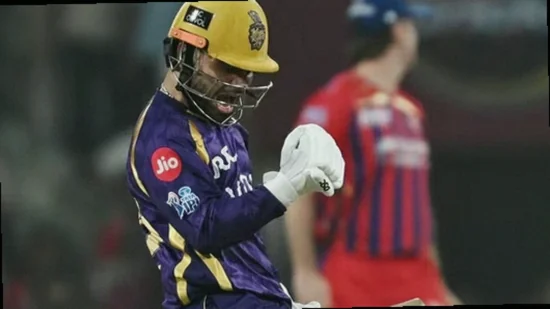
Kolkata Knight Riders didn’t leave Lucknow with a routine victory—they earned a lifeline, weathered a late scare, survived a Super Over, and produced one of the most rounded individual showings of their campaign. At the centre of it all was Rinku Singh, whose impact swung the contest from danger back to control, both with the bat and in the field.
Key takeaways
- KKR were 31/4 after 6.1 overs before Rinku Singh’s unbeaten 83 lifted them to 155/7.
- Rinku finished with five catches, including a crucial take in the Super Over.
- Kartik Tyagi’s final-over no-balls briefly flipped the chase momentum and pushed the game into a Super Over.
- In the Super Over, Rinku again contributed directly by taking a catch to remove Aiden Markram.
- A match-impact model valued Rinku’s contribution at about ₹1.76 crore, leaving KKR roughly ₹75.60 lakh above his rolling cost.
Rinku’s rescue turns a survival position into a defendable total
Rinku Singh’s innings shouldn’t be read as just “83 not out.” The context is what makes it special. KKR had already lost their top order and were struggling at 31/4 after 6.1 overs—an awkward phase where the priority is survival first, then consolidation, and only later the possibility of a late push.
From that moment, Rinku executed all three phases. His 83 off 51 balls took KKR to 155/7, a score they had little right to reach given the early damage. He managed pressure instead of taking unnecessary risks, knowing KKR couldn’t afford reckless shot-making once the top order had collapsed.
The value of his late hitting is also crucial. In the closing overs, Rinku’s acceleration transformed what could have been a 125–130 type of total into 155. That margin mattered—KKR won because 155 was just enough to keep the contest alive, even after the chase went down to the wire.
Fielding dominance: five catches and a Super Over moment
The impact of Rinku’s night extended beyond batting. He took five catches across the innings, turning key breakthroughs and pressure moments into concrete dismissals. In the chase, he removed Aiden Markram, got George Linde out during the death phase, and also caught Himmat Singh in the final over.
Then came the most significant fielding contribution of all: a catch in the Super Over. KKR were trying to keep Lucknow Super Giants within reach, where one clean strike can completely alter the complexion of a short-format decider. Removing Markram in that setting was not a routine catch—it was a match-shaping intervention.
The catch involving Himmat Singh carried its own weight as well. It arrived immediately after Kartik Tyagi’s no-ball disruption opened up the chase for LSG. Rinku’s role wasn’t limited to completing a wicket; he helped prevent the over from spiralling further, even as the match began to tilt in Lucknow’s direction.
That’s why his five catches can’t be treated like ordinary lines in a scorecard. With a tied match and one of those wickets coming in the Super Over, the timing and the pressure around each dismissal are part of what makes the performance stand out.
Kartik Tyagi’s no-balls nearly wipe out KKR’s advantage
Kartik Tyagi nearly turned Rinku’s rescue into a wasted effort. Lucknow needed 17 off the last over, which was challenging but still within the realm of possibility for KKR if they kept their discipline. Then control slipped—two no-balls changed the scenario.
The direct cost from the no-balls was eight runs, but the real damage was bigger because the sequence altered the final-over equation and pushed KKR toward panic. At that point, Rinku’s catch at 19.3 became a repair job. It didn’t remove every trace of the damage—Mohammad Shami still struck the final ball for six—but it stopped the over from completely escaping KKR before the last delivery.
That completeness is what defines the innings: Rinku built the total, Kartik’s no-balls threatened the defence, and Rinku then helped pull the match back in the closing moments.
How the match-worth model values Rinku’s performance
The performance was also quantified through a match-worth approach that estimates a player’s impact based on the total value generated in the game and the portion attributed to their actions. Rinku’s overall contribution is assessed across batting, fielding, and match context, with extra emphasis on pressure events—especially the end-of-innings catch and the Super Over catch.
The final figure also accounts for the no-ball damage he helped reduce through his fielding intervention. With all of that included, his match worth comes out to approximately ₹1.76 crore. Against his rolling match cost of around ₹1 crore, that leaves KKR with a surplus of roughly ₹75.60 lakh from a single match.
That surplus is presented as more than the cost equivalent of about four Hyundai Creta N Line cars at roughly ₹17.83 lakh each. The central idea remains the same: Rinku didn’t just contribute runs and catches—he rescued the innings, absorbed the chaos, and ensured only one of the two major match stories (his rescue versus Tyagi’s no-ball collapse) ended up determining the result.
What made it a complete KKR night
KKR’s evening nearly split into two narratives: Rinku’s turnaround from 31/4, and Tyagi’s no-ball unraveling at the death. Rinku ensured the outcome belonged to the rescue story. He was more than just KKR’s leading batter—he functioned as stabiliser, accelerator, key fielder, crisis handler, and ultimately a Super Over contributor, tying the different phases of the match together into one cohesive, match-winning effort.
