
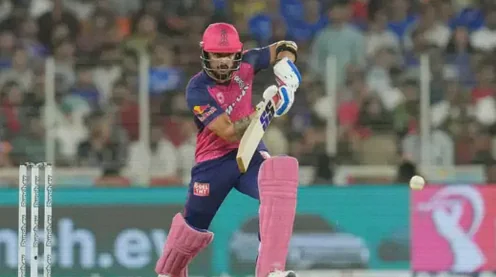
Riyan Parag’s “smoking moment” has stepped into a grey area for the Board of Control for Cricket in India (BCCI) and IPL decision-makers, mainly because there is no clear, recorded precedent of a similar violation in the league. A breach involving smoking in the dressing room is not explicitly covered under any existing framework the way some other conduct issues are—whether that is the anti-corruption set-up or the player code of conduct. Depending on how the situation is interpreted, it could potentially fall under the PMOA guidelines, and the way the BCCI chooses to handle it may become a reference point for future cases.
One clause often cited in this context is Clause 6.1.7 of the BCCI’s minimum standards for players and match officials. The provision states that any person covered under the PMOA must promptly present themselves and/or any clothing, luggage, or other items they have with them for a search by the BCCI Anti-Corruption Manager. It further specifies that the search should be conducted in the presence of an independent third party, who must be a member of the venue’s stewarding or security team.
As of the time this report was prepared, there was no confirmed information that the BCCI had issued a notice either to the Rajasthan Royals management or to Parag, the captain involved, after he was caught on camera vaping an e-cigarette in the dressing room during the Royals’ match against Punjab Kings in Mullanpur on Tuesday night. While the above-mentioned clause within the PMOA framework could theoretically be applied, such a move is still speculative because there is no documented prior incident to guide enforcement.
At the same time, India’s tobacco control legislation prohibits the production, manufacturing, import, export, transport, sale, and distribution of e-cigarettes and their components. Yet the relevant website also indicates that usage inside buildings is permitted. The site’s statement notes: “There is no law addressing the use of e-cigarettes in indoor public places, workplaces, and public transport; therefore, the use of e-cigarettes is allowed.” This creates an additional layer of ambiguity around which specific rules the BCCI may rely on, if any, in Parag’s case.
The PMOA handbook, however, does outline potential consequences. It provides that a first offence leads to a fine of INR 1 lakh, a second violation results in a penalty of Rs INR lakh, and a third—or any subsequent—breach can bring a three-match ban along with a fine of INR 5 lakh. If Parag and the Rajasthan Royals are questioned, they are expected to argue that the matter should be treated as a first-time incident.
There was no immediate response from Rajasthan Royals officials. Meanwhile, the BCCI and IPL management were not available for comment at the time of writing.
