
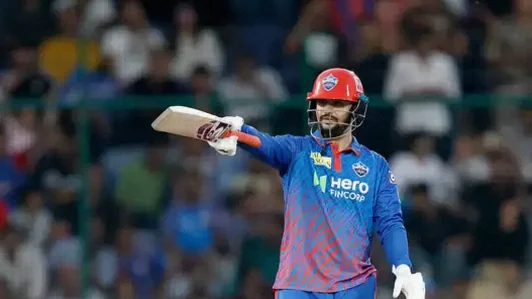
Sameer Rizvi arrived in the Delhi Capitals chase with a plan that looked anything but conservative, unleashing an audacious flick that sailed over square leg and landed at the edge of the Mumbai Indians dugout as the ninth over began. The shot was pure wristwork, the kind that tends to draw approving nods from senior pros and memories of class masters like Suryakumar Yadav. It also came from the sort of innings that had offered little warning just a short while earlier: before this burst, Rizvi had managed only 11 off 17 balls. Yet after being chosen as the Impact Sub for a second straight match—again preferred over options such as Ashutosh Sharma and the more seasoned Karun Nair—he delivered when Delhi needed it most. For a second consecutive outing in IPL 2026, he helped rescue his team from early discomfort and kept the chase on track.
Delhi’s script hadn’t been smooth elsewhere either. In Lucknow, swing-friendly conditions had tilted the early battle in favour of LSG’s new-ball unit, and Delhi were reduced to 21/2 when Rizvi came in. From there, the situation escalated quickly: the score moved to 26/4 within the next six deliveries, but Rizvi then took control and steadied the chase toward a modest target of 142. In the afternoon fixture on Delhi’s slow and sticky surface, the mood was similar at the start. Mumbai’s 162 looked close to par, and Delhi were again in trouble at 7/2 in the second over when Rizvi walked out to bat—this time at No. 4. The selection made sense not only because of his growing role, but also because he had just struck a 70* in Lucknow, reminding everyone he could swing the game from the moment he arrived.
Rizvi’s IPL path began with Chennai Super Kings, who bought the uncapped UP batter for a hefty INR 8.4 crore in 2024. However, the season that followed was largely forgettable: he played eight matches, got five batting opportunities, and scored 51 runs at an average of 12.75. Ahead of that year’s mega-auction, he went back into the player pool. CSK wanted him again, but Delhi Capitals outbid them, securing him for INR 95 lakh. His stint with Delhi started modestly—only five matches and four innings—and yet the timing of his contributions mattered. His final appearance that season was a 25-ball 58 not out in a successful 200+ chase against finalists PBKS, which proved enough for Delhi to retain him. In the meantime, he also grew into the No. 4 mould in domestic T20 cricket with Kanpur Superstars in the UP T20 League 2025. There, he struck 491 runs in 10 innings at an average of 61.38, finishing as the competition’s second-highest run-getter even though his team fell short of the finals. His strike rate of 161.51 was surpassed only by Rinku Singh among batters who made at least 250 runs, while Rizvi also stood out for power—hitting 36 sixes, the most in the tournament.
Inside the Delhi camp, Rizvi’s mindset had been described as “hungry”—hungry for the chance, hungry to score, and hungry to prove he belonged at this level. The Hemang Badani-led management, committed to the direction they had set for him, reinforced their belief by promising him the No. 4 position. Rizvi later explained that the coaching staff told him pre-season: they would back him at No. 4 regardless, urging him to play with his natural, positive style. He also wanted to “forget” the earlier knock and “start from scratch” in the next game, and he did exactly that. What he didn’t forget, though, was the work he had put in over the course of the year—especially against fast bowling—after recognising the difficulties he had faced previously. “I have worked very hard on myself because there have been many challenges since last year. I worked on all my weaknesses. I used to always struggle a bit against fast bowlers, so I worked on that extensively throughout the year. That hard work is paying off now,” Rizvi said after collecting a second successive Player of the Match award for Delhi this season.
On Saturday, that off-season progress was visible from the way he attacked pace. He scored 63 off his 90-run contribution against fast bowling at a strike rate close to 191, and the innings featured five sixes along with an equal number of boundaries. Just as importantly, his game showed adaptability across two different chase scenarios, settling in patiently before switching gears exactly when the match demanded it. Before Rizvi began his acceleration, Pathum Nissanka had carried the aggression, but then the momentum shifted. At the halfway stage, Delhi’s score was identical to Mumbai’s—73/3—and the contest still hung in the balance. Rizvi’s strike rate had been low enough to suggest he might be struggling, but that slow start was only a foundation; once he found his rhythm, the innings turned into a match-winning 90 off 51 balls. When he was finally set, Rizvi took apart Mumbai’s pace attack with decisive control.
The turning point arrived through Corbin Bosch’s 11th over, which effectively flipped the contest. It began with a dot, but that moment of stillness was brief. On the second delivery—slower in pace—Rizvi stepped in and drove Bosch toward mid-off. The very next ball was short, and he responded by using the bounce to ramp it over the wicketkeeper. He was beaten on the fourth ball, yet the next responses were emphatic. A short and wide delivery was cut powerfully over deep point, clearing even the longer boundary, and he capped the over by striking a slot ball straight down the ground. Twenty runs came from the over, and with them came the momentum that shifted firmly toward Delhi.
Against Mayank Markande’s legspin, Rizvi displayed sharp footwork, moving down the track for consecutive balls and hammering them to the boundary. The first of his two scoring hits brought up his half-century, with 26 runs coming off just eight deliveries from the halfway point of the chase. Mumbai then tried to slow the tempo with their best weapon—Jasprit Bumrah—who applied pressure with a one-run 13th over. Even so, Rizvi kept taking down different threats, including his former teammate Deepak Chahar. When the slower ball was cut to the fence, the attempted yorker that became a full toss was whipped over the legside ropes. From there, the pattern continued against Shardul Thakur as well, leaving little room for Mumbai to change the outcome.
Such was Rizvi’s dominance that David Miller, arriving after Nissanka’s departure, managed just a single contribution during the 50-run stand—watching the damage unfold from the comfort of the crease as the ball kept travelling. Or perhaps, the “second best” seat in the house. Teammate Mukesh Kumar, who has seen Rizvi up close during nets, camps, and simulations, summed up what it feels like when the batter gets set. “Thoda struggle karega par ek baar set ho jaye toh fir kisi ko nahin chodta hai woh [he may initially struggle but once he gets his eye in, he wouldn’t spare anyone!],” Mukesh said. He added that during pre-season camps it was clear Rizvi was hungry to score, and that hunger was now translating into pressure situations. “When he came for the pre-season camps, you could see he was hungry to score runs come what may. He’s doing that now in pressure situations. We’re very pleased to see his mindset,” Mukesh said.
What stood out across Rizvi’s two knocks wasn’t just the runs or the strike rate, but the control and clarity with which he paced the chase—knowing when to accelerate, when to absorb, and when to hit decisively. In conditions that demanded adaptability, he showed he is quickly evolving into a complete T20 batter. For Delhi Capitals, the improvement isn’t merely another innings added to a tally; it is faith repaid. After a season that had carried its share of batting inconsistencies, Rizvi’s performances could very well become the kind of spark that defines a campaign.
