
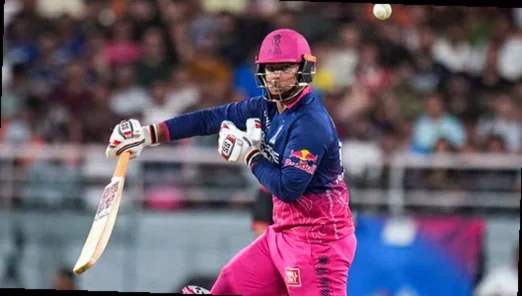
Rajasthan Royals splashed ₹1.10 crore to secure Vaibhav Sooryavanshi, and a custom impact model built from IPL 2026 ball-by-ball information suggests the youngster delivered far beyond that price. Over 16 appearances, the model puts his total impact value at ₹34.97 crore, translating into a season profit of ₹33.87 crore. The resulting recovery multiple comes out to 31.79×, ranking third across the entire IPL 2026 season by absolute profit.
Quick facts
- Rajasthan Royals paid: ₹1.10 crore for Vaibhav Sooryavanshi.
- Matches analysed: 16 appearances in IPL 2026.
- Total modeled impact: ₹34.97 crore.
- Season profit: ₹33.87 crore.
- Recovery multiple: 31.79×.
- Season ranking (profit): 3rd highest by absolute profit in IPL 2026.
- Highest-tier performances (model): 7 matches.
- Worst impact match (model): ₹0.18 crore lost impact.
- Best match (model): Match 72, ₹5.16 crore profit on ₹6.9 lakh investment.
The model’s top two profit earners in IPL 2026 are Shubman Gill and Rajat Patidar. Gill’s cost is listed at ₹16.50 crore with profit of ₹35.14 crore, while Patidar’s investment is ₹11.00 crore with profit of ₹35.06 crore. Despite Sooryavanshi finishing just behind them, the modeled profit gap between him and the leading duo is under ₹1.30 crore, while the investment gap is at least ₹9.90 crore.
Sooryavanshi’s season also shows a strong “tiering” pattern in the dataset. Seven of his 16 matches landed in the model’s top performance band, described as a rare zone where win probability shifts in ways the historical data treats as precedent-breaking. Even his weakest showing is framed as contained damage: one match cost Rajasthan Royals ₹0.18 crore in lost impact. At his peak, a single outing returned ₹5.16 crore in modeled profit on an investment of ₹6.9 lakh.
The model’s philosophy is direct: it does not weigh reputation, it weighs deliveries. Every ball is translated into what it was worth in the win-probability sense, and those values are then accumulated into a season-level ledger—measuring contribution against the player’s franchise cost.
The season story
Sooryavanshi’s IPL 2026 is built around a single, destructive edge: the powerplay belonged to him. Of his 776 runs, 521 came in the first six overs, with the match context repeatedly favouring his ability to attack early. With restrictions on field placement and bowlers forced to run into the same zones more often than they’d prefer, the field—fresh and constrained—became his hunting ground.
His fastest “headline” moment arrived with a century against Sunrisers Hyderabad in Jaipur. He reached the three-figure mark in 36 balls, described as the third-fastest century in IPL history. That innings produced 103 off 37 balls, featuring 12 sixes and five fours.
In the knockout phase, he again took the same opposition to the cleaners. In the Eliminator versus Sunrisers Hyderabad, he made 97 off 29 deliveries, striking at 334.48. That mark is recorded as the highest strike rate by any batter in an IPL innings of 90 runs or more.
Then came Qualifier 2 against the Gujarat Titans, where Rajasthan Royals were in trouble with multiple wickets down. Sooryavanshi scored 96 off 47 balls in an innings framed as his most technically composed of the campaign. On a two-paced surface, he anchored a middle order under stress while still clearing the ropes seven times. The only regret: he was dismissed just short of a century, and it happened in the second consecutive knockout match.
The season’s defining statistical quirk is his pull shot. He struck 20 sixes using the pull, and he was dismissed only once in 36 attempts when going for that stroke. His strike rate at that impact point is listed as 419.44. Across the 44 bowlers he faced, he hit 31 of them for six, including eight bowlers who were dispatched for six on the very first ball he faced from them.
The analysis behind the numbers
The valuations are produced by a custom player impact model created for this analysis and built on IPL 2026 ball-by-ball data. Each delivery is converted into Win Probability Added, and the model aggregates those figures to create a monetary account at season level. Performance is priced in crores and compared directly to the player’s cost to the franchise, producing a profit-and-loss result for the tournament.
For Sooryavanshi, the model reads simply: an auction price of ₹1.10 crore, spread across 16 appearances, generated impact worth ₹34.97 crore. Subtracting cost yields the season profit of ₹33.87 crore, and the recovery multiple is 31.79×—meaning that for every rupee Rajasthan Royals spent, the model credits ₹31.79 in impact value.
Across the full table of IPL 2026 profits, that output places him behind only Gill and Patidar. The model also highlights how close the top tier was: Sooryavanshi’s profit trails the top two by less than ₹1.30 crore, even though Gill and Patidar required much higher investments to generate their own gains. The investment difference between the top earners and Sooryavanshi is recorded as at least ₹9.90 crore.
Looking match-by-match, 12 of his 16 games returned a profit to the ledger. Seven matches are again flagged as top-tier performances in the model’s Elite/Freak band, where win probability swings are treated as materially unusual compared with the historical dataset. Three matches were damaging, but because his per-match cost is recorded at ₹6.9 lakh, even a total collapse in those games would shift his value by less than ₹0.18 crore in either direction. In other words, his upside is described as structurally uncapped, while the downside is shown as capped by the relatively low cost base.
His strongest modeled match is identified as Match 72. That game returned ₹5.16 crore in profit on a ₹6.9 lakh investment—so much so that Rajasthan Royals recovered nearly five times his entire season cost in a single evening.
What ₹33.87 crore looks like outside cricket
To contextualise the season profit beyond the model, the comparison uses consumer-style benchmarks. An average business-class return ticket from Mumbai to London on Air India is placed at roughly ₹1 lakh, implying his profit could fund 338 such trips. A Mahindra Thar Roxx is estimated at about ₹13.4 lakh at base, and the same surplus would cover around 252 of those vehicles.
Education costs are used as another analogy. A full four-year B.Tech degree at an IIT is estimated at around ₹8 lakh in total fees, which the article frames as enough for 423 students to complete the programme on this season’s surplus.
But the sharpest comparisons are kept inside cricket economics. The model’s ₹33.87 crore profit is said to exceed the full auction investments made in Rishabh Pant (₹27.00 crore), Nicholas Pooran (₹21.00 crore), Yuzvendra Chahal (₹18.00 crore), and Jasprit Bumrah (₹18.00 crore) individually. The article notes that all four finished the season in the red on this same model, while Sooryavanshi’s profit is larger than what any of those single players cost.
At league level, IPL 2026 is described as producing a combined league surplus of ₹294.04 crore across 203 players. Sooryavanshi, with 0.107% of the total wage bill, is credited with 11.5% of that surplus—highlighting how concentrated his value creation is within the overall tournament economics.
His price bracket is also examined. The ₹1–3 crore segment in the tournament is said to have returned an average player profit of ₹3.41 crore. Against that baseline, he beat his bracket average by 9.9×.
The price question
The auction context is pointed to: his price in the 2025 mega-auction was ₹1.10 crore, described as the floor for an uncapped player. At the time of bidding, he was 13 years old. Rajasthan Royals retained him at the same price ahead of IPL 2026, and the article frames that retention—looking back—as the franchise’s best piece of squad management in its history.
The next mega-auction, the analysis argues, would price him differently. Based on his two-season record—1,028 runs at 46.72 with two centuries and a strike rate above 230—the article suggests a conservative floor bid of ₹15–18 crore. The expectation is that franchises will pay more, potentially far more.
Methodology note
All player valuations in this piece are generated by a proprietary impact model designed for this analysis. The model processes IPL 2026 ball-by-ball data, converts each delivery into a Win Probability Added figure, and aggregates those outputs into a rupee-denominated impact worth per player per match. A season profit-and-loss figure is then created by comparing that worth against the player’s prorated match cost, derived from the player’s auction price.
The model also produces a 0–100 Impact Index with performance tiers ranging from Elite to Poor. The monetary numbers shared here are explicitly framed as model outputs rather than official IPL or BCCI valuations.
The comparisons to everyday consumer goods are also described as approximate, using publicly available retail data at the time of writing. Finally, the article stresses that these valuations represent analytical estimates of on-field impact, not market prices, official figures, or endorsements—and it makes no claim about actual commercial worth or franchise accounting.
