
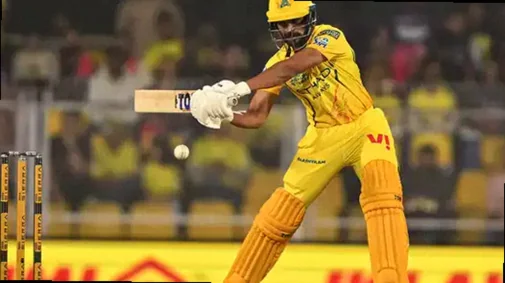
Ruturaj Gaikwad sounded confident when he explained why he moved down to No. 3 last season, framing it as a balance-driven decision for the team. But in this IPL year, with the opener’s role once again back on his shoulders, CSK’s skipper is finding it tough to convert Powerplay starts into meaningful totals—raising questions about intent, strike rates, and whether the batting order tweak has delivered the expected payoff.
Why CSK shifted Gaikwad—and why the debate started
Last season, Gaikwad’s promotion or demotion to a specific batting slot became a talking point, particularly because CSK had to think carefully about who would bat with him at the top. The franchise weighed its options between Devon Conway and Rachin Ravindra. Yet the surprising factor was that Gaikwad himself was not opening the batting at that time, even though he had still spent time batting at one drop during the previous campaign.
What changed this season: Gaikwad back at the top
His early-season movement raised eyebrows because Gaikwad has produced big numbers in the past when CSK were at their best. He scored 635 runs in 2021 and followed up with 590 runs in 2023—both seasons ending with CSK winning the title. Although his tournament last year was cut short by a finger injury, he had still shown encouraging signs by delivering a couple of useful efforts at one drop, leading to expectations that he would occupy a similar position again in the new campaign.
Those expectations were complicated by CSK’s squad reshaping. With the arrival of Sanju Samson and the rise of young Ayush Mhatre, there was a clear sense that CSK had options. Still, a few days before CSK’s opening match, the 29-year-old confirmed that he would return to the top of the order.
Powerplay struggles: strike rate, intent, and the latest match
After four games, CSK’s decision hasn’t produced the kind of impact they would have hoped for. While the run drought can be linked to a slight dip in form, the bigger worry for CSK is the level of intent—something that shows up in Gaikwad’s batting tempo.
- Gaikwad has struck at 103.70 in this IPL so far.
- In the Powerplay specifically, his strike rate drops to 102.43.
- The Powerplay has become a phase where scoring rates have surged in recent times, with batting surfaces helping batters push the tempo early.
His difficulties were put under a sharper spotlight during CSK’s most recent outing against Delhi Capitals on April 11. That day featured an IPL double-header, with eight openers taking the field across two venues.
- Travis Head made 31 off 15 in the Powerplay.
- Abhishek Sharma scored 66 off 22 in the Powerplay.
- Priyansh Arya replied with 51 off 18 in the Powerplay.
- Prabhsimran Singh made 41 off 18 in the Powerplay.
- At Chepauk, Sanju Samson (Gaikwad’s opening partner) struck 45 off 19.
- Pathum Nissanka scored 41 off 24.
- KL Rahul managed 18 off 10.
Among the openers, Nissanka had the lowest strike rate of the day at 170.83. Gaikwad’s effort was far more concerning: he struck at 88.23, scoring 15 off 17.
And it wasn’t a one-off issue. Gaikwad currently has the lowest strike rate among 19 batters who have faced at least 30 deliveries in the Powerplay this season.
Why the IPL template is changing—and how CSK could benefit from Mhatre
There is no doubting Gaikwad’s batting quality. He remains one of CSK’s most complete and dependable batters. But the demands of opening in the IPL have shifted. On many good batting tracks, a Powerplay score around 75—or even higher—has increasingly become a baseline expectation during fielding restrictions.
Teams have been able to attack more aggressively thanks to the Impact Player rule, which adds flexibility by effectively giving sides an extra batter option in the XI. In that environment, even if Gaikwad is being asked to fight for position early, CSK’s squad doesn’t lack alternatives—particularly with Mhatre’s emergence.
Ayush Mhatre’s impact after coming in mid-season
Mhatre joined CSK as a replacement player midway through the previous season and provided a much-needed boost at the top. He closed that maiden campaign with a strike rate of 189. This season, even after being moved down to No. 3, Mhatre has continued to deliver—striking at 180 and already registering a couple of half-centuries.
- Mhatre finished his debut IPL season with a strike rate of 189.
- This year, despite his demotion to No. 3, he is striking at 180.
- He has already notched a couple of half-centuries in the current season.
There is also a strategic angle to his profile. In his brief IPL career, Mhatre’s scoring rate against spin is notably lower than his numbers versus pace. That contrast actually makes him even more intriguing as an option to open again, especially if CSK want to exploit matchups early in games.
What pushing Gaikwad down could unlock for CSK
With Samson alongside him, CSK could potentially recreate the kind of explosive starts that tend to define successful T20 teams today. Moving Gaikwad down would also give CSK another strong option in the middle overs against spin, where once he is set, he can accelerate and find boundaries even off deliveries that aren’t at his absolute best.
Having no pressure to force the pace from the first ball also suits Gaikwad’s natural rhythm. That becomes crucial because CSK have already made a false start this season.
Historically, the franchise hasn’t been reactionary, but at this point a small adjustment could make a major difference. Gaikwad now faces a clear fork in the road: either step up and adapt to the new IPL opening norm—or make way for Mhatre to take charge at the top.
