
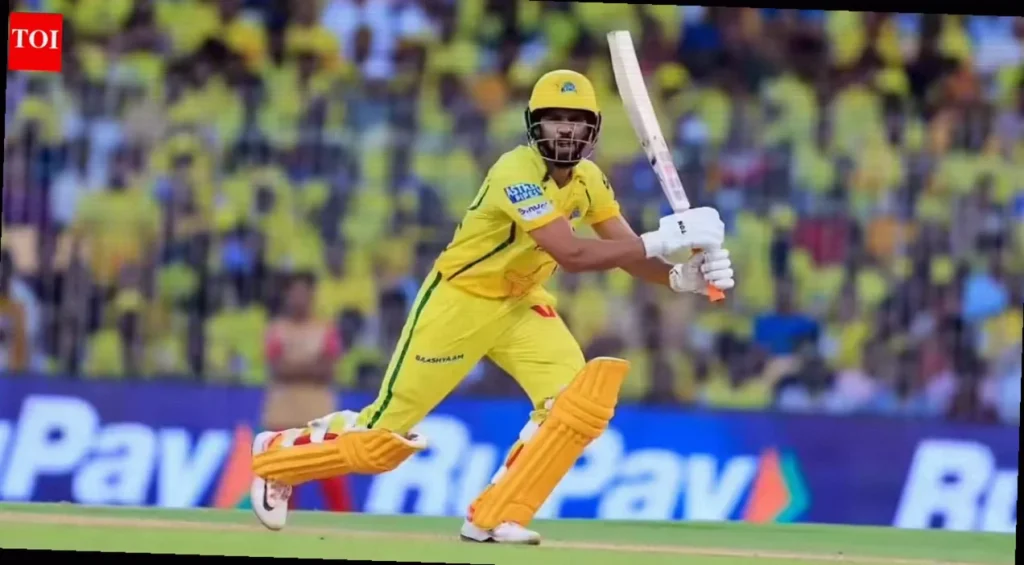
Chennai Super Kings found themselves at 52 for two after the fifth over, with Eshan Malinga taking charge of the final over of the powerplay. CSK’s plan was to lift the tempo and force Sunrisers Hyderabad (SRH) into uncomfortable decisions, and their captain Ruturaj Gaikwad was the key figure to switch gears. Gaikwad arrived at the crease on 5 off 7 balls, but the acceleration never properly arrived.
In that powerplay over, Gaikwad faced four deliveries and managed only three singles. CSK had looked poised for a typically brisk first phase after reaching 43 for one in the opening three overs, yet the Men in Yellow could add just 14 runs in the following three, losing one wicket to close the powerplay on 57 for two. By the time six overs were completed, Gaikwad had moved to 9 off 11 balls, carrying a strike rate of 81.82.
This wasn’t treated as a one-off by observers; it has emerged as a recurring theme in IPL 2026. Among batters who have faced at least 100 balls in the powerplay this season, Gaikwad currently owns the lowest strike rate at 124.6. By comparison, Vaibhav Sooryavanshi has been scoring at 244.51, while Abhishek Sharma has a strike rate of 228.87. While many openers across the league appear to be playing at breakneck pace, Gaikwad’s approach has still looked closer to an older rhythm—like he’s operating on a different tempo than the rest of the tournament.
Speaking to broadcasters during the 10th over of CSK’s innings, head coach Stephen Fleming defended the idea of a stabiliser at the top. He said, “I know it sounds old school, but we need one guy who bats through the innings. Rutu played a lot of cricket. He knows what’s needed. We trust him in that.” Yet the captain has not consistently managed to hold the innings together either. In the 13 matches CSK have played so far in IPL 2026, Gaikwad has compiled 321 runs, striking at 120.67, with only three scores of 30 or more.
Against SRH, that steadiness finally broke in the 12th over, when Pat Cummins dismissed Gaikwad. Cummins struck the key blow after Malinga took the catch at deep square leg. Gaikwad’s exit came after a knock of 15 runs off 21 balls, a strike rate of 71.42, with no boundaries in the innings.
At the other end, CSK’s opening partner Sanju Samson produced a far more aggressive spell on the same wicket. Samson struck 27 off 13 balls, hitting five fours and a six, with a strike rate of 207.69.
There’s a story from the Mahabharata often recalled at moments like these: at the start of the war, Arjuna set aside his weapons because he couldn’t bring himself to fight brothers and relatives. Only after Lord Krishna reminded him of his duty did Arjuna step forward. In a similar way, Gaikwad’s batting might be caught in an inner hesitation—perhaps thinking of the opposition bowlers as familiar faces from his own country—slowing his willingness to attack. If so, Gaikwad may need his own “Krishna” to point him toward the right path and unlock the kind of impact IPL cricket demands.
