
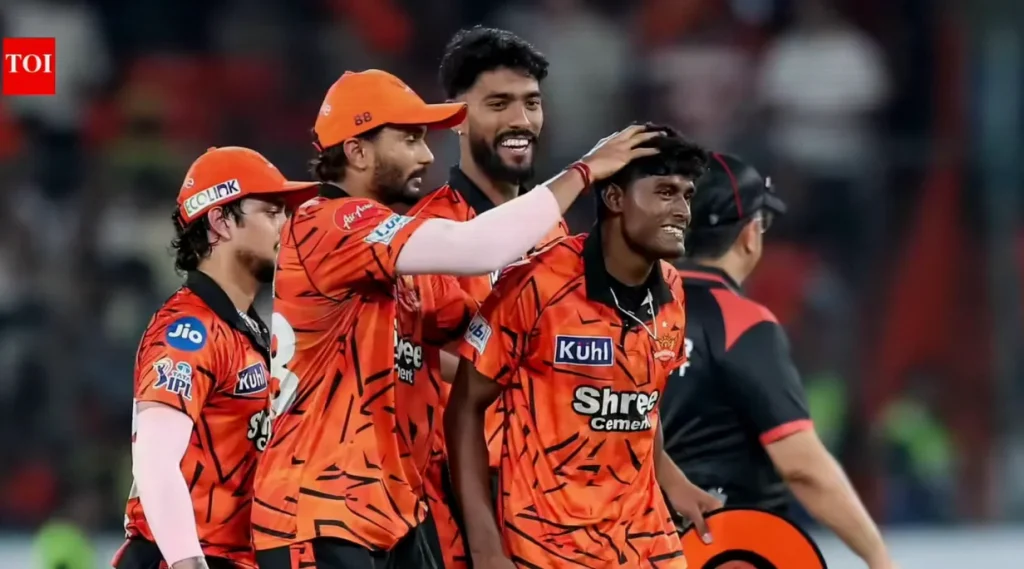
NEW DELHI: Sakib Hussain’s long wait for an IPL break finally ended in spectacular fashion. After being associated with Kolkata Knight Riders in 2024 without featuring in a single match, and then remaining unsold in the 2025 auction, the 21-year-old earned his chance with Sunrisers Hyderabad for IPL 2026—and repaid the faith immediately on debut with a spell of 4-0-24-4.
Key takeaways
- Sakib Hussain made his IPL 2026 debut for Sunrisers Hyderabad after earlier stints that did not lead to match appearances.
- On debut against Rajasthan Royals, he recorded figures of 4-0-24-4.
- Three of his four wickets came from changes in pace rather than sheer speed.
- His early development included bowling with a tennis ball before transitioning to proper leather-ball training.
- Bowling coach Varun Aaron backed him with confidence and tactical planning on the big stage.
Debut impact vs Rajasthan Royals
Sakib delivered a standout performance against Rajasthan Royals on Monday, drawing attention not only for the wickets, but for the awareness behind them. Local reputation had been built around his raw pace, yet on debut he showed a more complete skill set—mixing lengths, varying delivery speed, and leaning heavily on off-pace bowling to unsettle the batters.
In total, he took four wickets, with three of those dismissals coming through change of pace. It was a clear sign that the youngster was not simply relying on faster deliveries, but instead using different tempos and angles to force errors.
From “Rabada of Gopalganj” to IPL adaptation
Earlier in his career, he carried a nickname—“Rabada of Gopalganj”—due to his ability to generate pace even with limited resources, including a tennis ball. However, the IPL debut story was less about comparisons and more about adjustment: Sakib demonstrated control and match sense against established opponents.
At Sunrisers Hyderabad, he also received backing from bowling coach Varun Aaron, a former fast-bowling threat in his own right. Aaron’s work with young quicks helped translate training plans into on-field execution. The confidence Sakib showed on debut reflected an approach built on plans rather than only instinct.
The making of Sakib Hussain
Sakib’s rise began long before the IPL call-up, with his pace creating noise in Bihar’s cricket circuit. Locals used to say “bhaukaal machana,” and he did precisely that—often using a tennis ball in practice.
That growing buzz eventually reached the Bihar Cricket Association, which then looked to identify and test the young pacer through structured trials. A selection committee was formed, with Nandan Kumar among those tasked with spotting talent. Nandan found Sakib and arranged for him to attend trials at the Sonepur Railway Ground.
When Sakib arrived, he was wearing sports shoes that were worn and torn in several places. Noticing this, Nandan provided him with spikes and a leather ball—an upgrade that stunned him. Speaking in Bhojpuri, Nandan told him loudly, “Ka bhail bey, ball dala na,” urging him to bowl immediately. Sakib responded with disbelief, saying, “Ee ka. Pahila ber spike pahinle bani,” as it was his first time wearing spikes. Nandan then pushed him to get on with it: “Jaa bey, bowing kara ho.”
Once the spikes were on, Sakib struggled even to move comfortably. He then started his run-up, but the bowler known to touch 140 kmph suddenly lost rhythm. Uncomfortable and unable to continue properly, he stepped away from the trials, explaining, “bahut bhaari lagat baa, hum naikhin kar sakat,” meaning it was too heavy for him and he couldn’t bowl.
Nandan understood the situation, but he refused to let the opportunity slip. He called Robin Singh, a coach at the GenNext Cricket Academy in Patna, and asked him to take charge of Sakib’s raw ability. In Robin’s account, the speed was always talked about in Gopalganj. People used to call him Rabada and ask where “Rabadawa” had gone. Robin also highlighted that when Sakib first arrived, he did not have proper shoes, and he bowled with a tennis ball with no leather-ball experience. He missed the first trials, but after training under Robin Singh and returning for the second attempt, Sakib looked like a different bowler — and that improvement helped him break into the Bihar team.
Domestic grind to the IPL door
Sakib’s journey through domestic cricket carried the same intensity. On his Ranji Trophy debut, he was ready to go full throttle. Asked about his plan ahead of his first match, he said, “Sir, killi ukhadna hai hume,” promising to rattle the stumps.
He backed his words straight away. Bihar were dismissed for 143 in their first innings, but Sakib made an immediate impact with the ball by taking a wicket in his very first over. Robin Singh later summed up his mindset with a laugh, saying Sakib did exactly what he said.
Since then, Sakib has played six first-class matches and picked up 16 wickets, including a ten-wicket haul in a match.
His development continued at the MRF Pace Foundation, where he refined the craft of fast bowling. Eventually, Chennai Super Kings scouts noticed him, and he was brought in as a net bowler. Robin Singh described that step as a major leap—especially because Sakib had already built a reputation at the National Cricket Academy. With NCA connections helping scouts stay informed, invitations for trials began to come from different teams.
Kolkata Knight Riders later picked him for IPL 2024, but he did not get a game. In the following year’s auction, he went unsold. Then Sunrisers Hyderabad acquired him for Rs 30 lakh in the IPL 2026 auction—and early returns suggested the move was already beginning to pay off.
The struggle that shaped him
Behind the pace and performances, Sakib’s path has included real hardship. He comes from a family where day-to-day survival was not guaranteed. His mother sold her jewellery, while his father worked as a labourer—both efforts made to keep his cricket dream alive.
Robin Singh recalled how that struggle affected even the early training routine. In Robin’s version, when Sakib first arrived he was quick but not accurate with the leather ball. The pace was there, but the execution needed work. Robin asked him to stay in Patna, but Sakib replied, “Mehnga hai sir, paisa nahi hai,” explaining that staying there was expensive and they did not have the money. Arrangements were then made so he could train locally. Robin said the early phase showed potential, even if proper training was missing. Once the coaching started—because Sakib was naturally gifted—the transition to bowling with the leather ball became smoother, and he never looked back.
From those beginnings to stepping onto the IPL stage in spikes, Sakib has been making the most of the openings that finally came his way.
Practice with Vaibhav Sooryavanshi
While Sakib’s raw pace was taking shape under Robin Singh at the GenNext Cricket Academy in Patna, batting sensation Vaibhav Sooryavanshi was training under Manish Ojha at the same facility. Coaches often staged competitive practice battles between the two—friendly in nature but intense enough to test skill and temperament.
At times, Sakib would send Sooryavanshi’s stumps flying, beating him through sheer pace, sharp swing, or by finding clever slower deliveries. On other days, the batter would reverse the pressure—hitting Sakib hard enough to make the fast bowler chase the ball across the ground, forcing him to work harder for every delivery.
It was a rivalry full of respect. They celebrated each other’s breakthroughs, whether it was a wicket taken well or a shot timed perfectly. Even though their IPL journeys have now taken them to different franchises, that early competitive edge is still viewed as a key part of how both players developed.
Robin also described the dynamic between them, saying they used to devise plans for training sessions that made the two compete. He noted it was enjoyable—with banter and a sense of fun—while emphasising how well the pairing complemented each other. Robin added that Vaibhav’s rise came earlier, while Sakib had to wait, partly due to injuries.
Robin further predicted big things, stating that both Vaibhav Sooryavanshi and Sakib Hussain are destiny’s children—God-gifted talents—and suggested they are set to achieve major milestones in Indian cricket.
