
Chennai Super Kings have started IPL 2026 in a way that has left plenty of questions hanging over the franchise. After six matches, they have managed only two victories and find themselves placed seventh on the points standings. With results not coming through, attention has also sharpened on captain Ruturaj Gaikwad, whose batting form has dipped noticeably. In six innings, Gaikwad has accumulated 82 runs, averaging 13.67, with a strike rate of 112.33—figures that underline a clear loss of momentum at the top of the order.
Former India batter Sanjay Manjrekar, however, believes the criticism should not be directed at Gaikwad alone. Speaking on Sportstar’s Insight Edge podcast, he argued that the bigger responsibility lies with those making key calls behind the scenes. “This blame, I’m going to put at the doorstep of the owners and people who make the big decisions,” Manjrekar said. His reasoning was that Gaikwad, even before taking over the captaincy, had looked immensely effective opening the batting, implying the present struggles may be symptomatic of wider issues rather than purely a captain’s shortcomings.
Manjrekar also pointed to the way public attention and team-handling around MS Dhoni could be influencing the environment around Gaikwad. He suggested that the constant conversation surrounding Dhoni—whether he would play, and whether he would lead—has not been managed well. “And then that thing with M.S. Dhoni, whether he’s going to be playing, whether he’s going to be captain, they handled that very badly,” he said. He went on to argue that a culture of over-celebration can blur perspective in cricket, stating that the Dhoni fanbase is not just ordinary support but can slide into a kind of sycophancy. “I mean, there isn’t just a fan following of Dhoni, there is sycophancy around it,” Manjrekar added.
To illustrate how that kind of reaction can distort judgment, Manjrekar recalled an earlier moment involving Dhoni that drew an intense response from supporters. “There was [this] one instance of Dhoni trying to put his bat into the crease, and it was a very close call. And I said, well, he is clearly short of the crease, and it should be run out. They [fans] got angry with me for saying that because it was anti-Dhoni,” he said, suggesting that in such situations, people can lose sight of the wider picture and focus too heavily on the figure rather than the cricketing call.
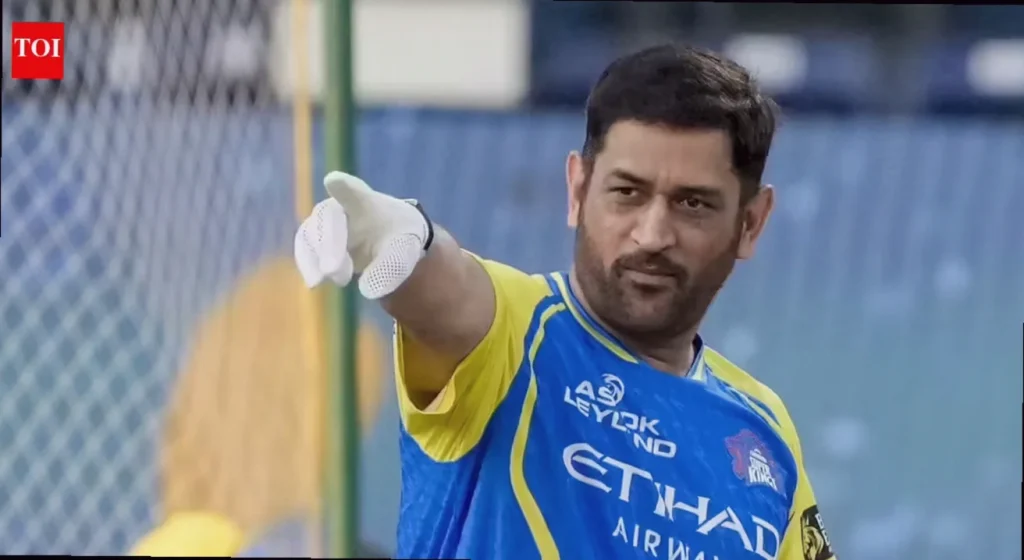
Dhoni, meanwhile, has been absent from IPL 2026 action so far due to a calf injury suffered ahead of the season. When asked whether the veteran’s eventual return could reduce pressure on Gaikwad, Manjrekar sounded unconvinced, questioning how Dhoni would realistically fit into the team’s current structure and on-field demands. “Maybe, but then you have to play Dhoni on the field. And how do you do that?” he remarked. He also suggested that Dhoni’s ability to deliver consistently has become increasingly difficult, comparing it to a role that once involved coming down the order and taking quick swings for a brief spell. “So it was a bit of a joke when he used to come down the order and just play three or four balls. The coverage would hype that up as well – ‘What an innings.’ And it lasted four balls,” Manjrekar said, adding that this sort of short, highlight-driven impact is no longer a workable pattern.
From there, Manjrekar argued that expecting a long-term return to that earlier style would be unrealistic. “So that’s not feasible anymore, and it was never going to be a long-term thing,” he said. He then added a careful caveat about his inability to know exactly what Gaikwad felt while Dhoni was present but not captaining, compared to a scenario where Gaikwad is fully in charge without Dhoni involved. “I can’t pretend to know how Ruturaj felt when M.S. was on the field, but not captaining, as opposed to M.S. not being there and he being solely in charge,” he said.
Manjrekar broadened the conversation beyond CSK alone, drawing a comparison with Mumbai Indians. In his view, both franchises can become excessively tied to established names, big-brand players, and familiar faces rather than prioritising those currently in their peak. “CSK and Mumbai Indians are slightly guilty of being emotionally connected and invested in the big-name, big-brand players a bit too much. CSK even more so with Dhoni,” he said. He argued that this approach can keep teams from building around players who are truly at the top of their powers in T20 cricket. “This means that you’re not getting people who are in their prime. It’s like living in the past a little bit,” Manjrekar added.
With T20 evolving at a fast pace, he stressed the need for franchises to remain aligned with the modern realities of the format. “It’s just about getting guys who are in their prime in T20 cricket. It’s such a modern-day format, so it’s best to be current with everything that you do with your team,” he said.
