
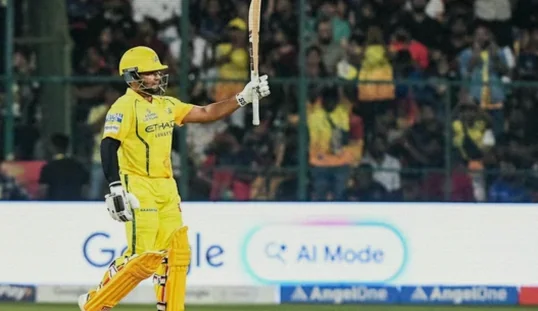
Chennai Super Kings shelled out ₹28.4 crore to bring in Kartik Sharma and Prashant Veer, a hefty two-player haul that was expected to move the needle. But in their most recent outing against Royal Challengers Bengaluru, the combined final impact score from that expensive duo was just 48.17 using the same calculation method. In the same match, Sarfaraz Khan—who was acquired for only ₹75 lakh—posted a final impact of 56.87 on his own. That contrast is the part CSK should be most concerned about: this is no longer merely a bargain tale around Sarfaraz. It has become a value story that underlines how little return CSK are getting from some of their costlier investments.
Sarfaraz’s solitary innings made CSK’s costly pair look like a poor purchase. Over the league phase so far, Kartik Sharma and Prashant Veer have together cost CSK about ₹2.03 crore per match. When their Bengaluru match output is weighed against the value benchmark created by Sarfaraz’s innings, their combined return drops to roughly ₹4.54 lakh. From that single game alone, the gap is therefore about ₹1.98 crore—money that simply isn’t being converted into impact.
That kind of shortfall is far from trivial in cricketing terms. It is the sort of amount that could bankroll a lavish Indian wedding, or cover rent of ₹1 lakh every month for more than 16 years, or even support a ₹50,000 monthly salary for around 33 years. CSK put that level of value into the playing XI for one match and ended up collecting less than what their ₹75 lakh batter delivered by himself.
The more troubling aspect is how the numbers were formed. Prashant Veer at least contributed to the total, ending with a final impact score of 48.17. Kartik Sharma, however, returned a final impact of zero. So this wasn’t a scenario where both high-priced signings delivered modest outputs that kept the overall investment afloat. Instead, one of the marquee-priced players produced nothing, and the other still couldn’t lift the combined spend to a level that would look respectable.
Sarfaraz, meanwhile, has been far more efficient in cost-to-impact terms across the season. His price works out to about ₹5.36 lakh per match. His knock of 50 off 25 balls did not only add urgency in a chase that needed momentum—it also created better value than a pair that cost close to 38 times more in total auction terms.
The tournament numbers make CSK’s gap harder to ignore
This isn’t being driven by a lone match swing. Across the competition so far, Kartik Sharma and Prashant Veer have together registered a combined final impact of 78.77. Sarfaraz alone already stands at 147.92. In other words, the ₹75 lakh signing has produced close to double the total impact of a ₹28.4 crore duo.
Why the money maths turns uncomfortable
That is where the financial framing becomes harsh. If the combined tournament output of Kartik and Prashant is valued at the same efficiency level as Sarfaraz, it comes to only around ₹39.94 lakh. Against the real auction outlay of ₹28.4 crore, that creates a shortfall of roughly ₹28 crore already.
Such under-return is the sort of spending mismatch franchises usually fix to build a core, not to simply add names to a squad sheet. The expectation from an outlay at this scale is clear: it should translate into match control, rescue moments when games unravel, contributions that decide phases, and repeated influence across matches. Instead, CSK have a budget signing outperforming an expensive package by a margin so wide that the comparison itself feels uncomfortable.
And that, ultimately, is the real story. Sarfaraz isn’t just “overachieving.” He is demonstrating how little value CSK’s expensive bets have produced when measured against what they cost. For a side that is already feeling disjointed, that sting will land more sharply than any single defeat. Because losing a match is one issue. Spending premium money and receiving bargain-level returns is a far bigger problem.
