
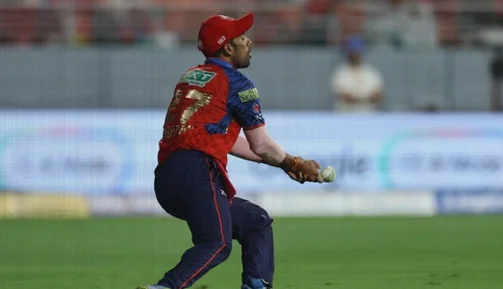
Punjab Kings’ fielding woes during their IPL 2026 clash against Sunrisers Hyderabad stood out again when Shashank Singh put down a chance that proved costly. The latest miss—coming against Heinrich Klaasen in the 8.4 over—extended an already alarming season narrative around PBKS’ catching, with the dropped opportunity turning into extra runs as well as a missed wicket.
How Shashank’s drop changed the SRH innings
The incident arrived early in the middle phase of SRH’s chase. Yuzvendra Chahal delivered a fuller ball on the leg-stump line and Klaasen went for a sweep, but the timing was off. The ball travelled straight to Shashank at deep backward square. Although the fielder got himself set and brought both hands into position, he spilled what should have been a straightforward catch.
That error didn’t just deny PBKS a wicket—it also cost them four runs, underlining how expensive the mistake was in a T20 match context.
PBKS catching collapse: more than one mistake
Shashank’s miss wasn’t isolated, and the broader pattern of poor catching appeared at multiple points in the innings. Cooper Connolly was also involved in a drop, failing to take Ishan Kishan at deep backward square in the 7.1 over off Lockie Ferguson.
The problem resurfaced in the 11th over as well. Ferguson again created an opportunity in the field, and this time Chahal was the bowler—yet Kishan was dropped once more, at deep midwicket. Chahal visibly showed frustration as another chance went down off his delivery, highlighting how the innings was slipping away from PBKS in the field.
- In the 7.1 over, Connolly dropped Ishan Kishan at deep backward square off Lockie Ferguson.
- In the 8.4 over, Shashank spilled a chance at deep backward square off Chahal against Heinrich Klaasen.
- In the 11th over, Kishan was dropped again at deep midwicket off Chahal.
Shashank Singh’s season numbers and why the SRH drop matters
While PBKS had a difficult night as a collective unit, Shashank’s case stood out because it aligned with his longer-running catching problems. Before the SRH match, he was already considered the weakest catcher in IPL 2026 among players with a meaningful volume of chances.
- Before this game, Shashank had taken 3 catches and dropped 4 from 7 opportunities.
- That translated to a catching efficiency of 42.86% heading into the SRH innings.
With the Klaasen miss added, his season ledger would worsen further. If the dropped catch is counted as another instance, his totals would become three catches and five drops from eight chances. His catching efficiency would then fall from 42.86% to 37.5%.
What his earlier drops have already shown
The match against SRH didn’t create the concern from scratch. The biggest damage earlier came in Match 29, where two dropped catches delivered a heavy negative fielding impact. That wasn’t treated as a one-off statistical blip; it pointed to catching lapses that were already costing PBKS throughout the season.
The Klaasen drop adds another chapter to that trend. Importantly, the nature of the chance made it more damaging. This wasn’t a difficult running attempt near the boundary rope; it was a top-edge that came straight to Shashank. He had time to settle, positioned himself properly, and still failed to hold on.
Impact on PBKS’ bowling plan and Ponting’s response
The wicket chance carried extra weight because the batter involved was Klaasen, one of SRH’s most dangerous middle-order hitters. In T20 cricket, dropping a player like Klaasen can turn a single life into a burst of momentum that changes the direction of the chase. PBKS also needed wickets during the middle overs to keep SRH’s scoring rate under control, so the missed opportunity hit harder than it might have with a less influential batter.
In immediate terms, PBKS paid a clear price. They didn’t merely miss the dismissal; the same lapse produced four runs. In T20 cricket, a dropped catch that becomes runs creates “double damage”: the fielding side loses the wicket and the batting side gains a scoring boost.
Shashank’s situation also looks more severe when placed alongside other players who struggled with catching. Naman Dhir had dropped four catches as well, but he had taken six from ten chances, resulting in a catching efficiency of 60%. Shashank’s pre-SRH record of three catches from seven opportunities was already worse, and after the Klaasen miss, the gap becomes even sharper.
Sample size matters in these comparisons too. A rough run of one or three chances can distort a player’s percentage, but Shashank’s numbers are based on a larger set of opportunities. Even with a filter of at least five catching chances, his efficiency had already been the lowest prior to this match—making the SRH drop significant beyond a single moment in the game.
Ponting calls the problem a “virus”
For PBKS, the concern isn’t only about embarrassment; dropped catches also disrupt bowling plans by removing the margin for recovery when bowlers are under pressure. Chahal created two opportunities in the middle overs that went down, while Ferguson also saw a chance missed. When a bowling attack is already being tested, poor catching can quickly widen the gap.
During the match, head coach Ricky Ponting addressed the issue while speaking to the TV broadcaster. He described PBKS’ catching struggles as something that had spread across the team’s mindset.
When asked about the venue lights potentially contributing to the mistakes, Ponting rejected excuses, saying they had trained at the venue and that preparation is exactly what helps players adjust to conditions.
- Ponting said the dropped catches issue felt like “a bit of a virus,” and added that he hoped it would not prove too costly.
- Ponting highlighted that Klaasen is “a very dangerous player in T20 format.”
- On the question of lights affecting catching, he said he “won’t make any excuses” and noted the team trained at the venue to get a feel for it.
