
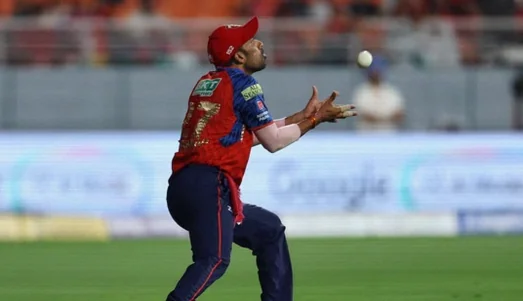
Cricket has moved into an era where one missed catch rarely stays confined to the fielding ledger. In modern T20, the mistake tends to spill across the scoreboard, distort bowling figures, shift momentum in the points table and even alter the mood inside the dressing room. With IPL 2026 combining flatter surfaces, deeper batting and the Impact Player safety net, a dropped chance can start to feel like an open-ended cheque.
The debate has intensified because these misses haven’t been quiet or occasional. Delhi Capitals’ inability to defend 264 against Punjab Kings turned fielding into a talking point in a big way. Karun Nair’s errors after being used as a substitute, Shashank Singh’s costly drops and the visible frustration from coaches and captains have pushed the conversation beyond routine cricket talk—into the realm of numbers.
Quick facts: IPL 2026 catching situation (till Match 39)
- Total catch opportunities: 442
- Catches taken: 360
- Chances dropped: 82
- Overall catching efficiency: 81.45% (about one in five chances goes down)
- KKR: 39 of 43 (90.70% efficiency), fielding impact 277.26
- RCB: 44 of 51 (86.27% efficiency), fielding impact 271.27
- RR: 40 of 46 (86.96% efficiency)
- LSG: 36 of 42 (85.71% efficiency)
- GT: 45 of 57 (78.95% efficiency)
- SRH: 43 of 55 (78.18% efficiency)
- PBKS: 28 of 38 (73.68% efficiency)
- DC: 23 of 32 (71.88% efficiency), worst in the league
- Best phase: death overs (72 of 80, 90% efficiency)
- Weakest phase: powerplay (98 catches from 127 chances, 77.17% efficiency)
The season context makes the drops more alarming than the raw percentage suggests. IPL 2026 is chasing larger totals more often, batting line-ups are surviving longer, and a single reprieve can swing into a run-heavy penalty before bowlers can reset their plans. A dropped chance is no longer simply a missed wicket—it becomes a delayed collapse, a broken bowling strategy and a tactical leak.
KKR set the standard: clean catching changes the whole bowling unit
Kolkata Knight Riders have looked like the benchmark side for catching this season. Up to Match 39, they claimed 39 catches from 43 chances, spilling only four. Their catching efficiency sits at 90.70%, the only team above the 90% threshold.
KKR’s fielding impact is also the strongest in the same model, at 277.26. That figure points to more than tidy statistics—it suggests they are generating real match value when chances fall their way.
The comparison to the tournament average is stark. With overall efficiency at 81.45%, KKR would have been expected to take around 35 wickets from 43 chances. They instead have taken 39, roughly four above expectation.
In T20, those extra four catches can represent four seized powerplays, four stops that prevent late acceleration, or four chases cut short before the game enters its panic zone. The advantage KKR hold is therefore structural: their fielders are completing the “transactions” built by their bowlers.
That confidence gives captains permission to attack with greater intensity. It also allows bowlers to invite the aerial shot without constantly worrying that the fielding unit might not return the chance. Even when results don’t always mirror catching efficiency, the wider point remains—other parts of their game have sometimes dragged, not their ability to secure chances.
Rinku Singh has become the clearest individual symbol of that reliability. He has taken 11 catches from 11 chances, the best high-volume perfect record in the tournament. That certainty isn’t just a highlight reel stat; it functions like tactical insurance.
RCB: catching efficiency backed by a high-value fielding impact
Royal Challengers Bengaluru have built one of the strongest catching identities in IPL 2026 up to Match 39. RCB have taken 44 catches from 51 opportunities, producing an efficiency of 86.27%, placing them third overall—behind KKR and Rajasthan Royals.
Their fielding impact stands at 271.27, second only to KKR. Efficiency tells the story of completion; fielding impact indicates whether those completions matter in the game’s critical moments.
Their clean work against Delhi Capitals offered a practical example. Jitesh Sharma completed four catches in that stretch, while Devdutt Padikkal added two more. With Bhuvneshwar Kumar and Josh Hazlewood applying pressure, the wickets that followed became scoreboard damage because the fielders finished the job.
RCB also show depth in personnel. Jitesh has taken 9 catches from 9 chances. Philip Salt is 6 from 6. Padikkal has 9 catches from 10 chances. That distribution across roles and zones is what makes a catching unit feel reliable rather than dependent on one name.
For RCB, the bowling blueprint relies heavily on early control and disciplined pressure. If the new-ball bowlers force batters into mistakes, the catching group must convert those chances. So far, RCB’s fielders have done that better than most sides in the competition.
RR and LSG: volume plus control, and the cost of missed chances
Rajasthan Royals sit close to the top in catching efficiency at 86.96%. They have taken 40 catches from 46 chances, combining volume with control. Dhruv Jurel anchors a large portion of that structure, with 12 catches from 14 opportunities.
Jurel is handling one of the heaviest catching workloads in the tournament while keeping RR inside the elite fielding band. That matters because wicketkeeping and close-catching opportunities carry different pressures compared to outfield chances. The ball reaches faster, the reaction window tightens, and a single miss can directly extend a batter’s innings.
Lucknow Super Giants follow at 85.71%, with 36 catches from 42 chances. Their execution is solid, but their fielding impact is lower than KKR, RCB and RR. That pattern suggests LSG are catching efficiently, yet the chances they drop are costing them more than their peers—turning a small gap in value into a larger gap in outcome.
The distinction is important. Catching efficiency measures who takes the chances. Fielding impact reflects whether the dropped chances are expensive enough to change innings patterns and results.
GT and SRH: trapped by volume and leaking at the wrong time
Gujarat Titans and Sunrisers Hyderabad may not look “bad” in simple catching terms, but both are high-event teams with noticeable leakage. GT have had 57 chances—the highest total among all sides after Match 39. They have taken 45 and dropped 12, giving an efficiency of 78.95%.
SRH have faced 55 chances, taken 43 and dropped 12 for an efficiency of 78.18%. Both figures fall below the league average.
The issue isn’t the absence of quality. GT can call upon Jos Buttler (10 catches from 12), Glenn Phillips (8 from 9) and Shubman Gill (6 from 6). SRH have Liam Livingstone (5 from 5) and Nitish Kumar Reddy (7 from 8). Talent is present.
What’s missing is distribution. When a team either creates or faces so many chances, weak links become louder. A side involved in 55-plus catching events can’t afford a drop rate above 21%—and that number isn’t about minor sloppiness at the edges. It’s a repeated tax on the bowling innings.
GT and SRH are living inside the danger zone of high-event cricket. Their bowling and match patterns generate opportunities, yet their fielding support isn’t clean enough to convert that volume into control.
PBKS and DC: the danger zone where missed chances become a pattern
Punjab Kings and Delhi Capitals occupy the bottom areas of the catching standings. PBKS have taken 28 of 38 chances, with 10 drops, for an efficiency of 73.68%. DC have taken 23 of 32, with nine drops, for an efficiency of 71.88%—the worst mark in the league.
DC’s number is especially damaging because they aren’t even dealing in huge chance volume. When a side gets only 32 opportunities and loses nine of them, the waste becomes more expensive. The implication is clear: they are not creating enough chances to absorb their own mistakes.
This is why the public discussion around DC’s fielding carries real bite. The dropped chances against PBKS didn’t look like isolated errors, because the broader season table keeps repeating the same problem. Their fielding has been a sustained weakness, not a one-off wobble.
PBKS, meanwhile, have a different angle to their struggle. Shashank Singh’s season profile is the ugliest meaningful sample in the tournament: he has taken 3 catches from 8 chances, with 5 drops, an efficiency of 37.50% and a fielding impact of -31.21. One player can’t carry all the blame for a team’s overall fielding ranking, but five dropped chances from eight is a visible structural wound.
It also helps explain why some drops feel louder than others. A single mistake can be forgiven as an event. Repeated misses turn into a pattern. Once that pattern sits inside a team already operating below the 75% efficiency line, the issue stops being anecdotal.
The powerplay leak: why early drops hurt most
The phase breakdown adds another layer to the catching crisis. Death overs currently show the best efficiency at 90%. Teams have taken 72 catches from 80 chances in that segment. That can sound surprising, but many death-over chances are boundary-related catches where fielders are positioned for the slog.
The powerplay is the weakest phase. In the first six overs, teams have made 98 catches from 127 opportunities, an efficiency of 77.17%. This is where a drop tends to hurt the most. Top-order batters are fresher, the field is up, and one missed edge or mistimed pull can quickly turn into a 60-run opening platform.
It also affects the new-ball bowler. The earliest stage offers the best window to change the trajectory of the innings, so a missed chance in the powerplay can remove that influence at the moment it matters most.
This is why the conversation around dropped catches has shifted beyond old clichés. In IPL 2026, the first six overs aren’t only about wickets—they’re about whether fielders can keep pace with the aggression the bowlers are trying to force.
A powerplay drop changes the innings differently from a death-over drop. At death, a batter who survives may still have only a handful of balls left. In the powerplay, the batter may have the full innings to punish the error, with time to build pressure elsewhere.
That’s why the season’s dropped catches feel so expensive. The actual mistake lasts about a second; the consequence can last the whole innings.
In the end, IPL 2026’s catching crisis isn’t about professionals forgetting fundamentals. It’s about margins becoming harsher. KKR, RR, RCB and LSG are protecting their bowlers. GT and SRH are producing enough chances but leaking too many. PBKS and DC are losing control through missed opportunities.
In a typical tournament, a drop is simply a mistake. In this IPL, it has become a form of currency—spent carelessly by teams that are now learning how quickly the bill arrives. Often it shows up on the scoreboard, sometimes in the final over, and frequently in the points table.
