
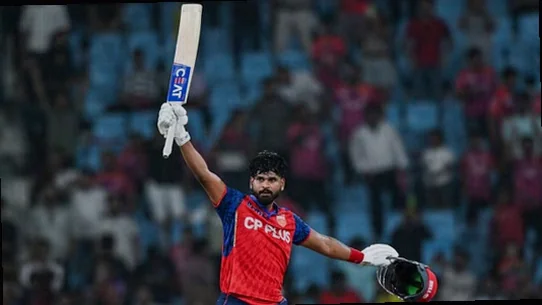
PBKS entered the final phase of IPL 2026 with their season held together by the stubborn output of Shreyas Iyer. After six straight defeats pushed their chances into the realm of arithmetic hope, Iyer delivered a defining rescue moment against LSG—scoring 101 off 51 balls—and Punjab edged the match by seven wickets. The turnaround was short-lived in the table, though: within 24 hours, Rajasthan Royals beat Mumbai Indians to secure their fourth playoff spot, making PBKS’ exit official. The stark truth of Punjab’s 2026 campaign lies in the gap between one captain’s commanding numbers and the rest of the squad’s inability to consistently translate that momentum into results.
Key takeaways
- Shreyas Iyer’s century versus LSG (101 off 51) helped PBKS win by seven wickets, snapping a six-match losing streak.
- Despite his tournament output, PBKS missed the playoffs after Rajasthan Royals clinched a playoff berth by beating Mumbai Indians.
- Across 13 innings, Iyer made 498 runs at a strike rate of 168.81, with 39 fours and 30 sixes.
- Iyer’s total “worth” contribution was ₹41.12 crore, producing a net profit of ₹14.37 crore—placing him first overall on the worth list and 11th on profit.
- Punjab’s season surplus finished at ₹27.29 crore, with more than half of that return (₹14.37 crore) coming from Iyer alone.
Iyer’s numbers: accumulation with pace
Remove the scoreboard result and the figures still underline the same message. Shreyas Iyer struck 498 runs in 13 innings, managing a strike rate of 168.81. He reached three figures once and also produced five innings of fifty-plus scores. His boundary tally—39 fours and 30 sixes—amounted to 69 scoring shots over 295 balls, averaging one boundary every 4.27 deliveries. For a player carrying Punjab’s highest contract value in the squad (₹26.75 crore), the value didn’t come merely from volume; it came from the tempo at which those runs were made.
His batting-only ledger ended with a profit of ₹2.65 crore. That figure is “modest” in isolation, but it’s still meaningful because a ₹26.75 crore base cost doesn’t naturally reward a near-500-run season unless the run-rate and strike efficiency arrive at the level Iyer delivered. In this case, he cleared that threshold—consistently enough that the contract looked justified on batting output alone.
The captaincy factor: surplus created through leadership value
Where the story tilts decisively is the captaincy component. Punjab’s analysis separates batting performance from leadership contribution, and in that framework Iyer’s captaincy generated a calculated worth of ₹18.41 crore against a captaincy cost of ₹6.69 crore. That produced a surplus of ₹11.72 crore, which fundamentally reshaped what the contract represented. In other words, Punjab didn’t just pay for a captain who bats; the captaincy itself added enough value to change the financial picture of the season.
When the batting and captaincy aspects are combined, the overall totals read cleanly: total worth of ₹41.12 crore and total profit of ₹14.37 crore. The ranking impact is equally sharp—No. 1 on the overall worth chart and 11th on profit—confirming that this wasn’t simply a good run of innings; it was an expensive asset that, at least in valuation terms, delivered.
Five innings that held the contract together
Shreyas’ season wasn’t built like a slow burn. The pattern was bursts that mattered when measured against worth and profit. Five innings did most of the structural work.
The 101 not out off 51 balls against LSG—described as Match 68, with Punjab facing elimination-pressure at that point—produced ₹8.36 crore in worth and ₹6.31 crore in match-level profit. In Match 35, his 71 off 36 returned ₹7.76 crore in worth and ₹6.35 crore in profit. In Match 17, he made 69 off 33, while in Match 24 he scored 66 off 34, and in Match 7 he hit 50 off 28—each of those innings returned worth above ₹4.75 crore and generated a positive margin against cost.
These weren’t just high scores on paper. The analysis frames them as nights where Iyer both won games and moved the financial ledger. Without those spikes, the contract would have looked like a bigger burden. With them, it becomes an example of how a franchise’s most expensive player can carry a price tag in a way that doesn’t make the expense feel inevitable—but still makes it defensible.
Where the value slipped: innings that dragged down the ceiling
Even with the strong headline totals, the season wasn’t flawless. Several lower-impact innings—30 off 27, 19 off 21, 5 off 5, 4 off 2, and 1 off 3—were linked to negative match-level outcomes and limited how far his batting profit could climb. At ₹26.75 crore, a “soft stretch” isn’t a minor inconvenience; every slow or low-output spell squeezes the ceiling because the baseline cost needs sustained efficiency to justify itself. Those matches are identified as key reasons his batting-only ledger ended at ₹2.65 crore rather than a much higher figure.
Still, the broader conclusion remains in his favour: the overall verdict leans heavily toward Iyer, even if the path to that conclusion included innings that didn’t match his best work.
Punjab’s wider indictment: one player’s surplus, the squad’s shortfall
PBKS closed IPL 2026 with a total team-level surplus of ₹27.29 crore. Shreyas accounted for ₹14.37 crore of that, representing 52.7% of the franchise’s entire positive return from a single player. Put differently, more than half of Punjab’s profit came from their captain. The remaining 47.3% came from the combined impact of the rest of the squad—other batters, bowlers, and allrounders together.
The analysis stresses that Iyer didn’t operate in a system that simply magnified his output. Instead, Punjab’s structure depended on him, and when the support weakened during the six-match collapse, there wasn’t a structural mechanism strong enough to steady the ship. That becomes the core indictment of Punjab’s 2026: the needed distribution of impact never arrived. The franchise had positive contributions from Prabhsimran Singh and Cooper Connolly, both returning stronger value relative to their prices and acting as genuine contributors. But Punjab still required a broader spreading of match-defining influence, not one concentrated reliance. They received the opposite.
An expensive success that still ended in a failed campaign
The bottom line is that Shreyas Iyer gave PBKS everything the auction ticket promised. He delivered 498 runs, a maiden IPL century under elimination pressure, a strike rate that touched 170, and a captaincy performance that pulled the contract well beyond breakeven. His ₹14.37 crore profit is described as a clean return on a bet that could have turned the other way if the spikes hadn’t landed.
Yet the playoffs still didn’t come. Even if the captain repaid the contract in full, the wider squad couldn’t convert the overall surplus into qualification. Punjab, in this view, bought the right player at the top of the auction—but then misbalanced the squad composition around him. And that, more than the man at the top of the worth chart, is where IPL 2026 truly ended for PBKS.
Method Note
This analysis uses the IPL 2026 monetary workbook. Player worth is calculated through performance impact and rating-adjusted value, with captaincy contribution tracked separately. Profit/loss compares total worth against seasonal cost. The model is an analytical framework designed exclusively by the author and is not an official IPL valuation.
