
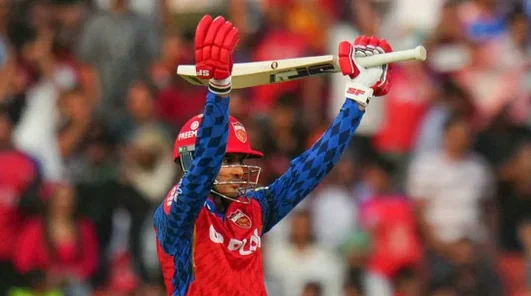
Since last night, Vaibhav Sooryavanshi has been the talk of Indian cricket circles. His 26-ball knock of 78 helped Rajasthan Royals defeat the defending champions, Royal Challengers Bengaluru, in Guwahati—and the praise has followed him across screens and timelines ever since. Yet the real storyline emerging from that burst of form is the intense fight for batting spots in the 2026 IPL, particularly among Indian openers.
At a glance
- Vaibhav Sooryavanshi scored 78 off 26 balls for Rajasthan Royals vs Royal Challengers Bengaluru in Guwahati.
- Rajasthan Royals won that match; the win came over the defending champions.
- On Saturday, Abhishek Sharma hit 74 off 28 balls against Punjab Kings in New Chandigarh.
- Abhishek’s innings included five fours and eight sixes.
- Punjab Kings’ Priyansh Arya followed with 57 off 20 balls (five fours and five sixes).
- Arya reached fifty in 16 balls after Sooryavanshi’s fifty came from 15 balls.
- Tanvir Ahmed made claims on TV about how fans would focus on Sooryavanshi once he plays for India.
- Before Saturday’s game, Arya had 46 IPL runs in three matches in 2026, at an average of 23.
- One of Arya’s matches in 2026 was washed out against Kolkata Knight Riders.
On Saturday, Abhishek Sharma attempted to wrestle back attention. In the contest in New Chandigarh against Punjab Kings, the left-hander struck 74 off just 28 deliveries, timing the ball with intent from the outset. His shot-making—five boundaries and eight maximums—made for a statement performance in a season where every innings can reshape reputations.
It also felt like a direct response to the chatter surrounding Sooryavanshi. Tanvir Ahmed, a former Pakistan pacer, had earlier predicted that Abhishek’s prominence would fade once Sooryavanshi’s momentum hit a higher gear. In that context, Abhishek’s burst of power felt like him trying to stay relevant in the same conversation, even as Sooryavanshi’s star continues to rise.
Punjab Kings weren’t passive in the chase. Priyansh Arya, another Indian batter, delivered a late surge that underlined Punjab’s sense of urgency. Sooryavanshi had taken only 15 balls to reach fifty in the earlier headline-making spell, and Arya matched the tempo closely by adding his own fifty with just one more delivery—an important marker of how quickly both batsmen were finding rhythm.
Arya eventually finished on 57 from 20 balls, lifting the score with five fours and five sixes. Even though his stay was brief, the impact was clear: he batted as if he wanted the message to land with fans immediately. The sentiment was captured in the line, “Arre Hum Bhai Race Main,” a reminder that this is still a race, not a procession.
Tanvir Ahmed’s bold prediction
Tanvir Ahmed’s comments added fuel to an already fiery season narrative. Speaking on a TV show, the 47-year-old—who played five Tests, 2 ODIs, and one T20I for Pakistan—argued that once Sooryavanshi gets chances with India, Abhishek Sharma’s name would not command the same level of attention. He went further, saying that if both are batting together, Abhishek would not come close to Sooryavanshi and that viewers on television would end up focusing primarily on the Rajasthan opener instead.
For now, these are predictions—but in the IPL, predictions often become pressure. Competition for the Indian team is already fierce, and a string of big knocks can flip perceptions quickly, especially in the opening slot where partnerships and roles are closely watched.
There is also a wider context to the rivalry. Last season, like Sooryavanshi, Priyansh Arya produced an IPL century that turned him into a household name. However, since that high point, his output has not matched the early hype, and recent performances have left room for doubt about whether he can consistently translate potential into runs.
That inconsistency was visible heading into Saturday’s match. In IPL 2026, Arya had managed only 46 runs across three games, with his batting average sitting at 23. One of those appearances ended without a result, with a washout against Kolkata Knight Riders, which naturally disrupted momentum—but the numbers still tell the story of a batter searching for form.
Even so, Arya’s innings on Saturday carried weight. It put Punjab Kings on a path that, at the time of writing, appeared to be leading toward yet another victory. The implication was that this knock had shifted the match from “possible” to “in control,” and the side were on the verge of winning their third game.
The season’s competitive temperature is rising fast, and the article’s larger point is hard to ignore. Abhishek Sharma’s international campaign in the T20 World Cup had been described as sub-standard, and the pressure from that experience seems to have followed him back into franchise cricket. With that kind of international risk hanging over performances, the IPL becomes more than a league—it becomes a proving ground where a poor run can directly threaten a future place in the national setup.
