
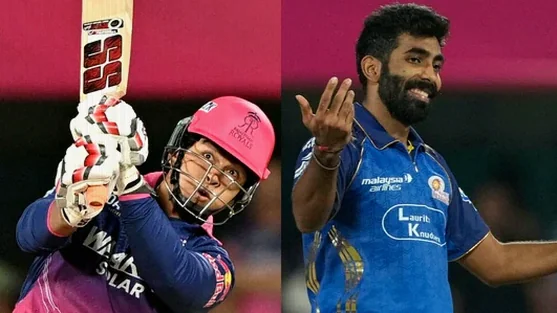
Before this clash even began, the hype had a strange intensity—like the matchup was built to last longer than a brief burst of overs. The setup was clear and hard to ignore: Vaibhav Sooryavanshi, just 15 years old, has already shaped a reputation for confronting Jasprit Bumrah with nerve, and in T20 cricket Bumrah remains one of the most complete answers to the fastest bowling questions. Leading into the contest, the main debate around Sooryavanshi was whether he would change his approach at all. The expectation was that he would not—and that’s exactly why this duel deserves more than the obvious headline of “teenage batter crushes Bumrah.” What played out was not merely a show of audacity. It was a contrast between a batter trying to seize every opening and a bowler who, even when struck, still seemed to draw the solution by the end of the passage.
Why Sooryavanshi won the visible battle
On raw numbers from the brief spell, the momentum leaned toward the teenager. In the five legal deliveries he faced from Bumrah, Vaibhav Sooryavanshi scored 13 runs, striking at a rate of 260. His tally included two maximums and just one single. Just as important, the pattern was set immediately rather than gradually.
The first scoring shot carried intent, not courtesy. It wasn’t a tentative prod or a respectful look at line and length—it was a six struck off a ball in the slot, pitched on the pads. That detail matters because Bumrah often imposes emotional pressure on younger batters. He can make them feel late, hurried, or unsure. Sooryavanshi flipped that script from the first ball, announcing through action that he would meet Bumrah’s reputation with his own aggression.
The second six made the exchange even more revealing. After that early explosion and a short interruption in the strike, Sooryavanshi returned and attacked again. This wasn’t another repeat of a pad-side gift. The delivery was slower, pitched on a length outside off, and sat up at a height that invited contact. Even so, the shot wasn’t automatic; Sooryavanshi still rotated and struck it over square leg. That one moment expands the story beyond “teenager hits a fast bowler”—it shows he could punish a different kind of ball as well.
The mini-battle was won by the teenager, but not because he played Bumrah without risk. He clearly didn’t. His advantage came because he landed the decisive blows, and in a spell against a bowler of Bumrah’s calibre, two sixes in five balls is not incidental. It becomes real damage—enough to tilt the visible contest.
Why this was not total domination
Still, calling it domination would be lazy. As the over—or at least the visible segment—moved along, Bumrah started making adjustments. The last two deliveries Sooryavanshi faced yielded no runs. One was an awkward, heavy full toss that avoided the swing. The other was a fuller ball that dipped onto the pads, and Sooryavanshi could only dab it, without finding the boundary.
With those attempts going nowhere, the shape of the duel shifted. The ball between the two sixes also highlighted Bumrah’s control. He bowled it back of a length and reduced the pace-off it, forcing the batter to work for a single rather than allowing another easy strike. This is the technical core of the matchup: Sooryavanshi looked most dangerous when the ball came into his comfortable pickup zone on the leg side or sat up into a pullable angle. When the ball slipped beneath that arc or stayed out of his reach, his comfort dropped quickly. That contrast is the whole difference.
There’s also a broader lesson in how Bumrah operates against young power hitters. “Full” is not automatically safe in T20 cricket—an attackable full ball can vanish over the ropes. But a low, dipping, harder-to-get-under full-length is a different proposition. Bumrah also likely found a way to deny Sooryavanshi his best timing, while keeping the delivery a touch shorter too. So while the teenager won the impact phase, Bumrah recovered enough to show that the contest wasn’t finished after the early damage.
Also Read: Vaibhav Sooryavanshi leaves Jasprit Bumrah startled, frustrates Rohit Sharma, then screams at himself in 14-ball mayhem
What the duel really tells us
Ultimately, this brief battle was a study in method versus margin. Sooryavanshi’s method is boundary-first, high-commitment batting—high belief in taking the game straight at the bowler. In the sample, 12 of his 13 runs came from sixes, leaving almost no middle ground. He wasn’t trying to nudge Bumrah around the field. He was trying to tip the balance through force, which is why the moment felt so loud.
But Bumrah’s response carried a longer-game truth. If he misplaces the line into Sooryavanshi’s scoring window or offers sit-up length, the teenager can punish instantly. Yet if Bumrah keeps the ball fuller, lower, and less swingable, the geometry changes quickly—angles that look hittable can turn into shots that demand too much from the batter. So who won? In the visible exchange, Sooryavanshi did. He won the scoreboard battle, the crowd battle, and the first psychological punch.
However, Bumrah still left behind the more sustainable tactical clue. Even in a spell that was clearly damaged by early contact, the bowler still showed the blueprint for how to contain Sooryavanshi. Had the battle stretched a little longer, Bumrah—at his level of expertise—would likely have refined the answer to the “Sooryavanshi problem.”
That’s what made the contest compelling. It wasn’t a simple story of one player overpowering the other. It was a glimpse of a young batter bold enough to attack the best, and a reminder that the best still have reasons to justify themselves—because elite fast bowling is never truly measured by the first blow alone.
