
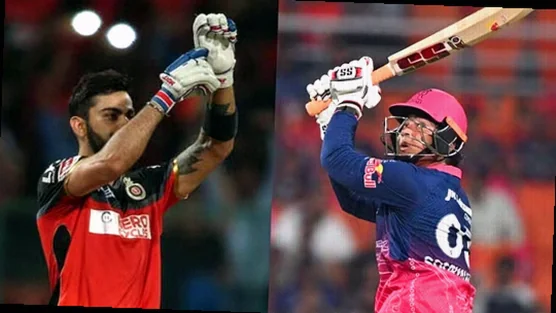
Vaibhav Sooryavanshi’s campaign this season has felt less like a young batter breaking through and more like a rising force taking over the spotlight. Week after week, another established name seems to slip into the background as he keeps finding fresh ways to dominate bowling units that are usually built to handle seasoned threats. What makes the story stand out isn’t only the runs or the highlight reels, but the calm, almost effortless manner in which he has gone about it in a competition that typically takes years to truly master. Amid all the noise that surrounds big reputations and even bigger price tags, Sooryavanshi has quietly become the most discussed figure in Indian cricket—never mind the IPL.
As the tournament has progressed, the talk around him has moved past “potential” and into direct impact. At an age when many players are still learning how to handle pressure, he has already begun resetting the standards for power-hitting. His tally of 65 sixes has become its own headline, particularly when you place it alongside some of the most feared boundary riders the format has produced. Even Chris Gayle and Andre Russell—two batters who built their careers on clearing the ropes—did not reach that level in their best IPL seasons. Yet Sooryavanshi has done it in just 15 matches.
His run numbers add another layer to the argument. While Virat Kohli’s record of 973 runs in 2016 remains the gold standard for a single IPL edition, Sooryavanshi’s 680 runs carry a different kind of weight because of how they’ve been accumulated. Kohli’s output in 2016 was powered by an already established career, shaped by experience and precision. Sooryavanshi, by contrast, is still in the phase of discovering and sharpening his game, and yet he has produced a season that forces an uncomfortable question: is this the kind of form that can reshape how batting promise is measured in the IPL from here on?
At this stage, comparing eras feels almost inevitable. Kohli’s 2016 campaign is still widely treated as the benchmark for batting excellence, but it’s hard not to place it alongside Vaibhav’s 2026 run and examine how these two extraordinary seasons stack up.
Virat Kohli IPL 2016 – Peak of batting mastery
For Royal Challengers Bengaluru, 2016 was filled with what-ifs. They came agonisingly close to winning their maiden IPL title, only to fall short in the final against Sunrisers Hyderabad. Even in defeat, one player managed to turn the tournament into a personal showreel. Kohli produced a season that still sounds almost unreal when you look back—nearly 1000 runs, finishing with the highest total ever in a single IPL edition, and a number many believe may never be surpassed.
By 2016, Kohli was already a proven global force, having handled World Cups and the expectations that come with representing India and driving an IPL franchise like RCB. Still, this season felt different. It appeared as if years of groundwork finally merged into a long, relentless streak. Talent had been evident before, but in 2016 it hardened into domination. Kohli didn’t simply score; he controlled the terms of matches, adjusting his approach to bowlers across venues, conditions, and chase situations.
Early on, his intent was unmistakable. He began the tournament with a fluent 75 against Sunrisers Hyderabad, setting a tone of sustained pressure. He then followed it with 79 against Delhi and 80 against Rising Pune Supergiant, rarely giving bowlers a chance to settle. In a short span of games, the message was clear—Kohli was operating at a different tempo entirely. The first century of the season arrived against the Gujarat Lions: a 63-ball knock at a strike rate of 158.73. Even though RCB lost that match, it marked the start of something extraordinary. From there, the momentum refused to slow down.
A second hundred followed against Rising Pune Supergiant, with Kohli cracking 108 off 58 balls and finishing the chase unbeaten, sealing victory in the process. Soon after, he struck again versus Gujarat Lions—109 off 55 deliveries—punishing bowlers in the death overs. One standout moment came when 30 runs arrived in a single over from Shivil Kaushik. It wasn’t just aggression; it looked like controlled destruction, built to keep accelerating.
One of the defining clashes came when RCB faced Punjab Kings in a must-win scenario. Kohli walked in with stitches on his hand after a webbing injury and still delivered 113 off 50 balls in a rain-affected 15-over match. RCB finished on 211 for 3, a total that felt far beyond what Punjab could realistically chase. It summed up his entire campaign—physical discomfort, high-pressure situations, and an intensity that never dipped.
Even in the final, Kohli contributed with 54 off 35 balls, doing enough to keep RCB’s chase alive before the match slipped away late. Sunrisers Hyderabad ultimately held their nerve to win by eight runs and deny RCB their first trophy. Kohli closed the tournament with a strike rate of 152.03, a figure that continues to define IPL batting excellence.
Vaibhav Sooryavanshi – A 15-year-old boy doing wonders
Sooryavanshi has quietly rewritten what T20 batting is supposed to look like. In a format that often rewards reputation, experience, and the ability to handle pressure, he has played without those typical limitations. His return of 680 runs in 15 games at a strike rate of 242.85 has an almost surreal feel—like the output you might associate with a video game rather than professional cricket. And it’s not only the quantity of runs. The key detail is the way they arrive once he finds rhythm, with bowlers of every type struggling to buy even a moment of breathing space.
From the very first match, the approach was clear: a 52 off 17 balls that set the template for what followed. Boundaries and sixes came in clusters, and the momentum swings he caused often flipped matches within only a few overs. Rajasthan Royals suddenly had something priceless—fast starts that prevented opponents from settling into the middle overs. His innings of 78 against RCB blended timing with raw force, and he followed it with a 37-ball 103 that looked like a complete display of range, control, and fearless intent. This wasn’t reckless hitting; it was calculated aggression sustained over extended periods.
Even when the situation demanded measured play, he adapted quickly. Against Lucknow Super Giants in a tense chase of 221, Sooryavanshi produced 93 off 38 balls, mixing power with awareness and refusing to lose his shape after getting set. That innings showed maturity under the fearless stroke play—paced enough to stay ahead of the required rate, without letting the chase slip out of reach.
The biggest statement, though, arrived in the playoffs against Sunrisers Hyderabad. Rajasthan Royals were under pressure after losing both league meetings, but Sooryavanshi responded with a stunning 97 off 29 balls. He struck 12 sixes in an innings that opened the game up completely and pushed his season tally of sixes to 65. That number surpassed Chris Gayle’s previous IPL record of 59 in 2012. He also came perilously close to smashing the fastest IPL century, with Gayle’s 30-ball hundred still standing as the benchmark, but the way Sooryavanshi paced his 97 left little doubt about where the match was headed the moment he walked out to bat.
Across the season, Sooryavanshi has not just added runs—he has changed the tempo of games and forced established bowlers into unfamiliar territory. Jasprit Bumrah, Pat Cummins, Josh Hazlewood, Mohammed Siraj, and Bhuvneshwar Kumar were all made to face a level of chaos control they weren’t accustomed to. For someone still in his mid-teens, the ability to manage disorder and turn it into scoring opportunities may be the most striking feature of his rise.
Sooryavanshi’s storm runs parallel to Kohli’s masterclass
Even though Sooryavanshi’s 680 runs may not be the highest ever in an IPL season, the effect he has had is unlike anything the league has seen. Kohli’s 973 in 2016 still stands as the ultimate reference point for run-scoring in a single edition. Yet the manner in which Sooryavanshi has gone about his work has demanded a different kind of attention—driven not only by the volume, but by the rate at which those runs have arrived and the pressure he has applied to every attack he has faced.
When looking at the most prolific run tallies in IPL history, the top line reads like this: Virat Kohli (RCB, 2016) with 973 runs at a strike rate of 152.03, Shubman Gill (GT, 2023) with 890 at 157.80, Jos Buttler (RR, 2022) with 863 at 149.05, David Warner (SRH, 2016) with 848 at 151.42, and Sai Sudharsan (GT, 2025) with 759 at 156.17. A strike rate above 242 across such a sample size completely alters the conversation. In IPL history, no one has combined a 600-plus run season with a strike rate above 200, and Sooryavanshi has pushed that boundary even further, hovering close to 250.
That blend of heavy scoring and explosive tempo makes this one of the most breathtaking batting seasons ever witnessed in the league, and it’s a run that can stand toe-to-toe with Kohli’s brilliance. With at least one match still left, the 700-run milestone is within striking distance, and if Rajasthan Royals continue their run, even 800 may not be out of sight. Whether Sooryavanshi’s 2026 season ends up being better than Kohli’s 2016 is open for debate, but what the youngster has delivered so far is undeniably a batting freakshow—one the IPL will struggle to forget.
