
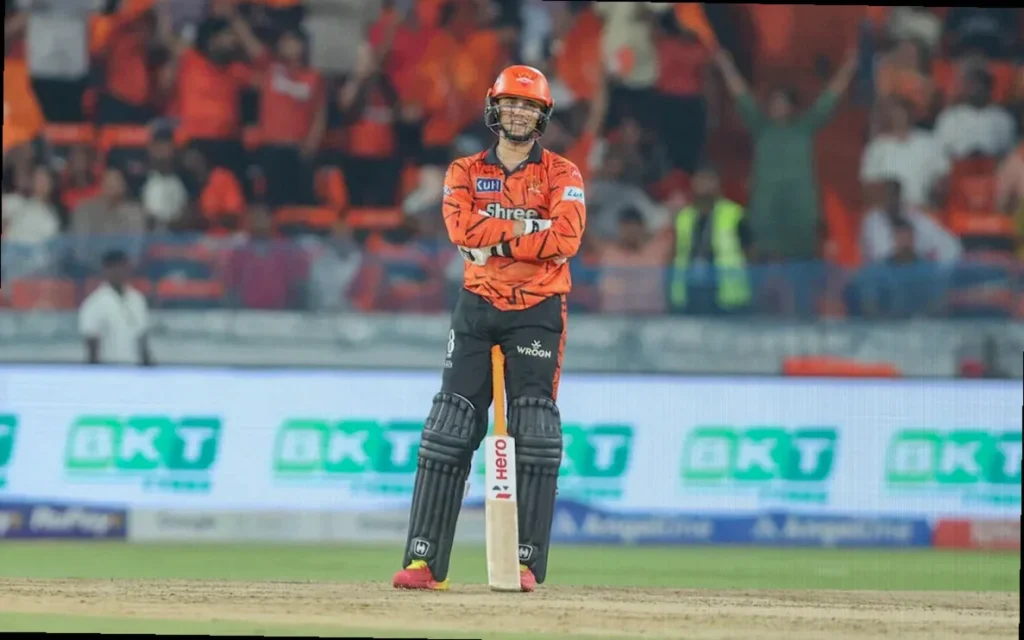
Abhishek Sharma turned a one-sided contest into a rout, hammering 135 not out off 68 balls as Sunrisers Hyderabad overwhelmed Delhi Capitals by 47 runs in an IPL match on Tuesday. Batting on a placid track at Uppal, Sharma punished Delhi’s bowling for a huge 242 for 2, striking 10 sixes alongside the same number of boundaries. Delhi’s reply never truly got going after a collapse in the middle overs: Eshan Malinga struck 4/32 in his spell and Sakib Hussain added 1/29, leaving Capitals stranded at 107 for 4. From there, the chase unravelled completely, with Axar Patel’s side finishing on 195 for 9. With the win, SRH moved up to third in the standings and tightened their grip on the playoff picture.
Key takeaways
- Abhishek Sharma made 135* off 68 balls, steering Sunrisers Hyderabad to 242 for 2.
- SRH won by 47 runs after Delhi Capitals were pushed to 107 for 4 before the chase disintegrated.
- Eshan Malinga (4/32) and Sakib Hussain (1/29) powered the key middle-overs collapse.
- Sunrisers consolidated their position, jumping to third place with four wins from six matches.
- Delhi Capitals slipped to fifth, ending the day with three wins and three defeats from six outings.
SRH’s big total and the decisive middle-overs burst
On a calm Uppal surface, Sharma looked in complete control as he sliced through the Capitals attack, producing a sustained assault that featured 10 sixes and 10 fours in the innings. His pace of scoring carried SRH through a platform that was always going to be difficult to chase, even with the depth Delhi could throw at the task.
Delhi’s chase was further damaged by the bowling work of SRH’s middle order. Malinga, delivering 4 wickets in his four overs, and Hussain, taking 1/29 in his four, combined to force a dramatic downturn after Delhi had started with more promise than they could ultimately sustain. The collapse saw Capitals slip from 107 for 1 to 107 for 4, and after that point, there was no meaningful recovery.
In the end, Delhi Capitals managed 195 for 9, falling well short of the target. The mismatch was reflected in how quickly the innings swung away from Capitals once the wickets started tumbling.
Where Capitals went wrong tactically
The defeat was also tied to a series of puzzling tactical decisions from Delhi’s leadership group featuring Director of Cricket Venugopal Rao, head coach Hemang Badani and skipper Axar Patel. One of the most talked-about calls was the use of Nitish Rana as a part-time off-spinner, despite the top three of SRH being left-handed—yet Rana was handed his full quota of four overs.
Rana’s spell backfired badly. He was struck for roughly half a dozen sixes, and crucially, all of them came off left-handed batters. The longer he stayed in the attack, the more SRH’s batters looked comfortable, and the plan lost its shape after the early phase.
There was also concern over how Delhi deployed their frontline spin resources. Axar, despite being used as a main spinner, bowled only 2 overs and returned figures of 1/23, while Kuldeep Yadav bowled 2 overs for 0/30. The criticism lay in how they tried to manage the onslaught from Abhishek instead of completing their full quota, especially when SRH’s batter was clearly dictating terms.
Delhi’s pace options also failed to deliver the breakthroughs they needed. Mukesh Kumar finished with 0/53, Lungi Ngidi with 0/44, and T Natarajan with 0/40, leaving Capitals without the kind of wicket-taking punch that could have slowed SRH’s momentum.
SRH’s bowling variations kept Delhi under pressure
While Delhi struggled to find answers, SRH’s attack—led by Malinga and supported by Hussain—kept producing wickets at regular intervals through intelligent changes in pace, including effective pace-on and pace-off deliveries. This helped them maintain pressure throughout the innings, limiting any chance for Delhi to settle into a chase plan, with Rana’s half-century offering only a partial consolation compared to the damage done by Sharma’s innings.
How SRH built the chase-proof foundation
Even with Travis Head not at his sharpest—scoring 37 off 26 balls—Sharma still forged a strong opening partnership, adding 97 runs for the first wicket. The innings then gained even more momentum when Ishan Kishan joined the attack, striking 25 off 13 balls. Together, Sharma and Kishan added 79 runs for the second wicket in only 5.5 overs, creating the kind of platform that turns the rest of the chase into a chase of impossible numbers.
As the innings approached the finishing stretch, there was a brief suggestion that Sharma might be slowing slightly, with his strike-rate dipping below 200. At that point, Heinrich Klaasen accelerated the end-overs, smashing 37 not out off just 13 balls to ensure SRH’s total stayed out of reach.
Powerplay control and the middle-overs swing
Delhi’s Powerplay output was 67, which indicated some early productivity. However, the match effectively turned during the middle phase between overs 7 and 15, when 116 runs were conceded. That stretch proved unacceptable for a side trying to defend a modest total, and it became the bridge between SRH’s strong start and the massive finish.
Abhishek’s batting style stood out for its adaptability: he adjusted the direction and timing of his bat based on the bowler, particularly with how he played Ngidi late and through the front of the bat. Many of his sixes were struck with the ball coming into the strike zone rather than being merely slogged, reinforcing how deliberate the power-hitting was.
His century arrived in 47 balls, slightly slower than his own typical standards, but he still pushed his overall strike-rate beyond 200 by the time he reached the mark. Importantly, he did not stop there—SRH built to a score that made a chase look highly improbable, especially given the batting depth Delhi had available only after the ball started moving.
Even with the tactical and personnel issues, the result was ultimately decided by the scale of SRH’s batting and the inability of Delhi to stem the flow once Sharma and Kishan had established control. Sharma’s dominance set a total that Capitals could not pull back from, and SRH’s collapse after that never arrived—leaving Delhi to absorb a comprehensive defeat.
