
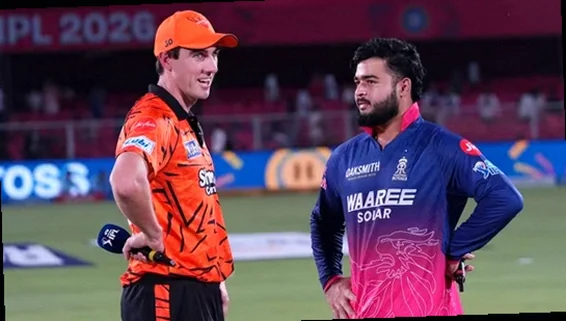
Ahead of Qualifier 1 featuring Royal Challengers Bengaluru and Gujarat Titans, the tournament’s narrative has been shaped by two sides viewed as the strongest with the ball in IPL 2026. The story in the other knockout game, the Eliminator between Sunrisers Hyderabad and Rajasthan Royals, is far more contrast-driven. That match could hinge largely on what happens early—especially during the powerplay—where the contest between Vaibhav Sooryavanshi, Yashasvi Jaiswal, Travis Head and Abhishek Sharma has the potential to swing the flow of the entire contest.
How could the Eliminator be decided?
The key question is whether Vaibhav Sooryavanshi can be pushed into a repeat of his worst outing or if he’ll instead find the rhythm that delivered his biggest statement innings. In two meetings against SRH this season, the teenager has produced two extremes: a scoreless effort in Hyderabad and then a rapid 36-ball century in Jaipur. There has been no consistent middle ground.
Plan A, B or C for Vaibhav Sooryavanshi?
Pat Cummins understands the danger if Sooryavanshi locks in. That’s why the SRH captain admitted ahead of the Eliminator that his team has been made to think beyond their usual primary bowling patterns. With that in mind, it now looks unlikely that SRH will simply hand Praful Hinge the responsibility of opening the bowling again against Sooryavanshi in New Chandigarh.
Cummins may instead take a more direct approach, leaning on a blueprint that mirrors the approach used by Mohsin Khan—the only bowler who has managed to trouble Sooryavanshi with regularity throughout the campaign. The plan is straightforward: deliver short balls into the batter’s body, squeeze him for space, and force hurried pull or hook attempts instead of comfortable hitting.
Cummins’s own work against Sooryavanshi in Jaipur already points to how the game could be managed. He bowled just four deliveries to him in that match. The first ended in a six—over midwicket—after Cummins tried to spring a short-ball trap with deep midwicket set. The next ball repeated that concept and nearly produced the breakthrough, but Hinge couldn’t stick the catch when it came.
SRH are also expected to manage Cummins’s workload differently, preserving overs for the death overs where he has been at his most effective this season. His figures in that phase have been exceptionally tight, with runs conceded at only 5.66 per over.
Against Jaiswal, SRH’s method has been similarly consistent, with repeated pressure aimed at the corridor outside the off stump. Eshan Malinga dismissed him in Jaipur using that line of attack, and Sakib Hussain repeated the same style in Hyderabad to get another breakthrough.
There could also be a rethink in how SRH deploy Hinge across the entire spell plan. Harshal Patel may emerge as an important alternative. In New Chandigarh, Harshal has taken 11 wickets at an average of 16.63, and the way he changes pace and angles could unsettle Rajasthan’s middle order—particularly given that this group has shown weakness against cutters and slower deliveries. The notable exception has been Riyan Parag, but even he has fallen three times to Harshal in T20 cricket.
How will Jofra Archer be used?
For Rajasthan, the biggest tactical headache may revolve around Jofra Archer’s usage. This season, Archer has been the only powerplay bowler who has delivered reliable returns for the side. He has 11 wickets in the opening phase at an economy rate of 9.28 and a strike rate of 15.8, which naturally makes him central to any plan against SRH’s aggressive top-order.
Rajasthan will likely look to bring him back into play immediately, especially because Archer has already dismissed both Travis Head and Abhishek once this season. Yet the matchup numbers still look daunting. Head has struck at more than 160 against Archer in T20 cricket, while Abhishek’s strike rate rises above 177 versus him.
Then there is Ishan Kishan, a batter who has historically done well against Archer—averaging 90 against him in T20s. Rajasthan’s most sensible approach, therefore, is to use Archer in short, aggressive bursts during the powerplay, when his pace and hard lengths can still force errors even from batters who look to attack from ball one.
Head has been dismissed by Archer three times across his six T20 innings, and Abhishek also struggled when they met earlier this season.
Why RR will need Jadeja at his best
That Kishan factor may be softened by Ravindra Jadeja, who also matches up well against Heinrich Klaasen. Kishan and Klaasen have been two of SRH’s most steady run-sources this season, and they rank among the competition’s stronger players when facing spin. Still, both have tended to struggle against Jadeja historically.
Kishan has managed only 37 runs off Jadeja across eight IPL innings, striking at 116. Klaasen, meanwhile, has a strike rate of just 100 against the left-arm spinner and has been dismissed by him once.
The bigger worry for Rajasthan is Jadeja’s fitness. He has been nursing an injury, appeared in the previous match against Mumbai Indians only as an Impact Player, and bowled just two overs. But if Rajasthan intend to slow down SRH’s momentum in the middle overs, they will need Jadeja fully fit and used heavily enough to influence the game when it matters most.
