
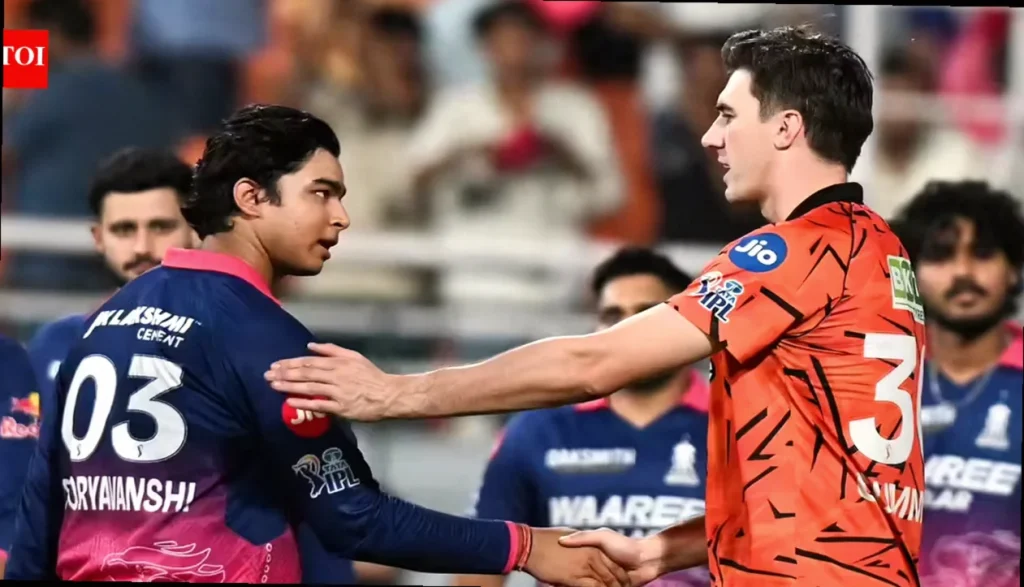
For much of IPL 2026, Sunrisers Hyderabad carried the uneasy look of a team trying to find its rhythm. In the league stage, they managed just one win from their opening four matches and, for a stretch, it seemed another season of starts and stops was on the cards. Then the script flipped in dramatic fashion. SRH roared back to form, winning eight of their last ten league games and stringing together a decisive five-match winning streak. The charge took them to the brink of the top two, where they finished level on points with Royal Challengers Bengaluru and Gujarat Titans. Yet their progress ended at the margins: an inferior net run rate kept them out of Qualifier 1 and denied them the safety net of a second shot at the final.
By the time the play-offs arrived, SRH were playing with the confidence of a side that felt dangerous in every phase. That is why the Eliminator turned into such a brutal shock. The team’s title hopes were smashed by a 15-year-old batting prodigy, Vaibhav Sooryavanshi, whose knock of 97 off only 29 balls for Rajasthan Royals at Mullanpur left Hyderabad with no answer. Rajasthan first piled on 243/8, then restricted SRH to 196 after dismissing them in the chase. What had otherwise looked like a remarkable resurgence from SRH became a season-defining heartbreak in one match.
IPL 2026 will likely be remembered as one of the most batting-heavy editions in the competition’s modern history. During the league phase, the average score in the first innings climbed to 192.04, while the average winning total rose above 217. Even par scores around the 200 mark often failed to provide comfort. Teams posting 200-plus totals won 19 out of 35 times, and totals beyond 220 were successfully chased just nine times across the season. Compared to the previous 18 editions combined, where only five chases of 220-plus had been achieved, the numbers underlined how dramatically batting-friendly the tournament became.
SRH were among the key reasons that batting dominance became the season’s defining theme. They struck nine times at 200-plus during the campaign and built their run-making blueprint around ruthless intent at the top of the order. Their batters repeatedly turned what looked like steep chases into more manageable targets, consistently overwhelming opponents with early momentum and relentless scoring. However, in the most consequential game of the year, SRH’s bowling unit was left exposed against Sooryavanshi’s extraordinary innings—one that arrived at the worst possible moment for a side that had otherwise looked in control.
One of SRH’s struggles, even when their batting was thriving, was their inability to consistently create early breakthroughs. They had a pace attack on paper that carried plenty of threat, but the new ball did not deliver regularly enough. Eshan Malinga, the Sri Lankan pacer, topped SRH’s wicket tally with 20 scalps from 15 matches and finished among the leading wicket-takers of the season. Yet only five of those wickets were taken during the Powerplay, a telling statistic that captured SRH’s recurring problem: opponents often settled quickly before the game drifted away from Hyderabad’s control. Young bowlers Sakib Hussain and Praful Hinge supported with 15 and 14 wickets respectively, but sustained match-winning spells were rare rather than routine.
Midway through the season, the return of captain Pat Cummins aligned with SRH’s surge, but his individual output did not reach the level of a consistent strike bowler in every game. Cummins took only eight wickets in eight matches and endured a particularly disappointing wicketless stretch in the Eliminator. SRH’s spin department also failed to deliver the kind of middle-overs impact that can change a chase or force false shots. Shivang Kumar’s nine wickets made him their leading spinner, highlighting how difficult it was for the team to consistently take wickets in the center overs and bend the match narrative once the Powerplay advantage had faded.
SRH’s batting successes were largely anchored in their explosive top four, and that structure carried them through the league phase. Heinrich Klaasen led the run charts for the franchise with 624 runs, Ishan Kishan scored 602, and Abhishek Sharma added 563. Travis Head contributed 410 runs as well, even if his output came with more inconsistency than the other three. That quartet did the heavy lifting, but the very strength of the top order created a vulnerability: the middle and lower order had not been tested in the same pressure situations. When knockout cricket finally demanded depth and composure, that gap was exposed sharply.
The Eliminator made the issue clear. Chasing a target of 244 against Rajasthan Royals, SRH watched their top-order stars fall within the first seven overs. With that early damage done, the middle order—largely insulated from high-pressure collapses across the season—was suddenly required to produce something close to a miracle. It never materialised. Nitish Kumar Reddy scored 302 runs over the campaign, but outside him there was little meaningful support at the level needed for a chase of this magnitude. Salil Arora managed only 156 runs from 11 innings, and no other batter crossed the 100-run mark. Hyderabad’s league-stage firepower had masked the concern, yet the knockout format stripped away the protection and revealed how limited the batting depth and experience became once the top order fell.
Even after the painful exit, SRH remain positioned as a franchise with a strong foundation for what follows. Their attacking batting core is already among the most potent in the league, and the early signs from bowlers such as Malinga, Hussain and Hinge suggest there is room to build a long-term bowling identity. Still, the franchise will have clear priorities. SRH need more wickets in the Powerplay, they will want greater reliability from Cummins as the pace leader, and perhaps most importantly they must find spinners who can consistently take wickets and control matches during the middle overs. They also require a middle order that can be trusted when the top collapses, not just when conditions and batting rhythm fall perfectly into place.
IPL 2026 showed that SRH can dominate when their aggressive style meets the right matchups. At the same time, it underlined a key lesson for any team chasing a title: balance matters more than one department’s momentum alone. For most of the season, SRH looked unstoppable. But in the end, one unforgettable innings from a teenage prodigy proved that even the most convincing comeback story can be undone in a single night.
